
 Nvidia just posted US$68.1 billion in quarterly revenue, up 73% year on year, and guided for US$78 billion next quarter.
Data centre revenue alone hit US$62.3 billion.
More than 91% of total sales now come from AI infrastructure.
Did someone say AI was a bubble?
Gimme a break.
Look if you thought Nvidia was going to miss to the downside, this probably isn’t for you. This is a company printing money at industrial scale. And no one, not even its closest competitor, AMD, is anywhere near it.
In fact, I’d call AMD Nvidia’s farthest-close competitor.
The market liked the numbers too, lifting Nvidia up a whole 2% in post-market trading.
But this reaction tells you something about where we are in the AI rollout cycle. Nvidia beating expectations is now the expectation. The company has been so dominant for so long that investors are starting to treat these quarters as routinely as the sun rising.
And that’s fine.
Let the mainstream focus on Nvidia. Let them obsess over the headline numbers. Because Nvidia doesn’t build chips in a vacuum. They do not control their entire supply chain.
Every GPU, every Blackwell rack, every Vera Rubin platform coming off TSMC’s lines depends on compound semiconductors, rare earth magnets, precision optics and photonic interconnects to function.
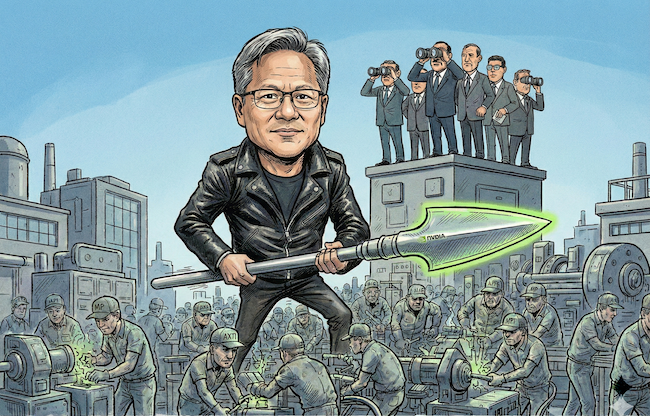
Nvidia is the tip of the proverbial spear. But behind it sits an entire supply chain of smaller companies that most investors have never heard of.
And that’s where the big asymmetric opportunity sits now.
Bet you’ve never heard of this lot
Let’s start with something like AXT (NASDAQ: AXTI).
This California-based company manufactures indium phosphide and gallium arsenide wafers, the compound semiconductor materials that underpin high-speed data transmission.
Every optical transceiver moving data between Nvidia’s GPUs relies on materials like indium phosphide. Without it, the photons don’t move, and neither does the data.
AXTI has been on an extraordinary run. The stock is up over 150% year to date, driven by surging AI demand for its indium phosphide wafers.
Then there’s Lumentum (NASDAQ: LITE), a photonics pure play making the lasers, modulators and optical circuit switches that form the nervous system of AI data centres.
Over 60% of Lumentum’s revenue now comes from AI and cloud infrastructure. Its lasers are part of what connects Nvidia’s next-generation platforms.
The stock is up 96% year to date.
And LightPath Technologies (NASDAQ: LPTH) is another name worth watching. This small-cap optics company just posted record Q2 fiscal 2026 revenue of US$16.4 million, up 120% year-on-year, driven by demand from defence, autonomous systems and advanced imaging. demand from defence, autonomous systems and advanced imaging.
The stock is up 390% in the last year.
When the stock moves, options move harder
Here’s where it gets interesting for those willing to take on more risk for potentially greater reward.
When AXTI surged over 22% a couple days back, stockholders did well.
That’s a great day’s outcome.
But in the options market, the returns were supercharged..
The March $40 calls closed at $1.30 on Monday. By Tuesday’s close, they were trading at $3.35.
The stock moved about 22%. Those out-of-the-money calls moved roughly 157%.
On a day like that, call options can return multiples of the underlying stock move. A contract bought for a few dollars can double or triple in value in a single session when the stock makes a move of that magnitude.
And this dynamic isn’t limited to AXTI. Companies like Nvidia (NVDA), MP Materials (MP), Lumentum (LITE) and LightPath (LPTH) all have active options markets. And when things are flying for the stock, you know the options market is making bank hand over fist too.
Of course, this comes with higher risk.
But also higher potential reward.
Options aren’t for everyone. They expire, they decay, and timing matters enormously. Losing your entire capital in a worthless expiry is a real outcome.
But for investors who understand the mechanics and can allocate their capital accordingly, they offer a way to extract outsized returns from high conviction trades in a market that is thirsty for AI.
Jensen Huang, CEO of Nvidia, said it plainly on the earnings call. Computing demand is growing exponentially.
The agentic AI inflection point has arrived.
The fear of an AI bubble is overblown.
Demand is real. Revenue is real. The infrastructure buildout is real.
This isn’t the dot-com era, where companies had eyeballs but no earnings. Nvidia alone generated US$215 billion in annual revenue.
And Nvidia won’t rise alone.
It is pulling an entire ecosystem of suppliers, materials companies and photonics firms up with it.
Yes, the household names will do well.
But the lesser-known suppliers, and the smart trading strategies built around them, could do even better.

Sam Volkering
Investment Director, Southbank Investment Research
P.S. Nvidia’s US$68 billion quarter proves one thing: the AI buildout is real. But the biggest moves rarely happen in the name already dominating headlines.
That’s why James Altucher is watching for signals like what he calls a “blue spike”.
When a company sitting in Nvidia’s supply chain starts flashing unusual activity before a potential deal, that’s where asymmetric upside can emerge.
By the time CNBC is talking about it, the easy money is gone.
Make sure you’re looking where the market isn’t.
Capital at risk.