In today’s Issue:
- We can’t afford to go on like this
- The inflation threat is different this time
- There’s only one way to raise a lot of money, fast
UK government bond yields are approaching 6%. At these rates, we’re slowly going bust. It’s only a matter of time. And so something has got to give. The only question is what. Oh, and when.
But it feels like we’re stuck in no-man’s land. Each potential policy can easily be ruled out by some sort of insurmountable obstacle.
Tax hikes don’t raise more revenue. We’re flogging a dead horse.
Tax cuts might help eventually, but in the short run they just reduce receipts while you wait for the Laffer Curve to do its thing.
The country is turning on immigration, throwing the baby out with the bathwater.
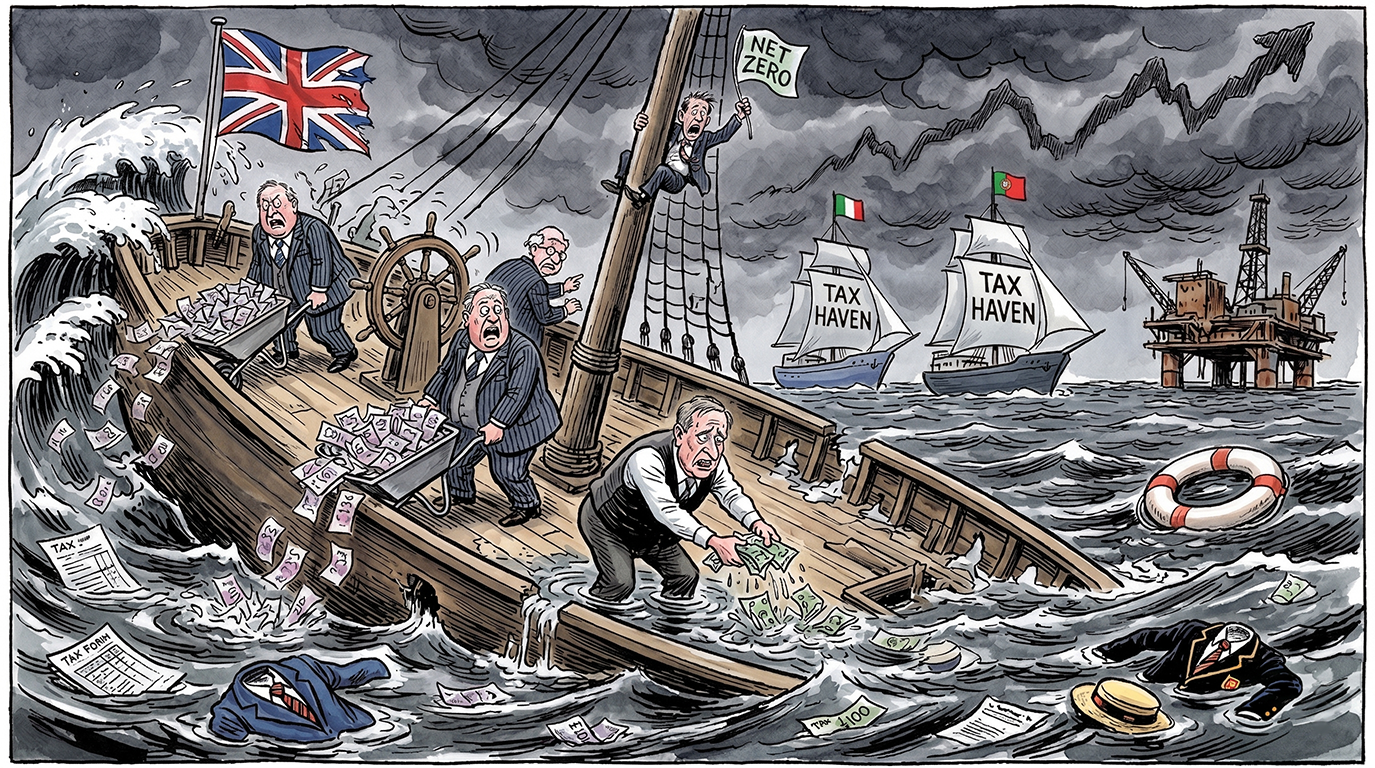
When it comes to creative solutions, we’ve got serious competition from countries that went through their sovereign debt crisis ten years ago. Italy and Portugal are offering all sorts of slightly odd tax breaks and good weather to attract taxpayers.
Britain’s Investment Letter Since 1938
In 1938, The Fleet Street Letter warned its readers that war was coming to Europe — and even identified September as the critical month.
Since then, its readers have been warned ahead of Black Monday, the dotcom crash and the 2008 financial crisis.
Today, Britain’s longest-running investment advisory is still looking for the “news behind the news” — and the investment opportunities others could be missing.
Click here to discover what The Fleet Street Letter sees coming next.
Capital at risk.
What Does Britain’s Oldest Investment Letter See Coming Next?
It warned readers ahead of Black Monday.
The dotcom crash.
And the 2008 financial crisis.
Now, nearly 90 years after it was founded, The Fleet Street Letter is still searching for the “news behind the news” — and the investment opportunities that could emerge from the next major turning point.
Click here to discover what its editors are seeing now.
Capital at risk.
Our islands don’t sell as well as Greece’s.
Our land doesn’t frack as well as the Permian.
Our finance industry still hasn’t got a grip on crypto.
Our defence industry is leaving allies in the cold, let alone selling onto the open market.
And all the Chancellor’s efforts so far have only made things worse…
From the government and here to self-help
The Office for Budget Responsibility and its minions in Parliament must be in a right panic. Their policies have been backfiring badly.
Their VAT raid on private schools is closing schools, taking students out of private schools and diverting students who would’ve attended private schools into government schools. The net result is higher costs for the government, less tax revenue, and worse education. A trifecta only repeated countless times throughout history.
In fact, the private school mess is so bad that Labour will soon have to come up with an alternative justification other than the tax revenue it was supposed to raise. Perhaps an ideological one?
The £100,000 tax trap is another case in point. Earn just a little more, and you can end up worse off once taxes and lost subsidies are factored in. Unsurprisingly, there’s a noticeable amount of “bunching” just below that threshold. A lot of people seem to land neatly on £99,999 and stop there.
But how much revenue is actually lost because people avoid crossing that line? Some estimates put it in the hundreds of millions. Not that the Treasury seems especially keen to dig into it, if Freedom of Information requests are anything to go by…
Then there’s the cost of transitioning to free energy. It’s proving expensive, particularly as it comes at the expense of a tax-generating North Sea.
Without the right incentives to keep exploring, North Sea oil and gas are either drying up… or ending up in Norwegian state coffers instead.
Raising the minimum wage will only send businesses broke, cutting a long list of tax revenues.
The UK’s tax burden is already at its highest since the 1940s.
What’s left for the government to plug the fiscal gap?
Sadly, there are still a few options…
It’s not about the money
The first option is simply to deny the problem and hope Britain goes bust on someone else’s watch. You might call that the Andy Burnham and Tony Benn approach.
After all, Labour can always argue that its policies were never really about the money.
Punishing people earning £100,000 is the point of the tax trap.
Dragging students out of private schools is the point of putting VAT on their fees.
Shutting down pub banter is the point of raising the minimum wage.
None of that fixes the underlying issue, of course. You still run out of other people’s money eventually. But “eventually” isn’t something the left tends to worry about when making decisions. Why start now?
“In the long run, we are all dead” was meant by Keynes as a response to unemployment, not as a defence of this sort of policy mix.
Still, it lines up neatly with the kind of blind spots Liam Halligan has been railing against for years.
So if politicians aren’t going to deal with the debt… who will?
The same people as always…
Inflate away the debt
If you can’t raise the money, you print it. That’s the traditional solution.
Let inflation run while the Bank of England keeps a lid on government bond yields, and the debt gets eroded through devaluation. Better yet, it even looks like growth.
Inflation has a useful side effect, too. It disguises the default. Lose 50% in a formal default, and you know exactly what’s happened. Lose 50% to inflation, and you still get handed a capital gains tax bill for the privilege.
It’s only later, when a pension buys half as much, that people start to notice. And even then, it’s not clear who gets the blame. The rich? Speculators? Foreigners?
Few voters recognise that inflation is, at its core, a policy choice — a way of dealing with too much debt. So the blame rarely lands where it should.
At least, that used to be the case. Now we have a clearly defined institution tasked with managing inflation. If the Bank of England lets it run too hot, it’s in the spotlight. Yet it isn’t elected, and it isn’t directly accountable.
That’s relatively new. Central bank independence hasn’t really been stress-tested in a world of high debt. We got a glimpse of how that plays out in 2022.
It’s entirely possible central bankers refuse to do the politicians’ dirty work and inflate the debt away. After all, few modern central bankers are keen to be burned in effigy. We haven’t seen that kind since the early 80s.
Reform…how?
Like “hope” and “fair,” it’s a wonderfully vague word. Which is precisely why politicians reach for it. “Reform” sounds good to everyone… right up until we find out what they actually meant. That’s when the trouble starts.
In theory, the UK economy would grow far faster without such a heavy regulatory burden. Deregulation could unlock construction, energy supply, manufacturing and plenty more besides. All of it taxable. All of it productive.
The problem is timing. The payoff takes years. And no one in office today would be around to claim the credit.
So who bothers?
Unlock natural resources
I’ve never quite understood why, but the government supposedly owns the country’s natural resources. Which means, in theory, it can sell access to them.
So the most obvious way to raise serious revenue is to unlock those resources, then charge hefty licensing fees and royalties.
It’s not even a hard sell. We’re already consuming vast amounts of oil, gas and minerals. Why not produce more of it at home, capture the tax revenue, create jobs, and export the surplus instead of importing it?
The stumbling block is political. Environmentalist politicians seem to think their voters won’t tolerate it. But that tends to change quickly once the right figure frames it as the “moral” option.
Call the North Sea the Thunberg Sea and you might suddenly find permits being handed out.
Which leads to the obvious, if slightly tongue-in-cheek, conclusion. Prime Minister Ed Miliband will end up fracking Yorkshire’s gas basin.
No one else could get away with it. But if it needs to be done… it will be.
Until next time,

Nick Hubble
Editor at Large