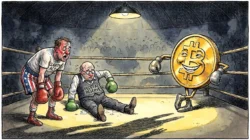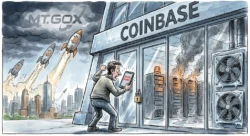
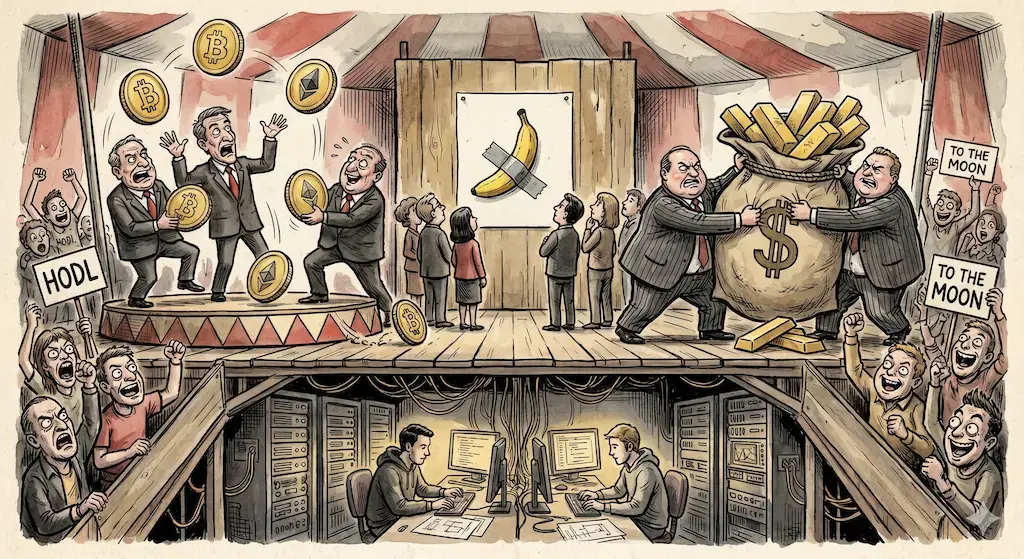
 A US senator’s family business is being sued for $320 million by the largest holder of its own crypto token.
Yep, we’re now at that part of the cycle.
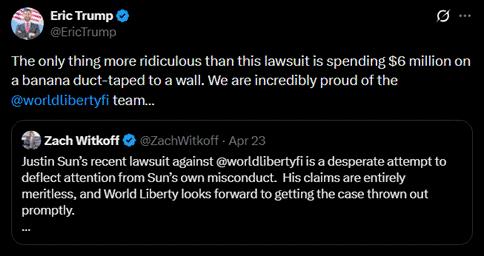
This lawsuit has a defence so far that consists of one co-founder calling the suit “meritless” on X, and another mocking the plaintiff for once buying a banana duct-taped to a wall.
Normally, you’d think this is the most flat-out-bonkers thing in the world.
But this is a normal week in crypto… always has been. And that’s a good thing.
Crypto’s circus has always been the warm-up act
Ok, so here’s the rub on this one…
World Liberty Financial (WLFI), the DeFi (decentralised finance) project tied to the Trump family name, is now facing a federal lawsuit from Justin Sun. He claims his tokens were frozen, his voting rights revoked, and that his WLFI holdings are effectively being held hostage unless he commits another $200 million to mint USD1 stablecoins.
Sun put $45 million into WLFI. At the peak, it was worth a billion. Now it’s worth $320 million, and he can’t move a single coin.
Meanwhile, WLFI has pushed through a governance proposal to unlock additional early supporter tokens over a two-year vesting period. All of this comes as the token has plunged more than 77% from its September 2025 high… while Eric Trump is posting banana memes on X.
So the question becomes, does any of this actually matter?
I’ve been around crypto for 16 years. I’ve seen this all before.
In 2013, it was Mt Gox and the great Silk Road auction theatre.
In 2017, it was ICOs minting overnight billionaires while 90% of projects failed. And of course, the Long Island Iced Tea company rebranded to the Long Island Blockchain Company.
In 2021, it was Three Arrows, Celsius, FTX, and subsequent implosions, plus a parade of celebrity-endorsed garbage.
Every cycle has its grift, its lawsuits, its public meltdowns, and its main-character-energy moments.
What’s different this time is the scale and the cast.
You’ve got serving political figures attached to tokens. You’ve got billionaires suing each other in federal court. You’ve got White House staff turning up to tokenisation summits hosted by Ondo.
The names are bigger and the news cycle, particularly in the mainstream, is much louder.
But the pattern is identical.
Public theatre has always been the town crier in the High Street. The real action happens inside, and under the hood, where almost no one bothers to look.
In my experience, the biggest, most exciting times to be in crypto are right before the super cycle blow-off-top mega wave of FOMO and hype hits hardest.
That also happens to be the point in time where exactly this kind of noise is loudest.
Lawsuits, accusations, founder feuds, retail euphoria curdling into retail rage.
The 2017 run into $20,000 BTC came on the back of relentless infighting. The 2021 surge to $69,000 followed a year of regulatory shouting matches and high-profile blow-ups.
Drama is not a sell catalyst in this market. It’s the market telling you to strap in.
Britain’s Investment Letter Since 1938
In 1938, The Fleet Street Letter warned its readers that war was coming to Europe — and even identified September as the critical month.
Since then, its readers have been warned ahead of Black Monday, the dotcom crash and the 2008 financial crisis.
Today, Britain’s longest-running investment advisory is still looking for the “news behind the news” — and the investment opportunities others could be missing.
Click here to discover what The Fleet Street Letter sees coming next.
Capital at risk.
What Does Britain’s Oldest Investment Letter See Coming Next?
It warned readers ahead of Black Monday.
The dotcom crash.
And the 2008 financial crisis.
Now, nearly 90 years after it was founded, The Fleet Street Letter is still searching for the “news behind the news” — and the investment opportunities that could emerge from the next major turning point.
Click here to discover what its editors are seeing now.
Capital at risk.
The real story is the buidl
While the banana jabs fly, here’s what’s actually happening in crypto: the buidl phase.
The NYSE is laying out a path toward 24/7 trading, with instant tokenised settlement running on crypto rails.
Nasdaq has applied to extend trading to 23/5, directly citing demand from digital asset investors. The SEC has approved this request.
Ondo Finance has launched more than 200 tokenised US equities and ETFs on Solana, with execution tied into NYSE and Nasdaq liquidity.
BlackRock, Goldman, Fidelity, BNY Mellon, the DTCC, and Franklin Templeton are all showing up to tokenisation summits with a clear message to TradFi: This is happening.
Stablecoin transaction volumes reached $33 trillion in 2025, up 72% year over year, with projections pointing to $56 trillion annually by 2030.
Revolut alone is processing more than $10 billion in stablecoin transfers each year, Circle is consistently profitable, Stripe is integrating stablecoin rails into its payments platform, and Visa is settling transactions directly on-chain.
The US Treasury is openly endorsing dollar-backed stablecoins as a tool of foreign policy.
And Bitcoin? Don’t forget the OG.
Bitcoin just pushed back above $80,000 for the first time since January. It’s quietly moved through Iran, through the WLFI mess, through all the noise, largely unbothered.
When it reclaims $100,000, that’s when momentum flips.
That’s when the mainstream turns back.
That’s when the FOMO machine kicks in. Retail piles back in. CNBC starts running relevant segments on Michael Saylor and swaps AI tickers for crypto across the bottom of the screen. And suddenly, every grift starts to look like genius.
Those are fun times, too.
The blow-off top, when it comes, will be built on what’s happening now, while attention is elsewhere.
Because what actually drives these cycles hasn’t changed. It’s always been the builders. When the infrastructure layer keeps advancing, with crypto at the core, that’s when you know nothing’s really shifted.
And there’s still a lot more upside to come.
Until next time,

Sam Volkering
Investment Director, Southbank Investment Research