
 In today’s Issue:
- We led the way out of socialism in the 80s
- Now we’re leading the way back in
- How to sidestep inheritance, capital gains, and exit tax
It doesn’t really matter who our prime minister is. Although I have to admit that Sir Keir Starmer lacked entertainment value, given all the taxes we paid to watch him.
Perhaps his more entertaining replacement will prove even worse. The extra laughs Andy Burnham provides may not be worth the higher taxes.
New Old Labour are going to try and take us back to the ‘70s on tax, inflation, and bond market bluster. So we know where this ends. Only a dose of euroscepticism could make it more familiar.
But the rest of the world has changed substantially since the ‘70s.
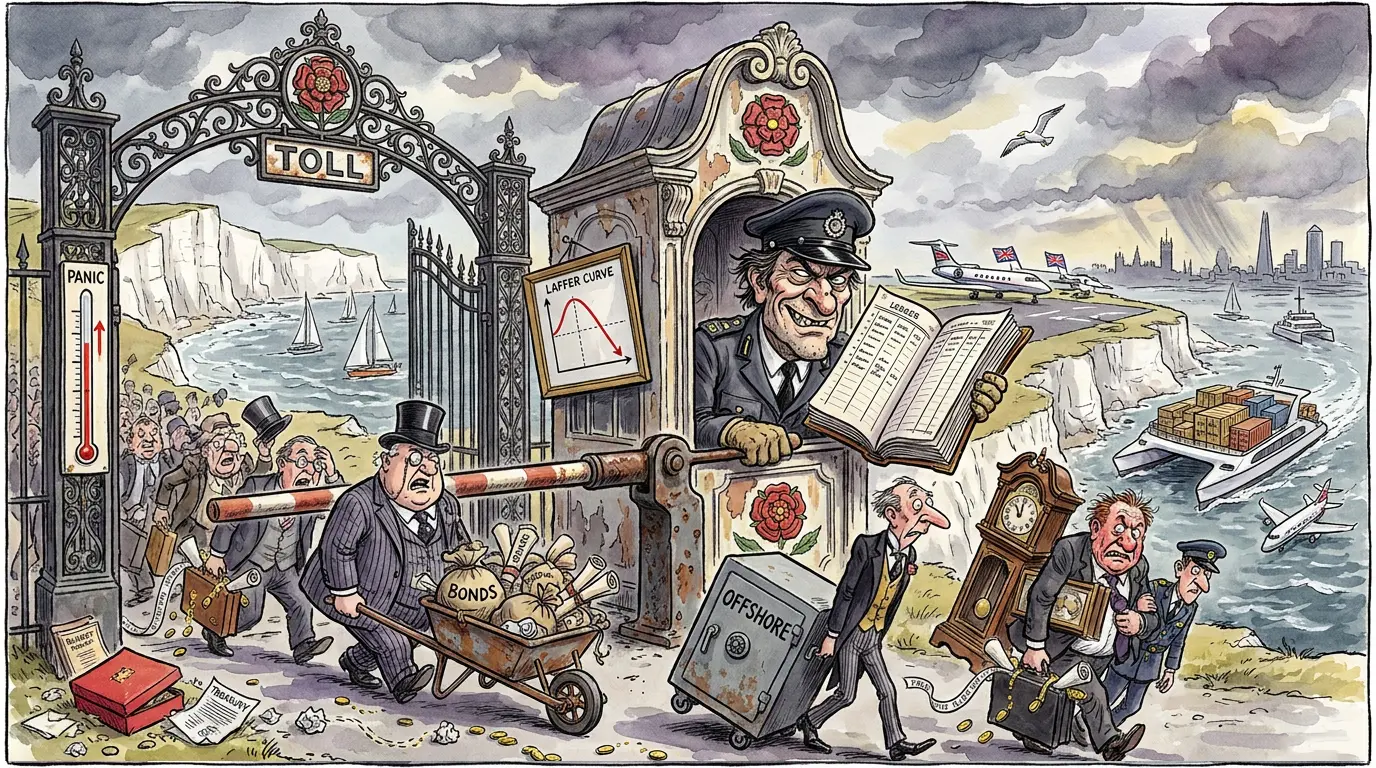
The UK led the way out of the leftist nightmare 50 years ago. Our government ushered in globalisation, international capital markets, and a march back up the Laffer Curve (which says excessively high tax rates can actually reduce total revenue by discouraging economic activity). Others merely followed.
In the 1980s, foreign exchange markets opened up. People still couldn’t move around the world freely but their money suddenly could.
This triggered massive capital flight out of high-tax countries and into low-tax ones. German wealth fled to Switzerland. British money escaped to the Caribbean. And Scandinavian funds went anywhere they could.
The exodus reached dangerous levels.
The response from governments was…
Britain’s Investment Letter Since 1938
In 1938, The Fleet Street Letter warned its readers that war was coming to Europe — and even identified September as the critical month.
Since then, its readers have been warned ahead of Black Monday, the dotcom crash and the 2008 financial crisis.
Today, Britain’s longest-running investment advisory is still looking for the “news behind the news” — and the investment opportunities others could be missing.
Click here to discover what The Fleet Street Letter sees coming next.
Capital at risk.
What Does Britain’s Oldest Investment Letter See Coming Next?
It warned readers ahead of Black Monday.
The dotcom crash.
And the 2008 financial crisis.
Now, nearly 90 years after it was founded, The Fleet Street Letter is still searching for the “news behind the news” — and the investment opportunities that could emerge from the next major turning point.
Click here to discover what its editors are seeing now.
Capital at risk.
Tax reform
Instead of lumping investment gains in with other income and then taxing it all at the marginal rate, governments separated the two. And then gave investment income substantial tax discounts.
Today, Japan taxes investment gains at 20%, Germany at 26%, the UK at 24%, and the US at up to 20%. All are dramatically lower than the tax rates applied to work as Andy Burnham likes to point out, which is a big hint for what’s coming.
The media spin back in the ‘80s was about encouraging people to invest by lowering their tax rate. The truth was combatting capital flight in an age of free capital flows. Governments had to be competitive to stay afloat. That’s why tax rates came down and why government policy improved.
Competition for investor’s money continues to this day. The countries caught up in the 2010 European Sovereign Debt Crisis cut taxes on investors to bring more money in.
We are about to do the opposite…
Andy Burnham’s inspiration
Today, most of the world taxes investment gains at rates well below what investors would pay if capital gains and dividends were simply lumped together with earned income and taxed at progressively higher marginal rates.
Australia is currently reversing this favourable tax treatment. It will serve as Andy Burnham’s model for his own tax reforms. So, let’s take a closer look…
Australia still combines all income into one pot and then taxes it progressively. But in practice dividend taxes are adjusted for corporate taxes already paid, and capital gains get a 50% discount. The result of these adjustments is to bring Australia in line with the rest of the world.
But under the new proposals, the capital gains tax discount in Australia will be abolished. That would leave Australia as one of the highest-tax jurisdictions in the world for investors.
Australians in the top tax bracket already pay 47% tax on dividends from foreign stocks. They may soon pay 47% tax on capital gains too. That’s more than double the typical global amount.
The result is the same phenomenon many high-tax European countries experienced during the 1980s: Capital flight. But Australia has a different way of dealing with the problem. An exit tax.
Under Australian tax law, if you move overseas, you have to pay capital gains tax as though you had sold your assets. It is called a “deemed disposal.”
This creates a whopping tax bill for leaving, forcing you to sell assets to pay the tax. And that stops people from escaping.
I’m sure you can see where I’m going with this…
High tax UK won’t work without an exit tax
The next Prime Minister will have to hike taxes substantially to avoid a fiscal crisis. Conveniently, taxing the rich is a part of the left’s playbook anyway. I don’t need to tell you about how it’ll be sold to the electorate.
But I do need to warn you that raising taxes will require an exit tax to work on paper. Otherwise, wealthy UK investors will simply leave. Just as they did in the ‘80s, until tax rates were cut.
I don’t know if the exit tax will be on unrealised capital gains or on asset values. There are all sorts of variations. But the point is that one is coming.
If you want to escape, the clock is ticking.
There’s an additional consideration, which I find truly mind-blowing.
HMRC’s tax support for emigrants
The UK taxpayer doesn’t just support immigrants. We also help out the rich who leave the country.
Because the UK doesn’t currently have an exit tax, it’s sometimes possible to avoid paying capital gains tax on certain assets simply by moving overseas.
Here’s how it works…
The UK generally doesn’t tax capital gains until an asset is sold.
But your new country of residence may not tax gains that accrued before you became a tax resident there.
In some cases, that means gains built up while living in the UK can escape capital gains tax altogether when you move abroad without selling your investments.
This opportunity won’t work for all assets. And not every country simply ignores your capital gains before you moved there. Tax law is highly complex. You’ll have to carefully check the particular destination you have in mind.
But the overall point is this: The fact that the UK doesn’t have an exit tax creates an extraordinary opportunity to not pay capital gains tax on your gains thus far.
But the next UK government will require an exit tax to stop wealth from fleeing the country as they unfurl their other new taxes.
Those leaving will go from not paying capital gains taxes to a whopping exit tax. A truly enormous shift in overall tax paid.
If you’re considering leaving the UK in anticipation of what the next government has planned for you, I expect the window of opportunity will close soon.
Expect a rapid exodus alongside you.
Until next time,

Nick Hubble
Editor, The Fleet Street Letter
PS The reason I spend so much time thinking about political and ideological shifts is simple. They tend to become investment themes long before most people realise what’s happening.
Brexit did.
The return of inflation did.
The collapse of the Net Zero consensus did.
And I suspect the rise of what I’ve called globalist populism will too.
On 9 July at 3 pm GMT, Sam Volkering and I are hosting a free YouTube live event where we’ll be discussing what we think could be the biggest shift in financial markets for more than 30 years — and the three stocks we’d buy to take advantage of it.