
 In today’s Issue:
- The “greater fool” retirement system didn’t collapse, yet
- The monetary system determines your investment returns
- Can central bankers deliver peace in the Middle East?
Fifteen years ago, I gave my first ever speech at an investment conference. I explained how my generation would destroy the retirement plans of those in the audience.
A bit audacious, given I was facing off with 500 wealthy investors who had paid to hear about good investment ideas.
Then my behaviour got even worse.
I made my dad stand up in the audience and told him: “I will not be your greater fool.”
My point was simple.
He didn’t have enough children to buy all the investment assets he planned to sell in retirement. Those shares he intended to offload each year to pay for trips to Milan?
He was going to struggle to find a buyer.
It was an analogy for the wider demographic challenge facing the West. If there weren’t enough young taxpayers to fund the state pension, there also wouldn’t be enough young investors to buy the assets retirees planned to sell.
Prices would have to fall. The “greater fool” retirement strategy governments had quietly sold to voters would fail.
What I missed at the time was simple: money printing.
Interestingly, do you know which investment changed the most when governments abandoned the gold standard and inflation became a permanent feature of the financial system?
|
When all else fails, print money
It turns out that central banks are willing to buy up the world’s financial assets. They do it with money they’ve created, out of thin air.
The Swiss and Japanese central banks alone have purchased more than half a trillion pounds’ worth of stocks. Strangely enough, they don’t just buy their local stocks. They hold a global portfolio.
Other central banks’ more traditional purchases of government bonds had an indirect effect on pumping up the stock market.
Quantitative Easing pushed yields in the bond market so low that people were forced to shift into stocks instead. Dividend yields even exceeded bond yields for a while.
That point is worth pondering.
Back when stock markets first became an American pastime, dividend yields were presumed to be higher than bond yields. Finance academics at the time wrote their PhDs about the reasons why.
They reasoned that because stocks are riskier than bonds, they had to offer a higher return. So dividend yields should be above bond yields.
But then something changed. The importance of capital gains began to dominate. Dividends took a back seat. And stocks were bid up so high that their dividend yields fell below bond yields.
That soon became the new norm. And finance academics began to write their PhDs about the reasons why dividend yields should always be below bond yields.
I suspect the shift was driven by a change in the monetary system.
Going off the gold standard allowed governments and then central banks to create money. The risk in the system became inflation.
Suddenly, bonds became riskier than stocks. Their promise to repay a fixed amount of money in the future is precisely what inflation undermines.
So bonds had to offer higher yields to compensate investors for the inflation risk they were taking. But that meant a crash in the bond market. Right up to double-digit yields in the 70s.
Capital gains and dividend growth in the stock market help protect investors from inflation. That shifts the return profile of equities away from steady dividends and towards capital growth and rising income.
Can you see how changing the nature of the monetary system caused a radical shift in the returns profile of financial assets?
It also made property an exceptional investment for decades. That’s because property is purchased with debt. And inflation reduces the burden of debt over time.
One of our key themes over at The Fleet Street Letter is that every few decades, the world undergoes a major monetary reform. It might be going off the gold standard. Or allowing exchange rates to fluctuate. Or quantitative easing becoming politically acceptable.
Each of these shifts eventually triggers a new wave of finance PhDs to explain how the returns profile of different asset classes has changed. But if we can figure it out beforehand, we can position investors to profit.
The point is that, since 2008, central banks have become an enormous buyer of financial assets. This filled in the gap of demographic change, which I so rudely pointed out at our conference in Sydney.
Reinflating markets has worked surprisingly well. So far, we’ve experienced only one major bout of inflation. And asset prices haven’t collapsed because of demographics, as I warned they would.
It’s not just demographics that central bank buying has offset, either.
Bank failures in the US, a sovereign debt crisis in Europe, and the chaos following Liz Truss’ budget were all papered over by central bankers… eventually.
But can central bankers overcome the latest threat?
Central bankers can’t print oil and gas
The Strait of Hormuz is closed again.
The Houthis are disrupting shipping in the Red Sea.
The EU is planning to stop its own gas imports from Russia.
And Bloomberg is reporting that some of Europe’s rivers, which are used to transport energy products, are about to run too low.
Not only that, but European and US oil and gas storage levels are concerningly depleted. China’s suspiciously low oil imports will have to normalise eventually.
Meanwhile, drones are wreaking havoc on shipping. Oil and gas tankers are obvious targets.
Can central bankers save us this time?
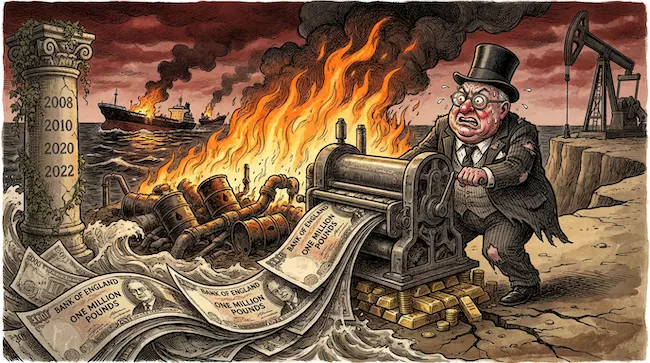
They fought off a financial crisis with money printing in 2008. They tackled a sovereign debt crisis between 2010 and 2018 the same way. They responded to the pandemic in 2020 with money printing. And they calmed the budget crisis in 2022 with more money printing.
Surely they can deliver peace in the Middle East with money printing?
Because if not, we’re in serious trouble.
The world is built on a foundation of “bailouts when needed.” And the oil trade is definitely “too big to fail.”
If central bankers come up short, they will be disappointing a generation of investors who are used to being rescued.
There’s one reason this situation is especially concerning.
Not only will central banks struggle to solve the problem, their usual solutions risk making it worse.
Spiking oil and gas prices create inflation. Printing more money to cushion the economy risks making that inflation even worse.
It would be like trying to put out a fire with petrol.
In the real world, real solutions take time
For a proper solution, we turn to former Bank of England governor Mark Carney.
He has since become Canada’s prime minister and thrown off his climate alarmist shackles to offer a very radical solution: more oil and gas.
Carney has approved a doubling of Canada’s largest LNG export facility, is expanding domestic and export gas pipelines, and has accelerated the review of an Alberta oil pipeline.
Bloomberg also reports that Japanese conglomerates are likewise looking to invest in vast pipeline capacity expansion around the world.
The Middle East has swapped ridiculous property developments for digging ridiculous canals to circumvent the Strait of Hormuz.
Even the North Sea is back on the menu.
But one oil and gas opportunity dwarfs all the others. It’s a resource so vast it would require cooperation at the United Nations level to unlock. One that could trigger a race to the pumps instead of another scramble around geopolitical chokepoints.
For the first time in decades, all that’s looking plausible.
It’s what I call real quantitative easing.
Until next time,

Nick Hubble
Editor, The Fleet Street Letter