
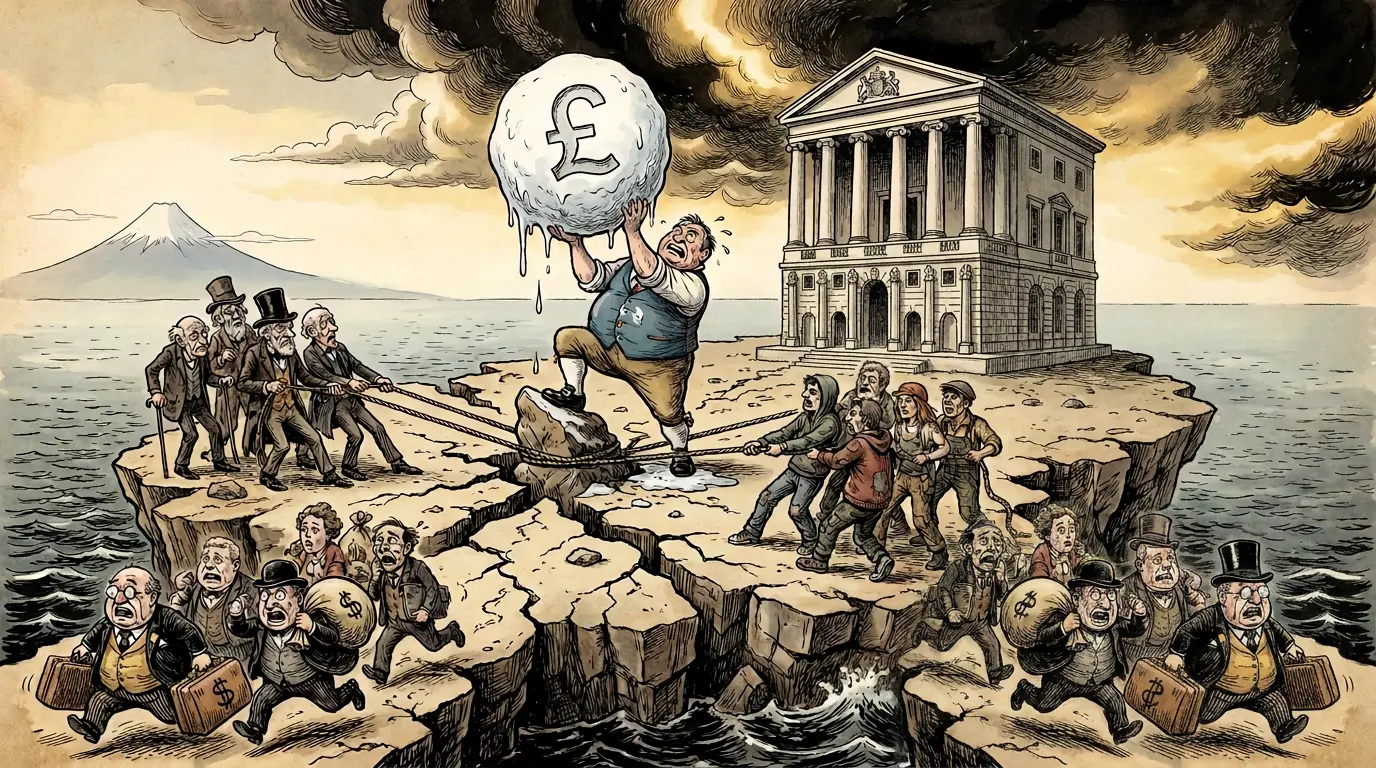
 In today’s Issue:
- Our debt to GDP ratio isn’t alarmingly high, but…
- Debt to GDP doesn’t count everything
- Why Japan might make it, but we won’t.
The debt doom-mongers won’t admit it, but we’ve been in far worse fiscal shape before.
Debt today sits at around 100% of GDP. After World War I, it was close to 200%. After World War II, it topped 250%. That’s about where Japan sits today.
We worked our way out of those post-war holes eventually.
And Japan is hardly in the middle of a fiscal panic. Its 10-year government bond yield is just over half that of the UK’s.
So is there really that much to worry about?
Surely the economic miracles of AI, green energy, and Manchesterism will fix things… ?
Isn’t that how we reduced the debt burden in the past?
The denominator in the debt-to-GDP ratio surged. Economic growth took off, making those old debts far more manageable.
There’s no doubt economic growth could boom. If the government got out of the way, as it did after World War II and again after the 1970s.
But it won’t.
Not this time.
Besides, inflation did most of the heavy lifting in reducing the wartime debt burden. The pound has lost about 98% of its purchasing power since 1945. Prices have risen around 5,500%.
Our past debts weren’t repaid… they were inflated away.
I often wonder how deliberate that strategy really was.
Government after government ran into political trouble because of high inflation. But given the importance of bringing the debt-to-GDP ratio down from dangerous levels, was inflation really just an oversight?
Could the politicians in charge of monetary policy really have been that incompetent? Did they trigger inflation by accident while it just happened to slash the real value of the national debt?
After all, governments have deliberately inflated away their debts throughout history.
So the idea they did it unwittingly doesn’t really pass the pub test. Nobody at the bar would believe it.
And it’s not as though anyone credible thinks rent controls and price controls are good ideas. Unless, of course, your primary goal is financial repression—reducing the real value of government debt through inflation. In that case, you also need to disguise the inflation by massaging the figures.
Perhaps the inflation that followed the world wars was deliberate.
Perhaps it simply got out of hand in the 1970s.
Perhaps that’s what happened in 2022 too.
And perhaps that’s what we have to look forward to in the years ahead.
Inflation may yet prove to be the least painful way for governments to deal with excessive debt.
And it’s often good news for investors who understand it.
Inflation pushes up asset prices while reducing the real value of the debt you use to invest. High inflation can make investors extraordinarily wealthy in real terms, if they know how to profit from it.
To sum up, our debt levels aren’t as bad as they look. We’ve escaped this pickle before, and inflation did much of the work.
So why worry?
Forget AI, America’s No.1 forecaster says a bigger boom is coming:
“I’ve invested $1 million of my own money to prepare for this…”
He predicted the Financial Crash, both Trump victories and 2025’s record rare metals surge that saw stocks soar as much as 645%
Now discover the move he is making as America seeks to unlock a home grown fortune potentially worth trillions on Friday, May 15th
Find out what that move is right here >>
Capital at risk
Why today’s debt burden is worse than it looks
Today, I’d like to raise another reason to worry about the national debt: cultural cohesion.
The country is more divided than it has been for generations. And that creates risks we aren’t used to considering.
In the past, we carried high debt loads during periods of remarkable national unity.
After the world wars, the country was highly unified. The debt had been incurred in a national struggle that most people believed was both necessary and worthwhile. Few questioned whether it should be repaid.
Heck, the Allies were remarkably magnanimous in victory. To the point that people often said Germany lost the war but won the peace.
Today, the debt is back. But the UK is anything but unified.
COVID policies divided the country as deeply as Brexit. Many believe the response was a wasteful scam. And evidence of large-scale fraud and waste continues to emerge.
The same applies to today’s enormous welfare bill, which taxpayers continue to shoulder. Welfare spending has exceeded income tax receipts for at least the past 13 years. But how much of that spending is actually reaching those most in need?
Intergenerational warfare is also brewing over housing affordability, student debt, and taxes. Many younger taxpayers believe they’ve inherited a mountain of debt created by the profligacy of previous generations.
Immigration is at historically high levels as a share of the population. Many newer arrivals don’t share the same ties to the British state as long-term residents. At the same time, many locals blame immigration for the country’s fiscal problems. Increasingly, even economists are beginning to agree.
The rich, the ambitious, and the successful are moving overseas to escape higher taxes. Their businesses often move with them. The national debt does not. That level of mobility is a relatively new phenomenon.
According to recent surveys, relatively few people would volunteer to defend the UK in a war. Some say they wouldn’t serve even if called upon. Who can blame them after Britain’s involvement in recent foreign conflicts?
The point is that we are no longer a unified country carrying debt accumulated in pursuit of a common purpose.
For many people, today’s national debt was incurred by someone else, for someone else.
And that makes it someone else’s problem—if they can avoid paying for it.
Why does this matter?
It would be easy to pay off the national debt. All you have to do is spend less than you collect in taxes. And by “spend”, I include the eye-watering interest bill.
The real issue is political will. Would people put up with it?
Fake austerity proved deeply unpopular. Imagine what the real thing would do to a country divided along so many lines.
If politics won’t restore fiscal sanity, what about cold, hard fiscal reality?
Well, the new prime minister believes the country is only in hock to the bond markets in the minds of Conservative journalists.
And he’s right.
As long as the Bank of England has a mandate to preserve financial stability, it also has a mandate to support the government bond market. The more gilts wobble, the easier it becomes for the Bank to step in and rescue the government from its own spending.
The irony is hard to miss.
The Bank of England and other financial regulators spent decades encouraging banks and pension funds to load up on government bonds because they were supposedly “risk-free”.
If the government bond market now becomes the source of financial instability, it’s like discovering your house was built on sand instead of concrete.
Just ask the shareholders of Silicon Valley Bank how that worked out.
So if the Bank of England ultimately backstops the gilt market, fiscal pressure becomes far less relevant. The government can simply rely on the Bank to create the money it needs.
Inflation and a currency crisis rear their ugly heads instead of austerity.
That’s where Japan is today. The yen has fallen about 70% against the pound since I joined Southbank Investment Research.
Inflation is rising for the first time in decades.
Of course, inflation only weakens cultural cohesion further. It creates winners and losers through currency debasement. It widens inequality in ways that feel fundamentally unfair. And the resulting economic chaos ripples through the entire economy.
Eventually, austerity is still required to bring the inflationary mess to an end.
But austerity is only politically sellable when it’s wrapped in a larger purpose.
Paying for a world war. Rebuilding after one. Escaping an inflationary collapse, as Argentina and Weimar Germany were forced to do.
That still requires an extraordinary degree of cultural cohesion. It demands a shared belief that everyone is carrying their fair share of the burden. A willingness to sacrifice for something bigger than ourselves, whether that’s national recovery or victory in war.
My children and I have spent their summer holidays in Japan. Every morning at 6:30, we’re sent off to do radio calisthenics with the neighbourhood children. So I can just about imagine Japan accepting genuine austerity. They still have the cultural cohesion to believe in shared sacrifice.
But if you ask me, there’s no chance of that happening in the UK.
Not the radio calisthenics.
And not paying off the national debt.
Not before we experience the pain of inflation first.
Until next time,

Nick Hubble
Editor, The Fleet Street Letter
PS Inflation doesn’t just destroy wealth. It redistributes it. The trick is knowing where it’s likely to flow next. James Altucher believes one of the biggest beneficiaries of the next wave of investment won’t be the headline names everyone knows, but an overlooked supplier sitting at the centre of Elon’s latest AI project. You can see why here.