 In today’s Issue:
- You only ration electricity to prevent a crisis
- Complexity increases costs and risks
- Prepare for the inevitable collapse
Energy companies exist to make a profit. That means they produce electricity until their marginal cost exceeds their marginal revenue from doing so.
But what does this “marginal” mean?
It’s a term that completely upended the “science” of economics in the 1870s. The basic idea is that the value of something is determined by the usefulness of the next unit.
One glass of water is very valuable. But by the third one, you’re not really willing to pay much.
Electricity is the same. A little bit of electricity is incredibly valuable. But once your basic needs are met, do you really need even more power? How much you’re willing to pay for an additional kilowatt begins to fall away.
But how much electricity we end up using doesn’t just depend on marginal benefit. It also depends on cost. How much does it cost you to make another unit of energy?
If electricity were free, we’d use an extreme amount of it.
But the costs of producing each additional unit of energy tend to go up. There is only so much cheap coal. There are only so many suitable wind farm sites.
The point is that marginal benefits from more electricity go down while marginal costs go up. Eventually, the twain meet. And that’s where the amount and price of our electricity is determined. That’s because the costs start to outweigh the benefits.
For decades, our grid worked in this way – the same way as any other market. Producing more of something meant incurring more costs and fewer benefits. And so the system balanced itself out.
A coal power station produces power until the cost of buying more coal is greater than the revenue from selling the additional unit of electricity.
We didn’t produce too much electricity because the costs exceeded the benefits. And we produced electricity from the lowest-cost source because that’s the profit incentive. The result was the cheapest possible electricity.
But the renewable energy we are introducing to the grid today violates this inclination to automatically balance the system.
Energy without marginal cost
Solar, wind, and battery storage have a negligible marginal cost. Whether they push another gigawatt more or less onto the grid doesn’t really impact what it costs them to produce it.
That’s not to say they don’t have costs. Those costs are high. But they are mostly fixed and sunk costs. The crucial thing is that these are not marginal – the costs don’t depend on the amount of power being provided. Producing another unit of electricity doesn’t really increase a wind farm’s operating costs.
This is fine. In fact, it’s fantastic in many contexts. When telecommunications swapped to the internet, the cost of sending a text message and making a phone call switched from having a marginal cost to almost no marginal cost.
This allows my family to keep in touch across three continents and five countries without a care in the world about the price of doing so. We all pay a fixed subscription per month for the internet, end of story.
The same goes for listening to music on a subscription platform. I can listen as much as I like. There is no marginal cost to me from doing so. My cost is a subscription that doesn’t care about how often I use it. The benefits of music, meanwhile, are limitless.
The trouble is that the electricity grid is a mixture of the two systems. It presumes that marginal cost still plays a role even when it is close to zero as renewables kick in. It’s the confusion that’s the challenge.
Britain’s Investment Letter Since 1938
In 1938, The Fleet Street Letter warned its readers that war was coming to Europe — and even identified September as the critical month.
Since then, its readers have been warned ahead of Black Monday, the dotcom crash and the 2008 financial crisis.
Today, Britain’s longest-running investment advisory is still looking for the “news behind the news” — and the investment opportunities others could be missing.
Click here to discover what The Fleet Street Letter sees coming next.
Capital at risk.
What Does Britain’s Oldest Investment Letter See Coming Next?
It warned readers ahead of Black Monday.
The dotcom crash.
And the 2008 financial crisis.
Now, nearly 90 years after it was founded, The Fleet Street Letter is still searching for the “news behind the news” — and the investment opportunities that could emerge from the next major turning point.
Click here to discover what its editors are seeing now.
Capital at risk.
The profits will evaporate
As forms of energy without marginal cost play an ever-greater role on the grid, the marginal cost of our electricity will fall ever lower. This is very bad news for electricity providers’ revenues. Because marginal cost and revenue tend to move in tandem due to competition. If cost is falling to zero, you’d expect revenue to as well.
Think of it like this. We don’t have enough batteries to store up electricity during the day and discharge it at night. So batteries will be a profitable endeavour. They can trade the difference between cheap energy during the day and expensive energy during the evening.
But what happens the moment we have enough batteries?
In most industries, you’d hit an equilibrium price where marginal cost and revenue even out. But if the marginal cost of batteries is close to zero, because the costs are upfront, sunk costs and not operating costs, what’ll happen to electricity prices?
How will batteries make money if they are all willing to charge and discharge the electricity we need each day?
Of course, they won’t always be able to. Because the wind and solar output fluctuate. So, sometimes, higher marginal-cost energy will suddenly set the price.
The result will be a bizarre system where electricity prices fluctuate extraordinarily. Either far too high to be economic or too low to be profitable for anyone to provide the power.
Whenever renewables manage to charge batteries sufficiently to cover the day’s demand, the price will approach extreme low levels. That’ll leave the batteries without much of a profit margin.
When renewables fall short, backup power will have to spring into action. But can you imagine what sort of power prices will be needed to allow rarely needed power sources to be profitable over time? The price spikes will have to be enormous to make patience pay off.
If Britain gets most of its electricity from wind and solar, which part of the system could become more valuable, not less? |
No wonder demand management is making its way into the Overton Window. For politicians to be pushing electricity rationing, the alternative must be something absolutely horrific. A grid that goes completely haywire.
Nationalisation is the only way out
Had the UK experienced a blackout during the World Cup game with Ghana, the country would already be on a warpath with its grid operators. But I think we’re close regardless.
Recent internal scandals and news suggest the grid’s players are at each other’s throats already.
But so far, the blame is being sprayed around liberally.
This is a prime example of the free market getting the blame for a failure of government. Once the grid is given priorities other than price and reliability, those two inherently suffer.
We’ve been given a grid that prioritises renewables. Not just in terms of what is built, but what gets to sell its power “first.”
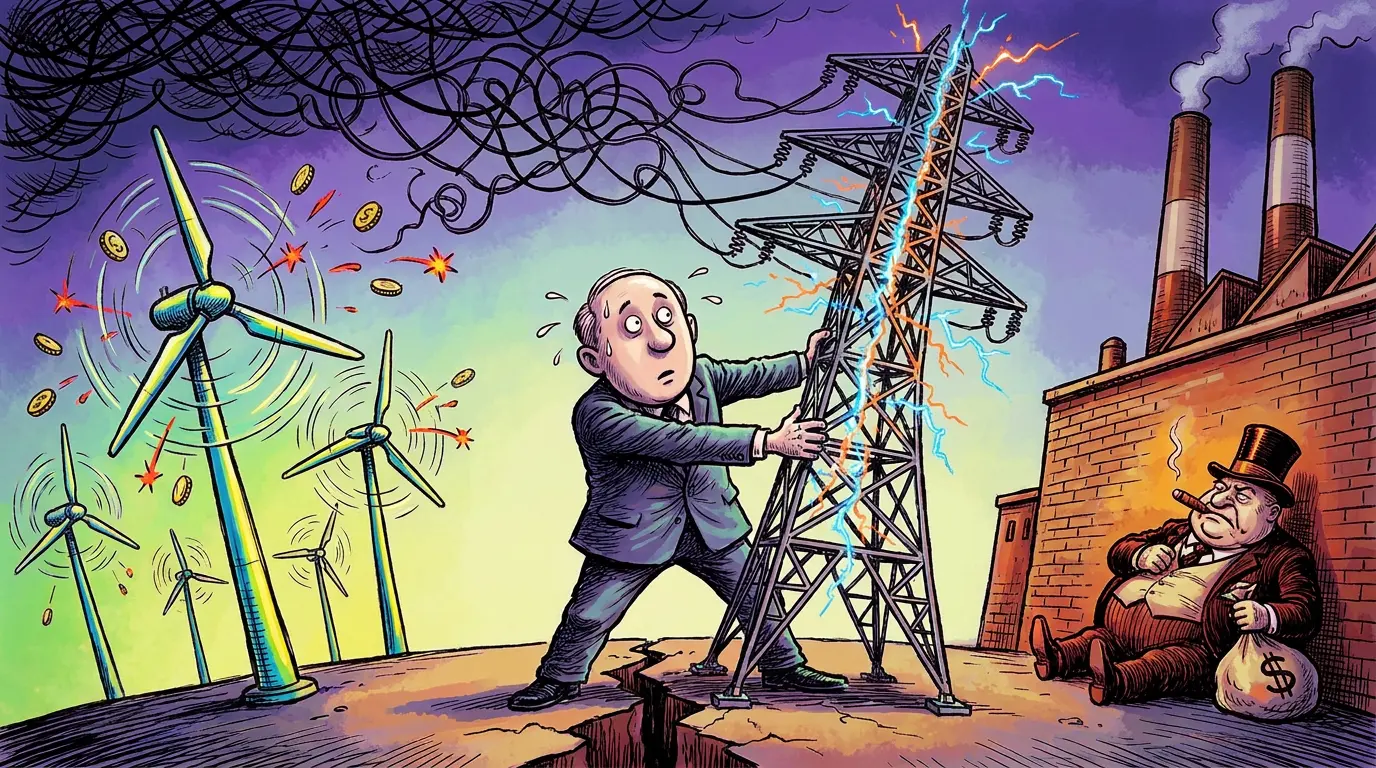
The result is a violation of what makes economics function – marginal analysis. And the chaos will force the government to act. They will have to nationalise the grid to stabilise it.
Here’s where things do get interesting. What would the system look like once nationalised?
A grid full of independent power producers is chaotic if some have marginal costs and some don’t.
But a system-wide managed grid could work if the same single body benefits from both negligible marginal costs when renewables and batteries are doing the job, and suffers from the high marginal costs when gas is required to step in.
If a single organisation sets electricity prices so that it earns money when renewables and batteries are sufficient, and loses money when gas must be brought in as backup, the two could balance out. We could have stable electricity costs.
My point is that the bizarre energy mix the government has created isn’t going to be viable for private companies to operate for much longer. Politicians have engineered another “market failure” that requires them to intervene.
We predicted all this chaos back in 2024. But the biggest scandal hiding on the electricity grid is yet to be exposed.
Until next time,

Nick Hubble
Editor, The Fleet Street Letter
PS If you think Britain’s electricity grid looks chaotic, take a look at the markets trying to price all this in. Sam Volkering has spent three years building a new system designed for exactly these kinds of conditions. Next Thursday, he’s switching it on live. Click here to reserve your free spot and see what it finds.