
 In today’s Issue:
- The only economic indicator that matters
- An honest day’s worker
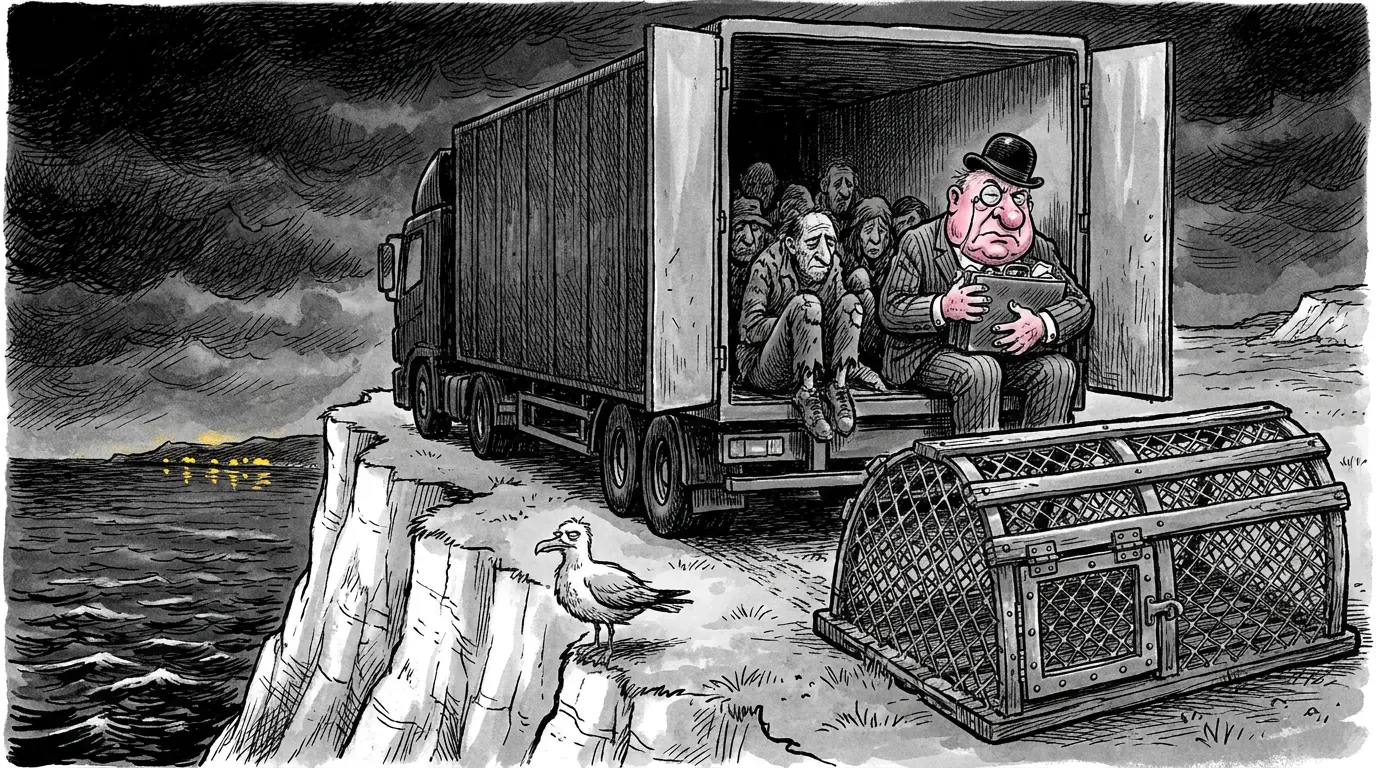
- Will entrepreneurs join illegal immigrants on the lorry?
What makes a political system successful? Is it separation of powers? Democracy? Losers’ consent?
We all have our theories. But by far the most important factor is the right to leave. It forces politicians to behave.
That’s why the most successful political systems are places with easy exits.
Americans can move between states without barriers. The Swiss can arbitrage between Cantons. Companies in the EU can make a run for Ireland’s corporate tax rate.
The borders of successful small countries are known for being porous with their larger neighbours. Labour flows across the borders of Lichtenstein and Luxembourg freely.
Contrast this with governments that restrict movement. They’re the least prosperous on earth.
Most people believe the causation runs in the obvious direction: poor countries have to restrict labour movement to prevent an exodus… rich countries need more labour, so they attract immigrants.
But what if the causation runs the opposite way?
What if countries with high labour mobility deliver wealth because they have to in order to retain their citizens.
It’s a form of competition.
Instead of competing for customers and workers, countries have to compete for taxpayers. In the free market of free movement, you’ve got to offer a good political system.
It’s also why dishonest governments must have border and capital controls… to hide how bad things are… and to keep their claws in the productive people that don’t escape.
Immigration patterns are also reliable indicators in the sense that it’s not mere talk. It’s not an arbitrary think tank ranking, nor a dodgy economic statistic. It’s people voting with their feet.
People love to disparage the US political system. But it’s still the best place to be, if you look at the foot traffic over the years.
Post-Brexit Britain was a hit too, which is awkward for some.
Japan went from economic pariah to the next great economic superpower after it opened its borders to foreigners. The best minds in finance today did a spell in Tokyo during the bubble years. The Japanese even call it a bubble, which makes their inability to pronounce my surname even more of a mystery.
Eastern Europe’s recent economic boom was tied to the remigration of its diaspora from Western Europe.
My favourite immigration-linked indicator of economic prosperity is this one from Bob:
Further to your articles I thought you might be interested in my family history in that it relates to this subject.
My father grew up in Nazi Germany during the late 1920s, my grandfather was employed in a factory around 1930 and because prices were going up so quickly that they were paid daily and a lorry would pull up in the yard, the names of employees were called out and bundles of money were thrown in their direction.
My father had to go to the factory gate with his mother so that my grandfather would rush over to give her the bundle of notes (his wages for the day) which she then gave to my father and his brother with instructions to run to the butchers to buy some meat because the prices were rising by the hour. He actually witnessed a scene where the butcher tipped the money out of a wheelbarrow which someone had brought to the shop full of paper money, because the wheelbarrow was of more value than the paper notes within.
This type of experience stayed with my father for the whole of his life and I was always taught to save up the money to buy something rather than taking hire purchase etc.
My father ended up as a German POW who settled in the UK and worked on the land as a POW, ending up marrying the farmers daughter (my mum). There is a much longer story behind all of his life which is for another time, but I thought the inflation detail shown above relates to your articles.
Nothing, and I mean nothing, anticipates economic prosperity better than POWs who choose to stay. The Italians who famously stayed in Australia. The Germans who stayed in the UK.
You’d think they’d be treated worse than illegal immigrants. But find me a harder working demographic.
Britain’s Investment Letter Since 1938
In 1938, The Fleet Street Letter warned its readers that war was coming to Europe — and even identified September as the critical month.
Since then, its readers have been warned ahead of Black Monday, the dotcom crash and the 2008 financial crisis.
Today, Britain’s longest-running investment advisory is still looking for the “news behind the news” — and the investment opportunities others could be missing.
Click here to discover what The Fleet Street Letter sees coming next.
Capital at risk.
What Does Britain’s Oldest Investment Letter See Coming Next?
It warned readers ahead of Black Monday.
The dotcom crash.
And the 2008 financial crisis.
Now, nearly 90 years after it was founded, The Fleet Street Letter is still searching for the “news behind the news” — and the investment opportunities that could emerge from the next major turning point.
Click here to discover what its editors are seeing now.
Capital at risk.
The only economic indicator that matters
So immigration is the best signal of economic prosperity. But what about the opposite?
You know it’s serious when the immigrants start to leave.
The Telegraph has discovered just that:
Illegal migrants are being smuggled out of the UK across the Channel to cash in on Spain’s asylum amnesty, a Telegraph investigation has found.
People-smugglers are exploiting weaker border-exit controls to sneak the migrants out of Britain and into France by hiding them in lorries to be transported across the Channel by ferry or train.
The migrants – many of whom face deportation to their home countries from the UK for overstaying their visas or working illegally – are paying up to £1,000 for the journey.
It’s always struck me as odd that illegal immigrants prefer four-star hotels in the UK over Spain…
If the Prime Minister of Spain is to be believed, Ceuta tells a similar story. Tens of thousands crossed into Spain, only for many to leave again.
Japan is famous for wearing down its immigrants too. The place comes with extraordinary obligations, not just benefits. You can only be blissfully unaware of the challenges for so long. Few people stay for their retirement.
Japan is also tightening its immigration policy. Visa fees are rising and minimum income requirements are increasing as policymakers seek to attract higher-value workers.
It is another example of how conventional economic thinking has shifted. Countries once focused on importing low-skilled labour, arguing that domestic workers were too skilled or too expensive to fill certain roles. Immigration was seen as the answer to shortages at the lower end of the labour market.
Surprisingly, low-skilled workers are more likely to end up relying on welfare. They’re also more likely to be associated with higher crime rates, a major political issue here in Japan.
In the end, they can become a net cost to the public finances they were expected to support.
It’s little wonder governments are changing tack.
Instead of lowering the bar, many are raising it, shifting towards higher-skilled migration. Just as AI begins competing for many of those same jobs.
The only honest day’s worker
Personally, I’m a big fan of illegal immigrants. They have to do an honest day’s work to survive.
They can’t rely on government protection, only the freedom of contract between worker and employer. Do the wrong thing and you might be kicked out of the country altogether.
It’s only once the government tries to help that things go wrong.
Welfare corrupts the best of us. Even illegal immigrants fall for it.
The flows of illegal immigrants also reveal the prosperity of nations better than legal migration. The Berlin wall wasn’t built to keep the capitalists out. Koreans don’t sneak North across the demilitarised zone. And not many Australians flee to New Zealand.
Well… actually… get a load of this from the New Zealand news site Stuff:
There’s been a huge spike in the number of wealthy Australians eyeing property in a part of New Zealand many Kiwis are already priced out of.
Property experts report a surge in interest in homes in and around Queenstown since the government across the Tasman proposed changes to its capital gains tax in May.
Hamish Walker, director of Queenstown-based real estate agency Walker&Co, says he’s seen a 30% increase in inquiries over the past month from Australian buyers with budgets north of $3 million.
And NZ Sotheby’s International Realty managing director Mark Harris told Stuff that, year-on-year, Australian inquiries are up 90%, and lifted sharply after the tax announcement.
What changed?
Australia raised its capital gains tax system and hiked taxes on trusts.
New Zealand, by contrast, doesn’t even have capital gains tax. The New Zealand Prime Minister humiliated Australia’s at a press conference by calling capital gains tax a “wrecking ball.” New Zealand’s Finance Minister previously told Australian entrepreneurs, “Where the bloody hell are you? Come over!”
But the crafty Australian Tax Office is one step ahead.
It has a lobster trap of a tax system. If you leave, you have to pay a deemed disposal tax. That means paying capital gains tax as though you’d sold everything. The same capital gains tax they just hiked dramatically.
Again, it’s about keeping the immigrants in. A sure sign prosperity is ending.
What could the UK look like in three years’ time?
The next UK election is pencilled in for August 2029. The Burnham bounce suggests it could come much sooner.
But as I’ve tried to make clear, your vote may count, but it’s the immigrant’s feet that matter.
Net migration is plunging. Even illegal immigrants are fleeing to Spain.
What will UK migration look like in three years’ time?
Will we pull up the drawbridge? Or raise it high enough to create hurdles for unskilled labour?
Will we welcome in more unskilled workers while taxing the rich out of the country?
Will the world’s non-doms come to the UK, or go elsewhere?
Will the UK’s wealthy entrepreneurs join illegal immigrants on the back of lorries heading for Europe?
I don’t know the answers.
But I do know those decisions will matter far more than most of the arguments you’ll hear during the next election campaign.
Before I sign off, a question for you:
|
Until next time,

Nick Hubble
Editor, The Fleet Street Letter
PS Migration trends are just one way to see where the world is changing. Jame Altucher has spent decades identifying the bigger forces shaping markets before they become obvious. In his latest presentation, he explains where he believes investors should position themselves now – and why the biggest opportunities may still lie ahead. Learn more here.