
 Tomorrow at 7am the Office for National Statistics publishes its first estimate of second-quarter GDP.
The number will be small and positive.
The Treasury will call it resilience, the opposition will call it stagnation, and by Friday nobody will mention it again.
What we know, according to the ONS, is that the economy grew 0.1% in May, after shrinking 0.1% in April, and grew around 0.7% across the three months to May.
So another growth quarter, and you bet the politicians will crow about how “resilient” and “strong” the economy is in the face of the Iran war…
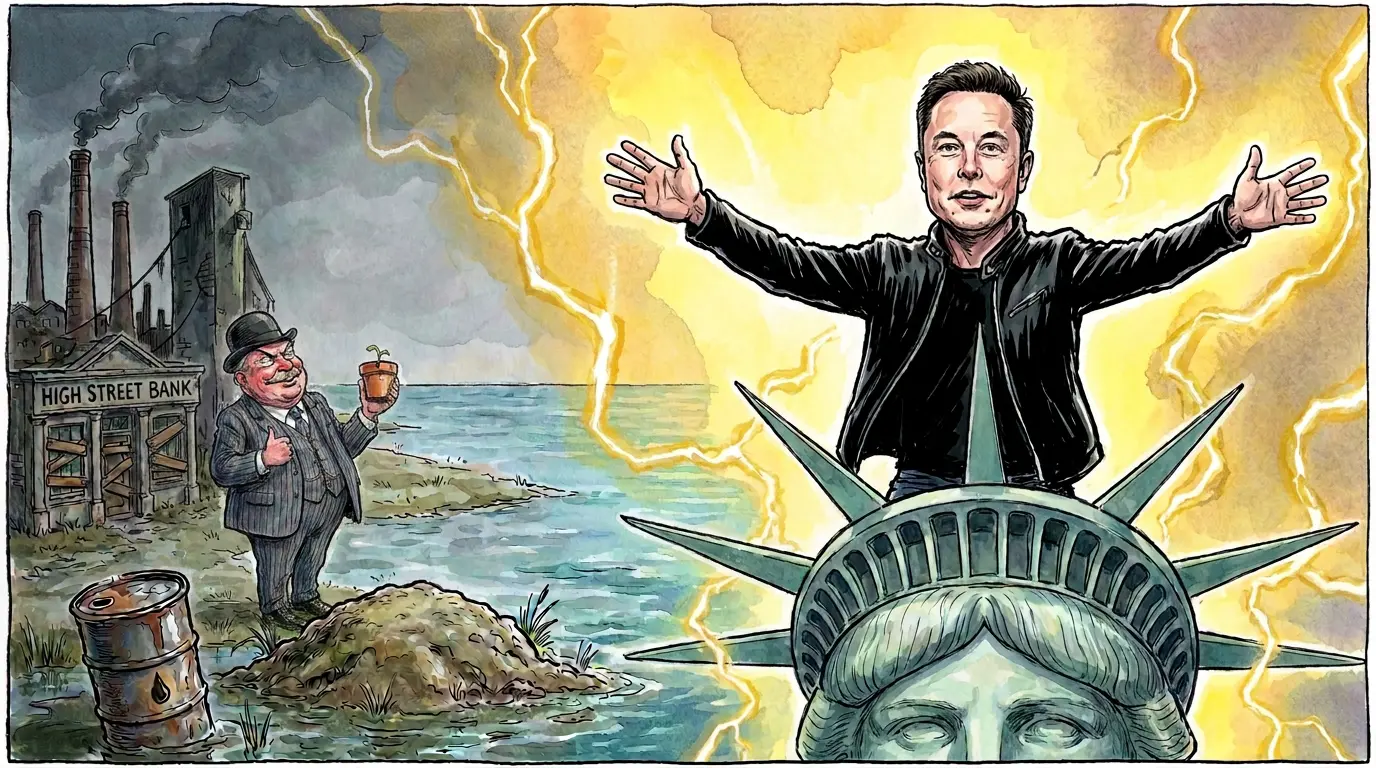
How Britain is a powerhouse of growth in Europe…
How we’re outpacing our neighbours.
Well, there are a few caveats to that.
One is that growth in respect to GDP is like beauty… it’s in the eye of the beholder.
Because what most politicians (or government stats offices) don’t do is live in the real world.
Consumer prices rose 2.6% in the year to June. Unemployment sits at 4.9%, and youth unemployment is 16.4%, the highest in 11 years.
Then there’s productivity.
I think that productivity is really the most important aspect of a country’s growth prospects.
Low productivity = garbage economy.
High productivity = an economy firing on all cylinders.
Output per hour in the first quarter was 0.4% higher than a year earlier, and 2.6% above where it stood at the end of 2019.
Six and a half years, for a 2.6% increase in productivity?!
That stinks.
And it shows in the non-existent growth figures.
Britain’s Investment Letter Since 1938
In 1938, The Fleet Street Letter warned its readers that war was coming to Europe — and even identified September as the critical month.
Since then, its readers have been warned ahead of Black Monday, the dotcom crash and the 2008 financial crisis.
Today, Britain’s longest-running investment advisory is still looking for the “news behind the news” — and the investment opportunities others could be missing.
Click here to discover what The Fleet Street Letter sees coming next.
Capital at risk.
What Does Britain’s Oldest Investment Letter See Coming Next?
It warned readers ahead of Black Monday.
The dotcom crash.
And the 2008 financial crisis.
Now, nearly 90 years after it was founded, The Fleet Street Letter is still searching for the “news behind the news” — and the investment opportunities that could emerge from the next major turning point.
Click here to discover what its editors are seeing now.
Capital at risk.
Compute as an asset class
Also, let’s not forget that these statistics are being measured from a low base. Growth quarter-on-quarter can look positive if it’s coming off a negative previous number.
And if you wind back the last few years, the UK has barely been able to scratch out 1% growth. And for productivity it’s miles behind its neighbour across the Atlantic.
Dire situation?
Well, yes, a little.
There is an opportunity to grow, and grow fast. And we can see what that looks like by casting an eye across the Atlantic.
But it appears the policymakers aren’t all that interested in it.
Also, the question you might have is, where is the growth supposed to come from?
If you look at the FTSE 100, you probably think all is well.
But that’s a sleight of hand because what’s pushing the FTSE higher are the old-school flavours of miners, banks, oil, and pharma.
And a higher FTSE by no means equals economic growth.
Oil is consolidating into the giants and does well when oil prices rise (thanks for that, Iran).
Miners are benefiting from consolidation and cost-cutting measures.
Banks do better when rates are higher.
And pharma loves price inflation.
But are these the engines of economic growth and prosperity?
I’ll tell you where growth comes from and how it happens.
It’s investment in technologies that allow industry to improve, operate more efficiently and become more profitable.
Right now, that comes through investment in AI and the AI infrastructure buildout.
|
Take a look at what Jensen Huang just announced in the US.
Nvidia (Nasdaq: NVDA) is partnering with Apollo, BlackRock, Blackstone, Brookfield, Goldman Sachs, and KKR to build financing platforms and instruments to unlock more than US$500 billion of capital.
In a CNBC interview with all the CEOs from those companies, it was noted that there’s around US$9 trillion in US money market funds, and more than US$100 trillion in US equities. There’s a lot of capital out there, and a lot of capital that’s looking for the best way to deploy into growth opportunities.
Also worth noting is that not one of those six that have come together to fund the AI buildout is British.
What Huang and these giants of finance are doing is changing the idea of what “compute” is.
Traditionally, a giant shed full of GPUs, CPUs, memory, and server racks would have been treated as capital equipment. Companies would depreciate this equipment over time, its usable lifespan would shorten, and then it would all end up as scrap.
Nvidia is arguing that compute behaves more like a toll road instead.
It earns money, serves many customers, gets better with each software release, and can be handed to a new tenant when one walks away.
Add to this the fact that the lifespan of this equipment may actually be far longer than current depreciation schedules suggest.
This was clear in the CoreWeave (Nasdaq: CRWV) earnings call that dropped last night. CoreWeave’s CFO said, “we recently signed an A100 contract that extends into 2029 at an attractive price. As a reminder, this SKU was introduced in 2020.”
That’s nine years for what are effectively now “ancient” GPUs. And it’s reasonable to think their useful lives could be extended even further. If A100s are approaching a decade-long lifespan, then imagine how long the subsequent H100s and B200s could last.
Further to this, one-year H100 pricing went from about US$1.70 per GPU-hour in October 2025 to around US$2.35 by March 2026, and Blackwell B200 capacity fetches US$5.30 to US$7.05.
Package that up into financial instruments, like a mortgage-backed securities (MBS), and a pension fund gets interested because these assets can be financed at infrastructure rates over decades rather than factory equipment as they were once viewed as.
Bear in mind, that includes British pension funds.
So the British saver is funding the AI build out, collecting the yields, so it only makes sense to also own the equity.
Now compare what’s going on there with the UK.
The government has committed £2 billion to expand public compute twentyfold by 2030, plus a £500 million Sovereign AI Unit and five AI Growth Zones.
Single-digit billions of taxpayer money from a Treasury that is more or less broke… versus half a trillion dollars of private capital seated around a CNBC desk ready to financialise the biggest technology change we’ve seen in 50 years.
Where the risk sits
The “bubble” claims sit on the idea that it’s all just circular financing.
Nvidia sells the chips, but also provides the money to the purchaser to buy them. Nvidia books the deal and the revenue, and their financials look glowing.
Furthermore, if the actual demand for AI tokens is nowhere near what is expected, somebody wears the loss. Nvidia is primarily in the firing line, and we get a 2008-style collapse where securitised AI infrastructure debt turns to junk, it all collapses, and there’s systemic risk flooding through not just banks and big money market players, but every one of the giant hyperscalers too.
So you either believe the demand and the payoff on all this will materialise, or even exceed forecasts.
Or you think that people aren’t going to use AI at anything like the expected scale, and that demand for tokens and compute is grossly overstated.
I think the demand is there and the depreciation schedules are far too short. I think there’s a comparison to be made with cloud and cloud adoption, but at a scale magnitudes higher.
Remember that time before “cloud” existed? Well, that’s where we are now.
Now imagine the growth that comes if the AI buildout is 10 times bigger than the impact cloud has had on the world.
And to finish with why we continue to look to the US as this happens rather than the UK, take a look at Nscale, a London company backed by Nvidia with a rough US$25 billion valuation.
They’re said to be looking to IPO. Except that’s likely to happen in New York, not London because that’s where the capital lives.
The share of UK companies choosing to list at home fell from 71% in 2019 to 46% in 2025.
So buying British AI means buying dollars on American exchanges. If that’s frustrating, I get it, but you’ve got to go where the money lives.
And right now, that’s in America, and it’s riding the AI wave.
Until next time,

Sam Volkering
Investment Director, Southbank Investment Research
PS If you agree that the biggest growth story is happening across the Atlantic, there’s something else I think you should see. Jim Rickards has identified an opportunity emerging from the enormous amounts of capital now pouring into America. Click here to see what he’s found.