 In today’s Issue:
- No matter how bad things get, we’ve been here before
- If you’re surprised, you didn’t look back far enough
- Time to recalibrate your historical parameters
We’re in uncharted waters, with only past wrecks to guide us. At least, that’s how it feels.
Debt levels are extreme. Not just among governments, but in the private sector too.
And the money isn’t being spent defeating Nazis or building bridges. It’s being transferred to people who rely on the flood continuing.
Black markets and the underground economy are booming. Taxes and regulation have destroyed the legitimate economy.
Demographics have turned down… and kept on falling.
Deindustrialisation is almost complete.
The electricity system is failing as electrification sputters.
Governments are turning on legal immigration while illegal immigration is blooming.
New political parties promising radical change are on the cusp of creating hung parliaments around the world.
South America is turning capitalist.
Socialists are winning in the US.
AI could trump the lot of us.
And, most astonishing of all, the Australian housing bubble has finally popped.
It all looks very discombobulating. Because it all feels so new. As though it hasn’t happened before.
But has it?
Dust off ye old newsletters
Back in 2015, I moved back to Europe because it had become a rather interesting place. I also joined Southbank Investment Research.
British investors needed help in anticipation of Brexit, a continuing European Sovereign Debt Crisis, and net zero.
After signing on, I was sent on a pair of bizarre journeys. One involved visiting 30 countries and about 40 cities in just three months.
The other required me to dig through dusty old newsletters in the basement of the British Library in St Pancras each day for another three months.
My task was to collate a “best of” compendium of The Fleet Street Letter – the UK’s oldest financial newsletter. We were going to relaunch it.
The Fleet Street Letter has an extraordinary past. Its editors had included a Soviet spy, the editor of the Financial Times, and worse. They’d predicted the month World War II would start, warned about the crashes of 1987 and 2008, and anticipated the rise of Margaret Thatcher from early on.
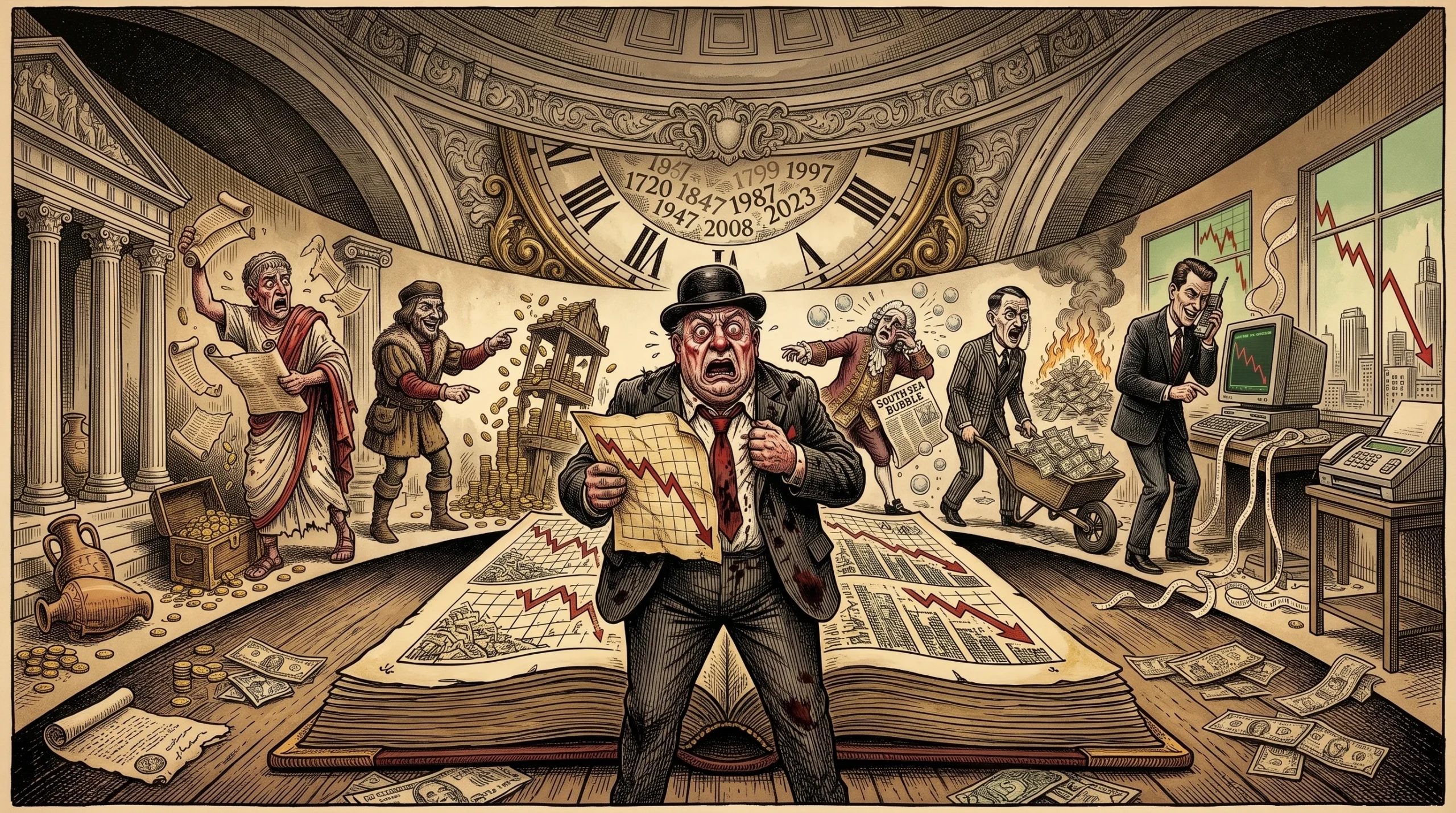
But, reading through more than 80 years of fortnightly newsletters each day made me realise something else. History doesn’t just rhyme. It practically repeats.
The real challenge is to be properly aware of enough history to get a feel for what is about to happen. You just need to go back far enough and look beyond your own shores.
This was a serious epiphany for someone who described history as “just a load of stuff that already happened” at school.
It also explains why history is experiencing such a boom on YouTube and podcasts. People don’t care what happened, back then. They want to know what’s going to happen next. And historians seem to do a far better job than the Office for Budget Responsibility, often, without even trying.
Anyway, the investment commentator Luke Gromen recently pointed out the same thing on X:
“While many investors (correctly) say, “It’s never different this time”, most investors do not look back far enough in time. History did not start in 1980 or 1945.”
Gromen’s comment was made about a quote from circa 1910. Back then, the same insight was already true. Someone pointed out that the Chinese had preceded Europe’s inflationary boom and bust cycle by a generation thanks to their own experiments with paper money.
Yes, even that folly is old enough to have repeated several times already. The Germans just did an even better job of it in the 1920s.
Gromen was describing a form of “recency bias” – the human flaw to presume the future will look like the recent past instead of the long-term historical record.
|
You have already voted in this poll. Long before the 2008 financial crisis, which country suffered a banking crash after years of easy credit, soaring property prices and reckless lending?
|
Lots of investment analysts claim to look at history. I only know of one who really goes back far enough and has made that his point of difference as an investment strategy – Russell Napier.
The point is that the flaws in human nature, when it comes to economics, are universal and repetitive. Look back far enough, and wide enough around the world, and you will find a surprisingly accurate version of today’s events.
To be honest, it also makes today’s follies all the more entertaining. You know how things will go wrong, so your schadenfreude can begin before they do.
It’s comforting to know that the likes of Andy Burnham and Ed Miliband will be humiliated in the end.
Of course, it’s not always funny. I mean, who could’ve seen a pandemic coming, given how many times they’ve happened throughout history?
Lately, the culture wars are resembling the purges that happen both left- and right-wing cultural revolutions. Those end very badly.
Attempts to control the weather by making sacrifices in living standards are as old as civilisation too. When you’re trying to save the planet, there are no limits to what people will do.
Whether it’s funny or not, it’s all so… familiar.
But what does this mean for investors?
Britain’s Investment Letter Since 1938
In 1938, The Fleet Street Letter warned its readers that war was coming to Europe — and even identified September as the critical month.
Since then, its readers have been warned ahead of Black Monday, the dotcom crash and the 2008 financial crisis.
Today, Britain’s longest-running investment advisory is still looking for the “news behind the news” — and the investment opportunities others could be missing.
Click here to discover what The Fleet Street Letter sees coming next.
Capital at risk.
What Does Britain’s Oldest Investment Letter See Coming Next?
It warned readers ahead of Black Monday.
The dotcom crash.
And the 2008 financial crisis.
Now, nearly 90 years after it was founded, The Fleet Street Letter is still searching for the “news behind the news” — and the investment opportunities that could emerge from the next major turning point.
Click here to discover what its editors are seeing now.
Capital at risk.
Nothing should surprise you anymore
If stocks plunge 50% or skyrocket 100% in the coming 12 months, that shouldn’t come as a surprise. It’s practically tradition.
You need to be able to handle it. Because it has happened enough times in the past to make it a credible possibility.
Living your life as though it’s impossible is the real risk.
The same goes for radical changes in politics and taxation. New parties do pop up, eventually. People are outraged by tax reform, as though it was ever unlikely to occur.
And for those demanding political change, be careful what you wish for. Upstart political parties don’t necessarily deliver what you expect, let alone what you want. History says the law of unintended consequences is the only one that works.
The presumption that the future will look like the recent past should be deliberately discarded, not unwittingly embraced.
The 2008 crisis was largely caused by such historical blindness. The “value at risk models” that controlled investment bank balance sheets were based on the volatility of financial markets in recent times. The models didn’t look back far enough to examine periods of higher volatility.
In fact, that stability became self-enforcing. The lower volatility fell, the lower it was presumed to be by the risk models. But that lower volatility allowed investment banks to take on even bigger positions because they were perceived to be less risky.
Yet the idea of “the calm before the storm” has existed for… well, who knows how long. But certainly a lot longer than investment banking.
That’s why…
Getting your historical parameters right is the key to investment success
And that’s what Sam Volkering has been up to. He calls it Hyperion.
Hyperion uses AI to analyse how financial markets have behaved in the past and rank stocks based on their potential to outperform or underperform in the future.
If you have a portfolio, you need to see his work.
In the meantime, it’s time to dust off some old history books. The dustier they are, the more useful they might prove in the years ahead.
The past wrecks that guide us are the map now.
Until next time,

Nick Hubble
Editor, The Fleet Street Letter
PS One final thing. As I’ve said, Sam’s Hyperion is built around exactly the problem I’ve been talking about today: using far more historical market data than any human could reasonably process to identify stocks showing the potential to outperform.
But if you want access, the deadline is midnight tonight (GMT). After that, the current opportunity to join Hyperion closes.
If you’ve been considering it, don’t leave it until tomorrow. Take a look at Sam’s work and Hyperion before the deadline expires tonight.