|
Associate Publisher’s Note Today, Bill writes about the decline of American dominance. For Britain, the consequences could be particularly important. For decades, the UK has operated inside a global order built largely around American military, financial, and economic power. The dollar sits at the centre of the international financial system, while the US remains Britain’s most important defence and security ally. So, if Bill is right that the world is becoming increasingly multipolar, Britain won’t simply be watching that transition from the sidelines. We’ll have to navigate it. That could mean a Europe forced to take greater responsibility for its own defence, a global financial system less completely dominated by the dollar, and emerging powers exercising considerably more influence over the rules of global trade and investment. In other words, the map Bill describes below may be changing in more ways than one. And Britain has to find its place on it. – Elizabeth Cox |
 Credit: Getty Images
The UN just voted to make Africa bigger. The Guardian:
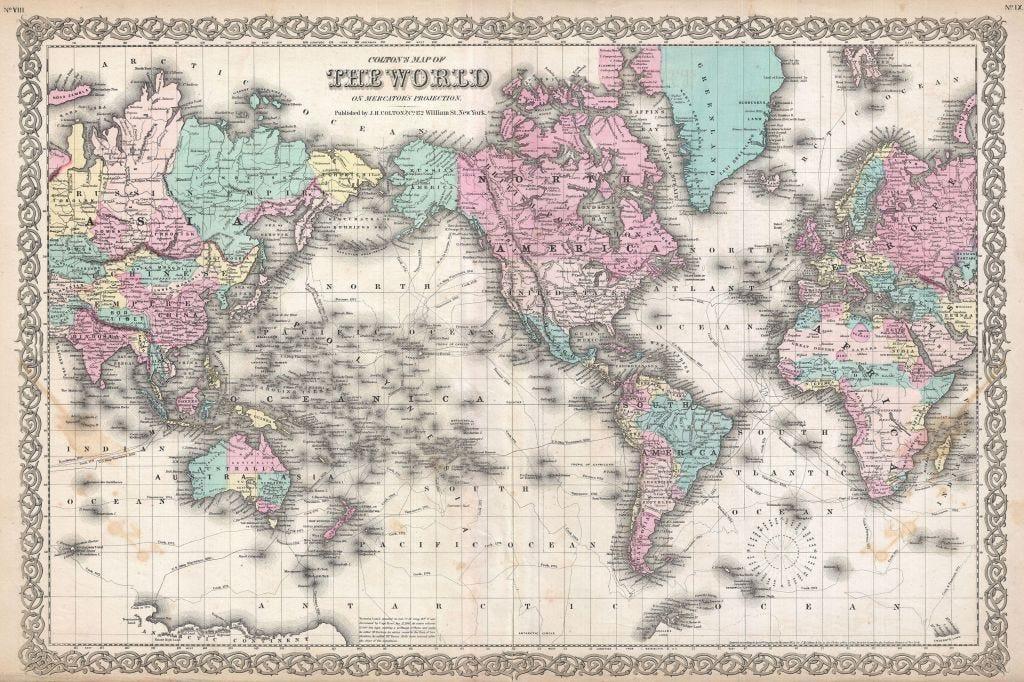
The United Nations has voted to adopt a resolution for the world to formally phase out the traditional Mercator map of the globe in favour of one that more accurately displays Africa’s size.
At the session, 164 countries voted in favour of the resolution. Only the US voted no, with its representative saying the resolution was “superfluous.” There were six abstentions.
The Mercator world map took the round globe and showed it in two dimensions. It did so by holding fast to the size of the landmass near the equator but stretching out Canada, Greenland and Russia to make them appear much bigger. Sailors understood the trick; they relied on it to get to Bermuda rather than Boston.
The new map is more “realistic.”
Greenland no longer pretends to be the same size as Africa. But the world is not infinitely big. So, if Africa is larger, the rest of the world must be relatively smaller.
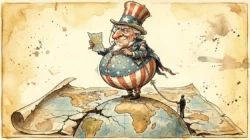
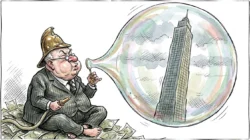
Even the US, comfortably seated between the hot tamales and the Canook’s maple syrup, must be somewhat diminished. That, by our reckoning, is the most significant geopolitical trend of our time — the deflation of the Bubble Empire.
Historians are always looking for hinges — pivot points, where trends change and doors open. Helena Cobban thought she heard the squeak of a hinge point last week, coming from Bishkek, Kyrgyzstan…
Iranian Pres. Masoud Pezeshkian was conferring with the presidents of China, Russia, and India, and the heads of state and government of six other Asian states, at the 25th anniversary meeting of the Shanghai Cooperation Organisation (SCO.)
While the US was trying to preserve an old world, with an outsized USA, a huge, new world was being born on the other side of the planet. Tout le monde was there. The heads of state of the largest countries on Earth, covering the Eastern European steppes to the Sea of Japan, and from the Arctic down to Ceylon.
What were they up to? Pres. Xi:
Hegemonism, unilateralism and protectionism are resurging against historical trends. Nevertheless, the overwhelming majority of the world do not condone power politics, conflict and confrontation, or isolation and backwardness. What they want instead is to hold a place on the world stage through national development and international cooperation. In recent years, the rise of the Global South is driving a profound shift in the international balance of power. The trend toward a multipolar world is irreversible…
This was another way of saying that America’s days as the world’s only big shot are over. This SCO group represents far more people and a much greater landmass than the US and NATO.
Britain’s Investment Letter Since 1938
In 1938, The Fleet Street Letter warned its readers that war was coming to Europe — and even identified September as the critical month.
Since then, its readers have been warned ahead of Black Monday, the dotcom crash and the 2008 financial crisis.
Today, Britain’s longest-running investment advisory is still looking for the “news behind the news” — and the investment opportunities others could be missing.
Click here to discover what The Fleet Street Letter sees coming next.
Capital at risk.
What Does Britain’s Oldest Investment Letter See Coming Next?
It warned readers ahead of Black Monday.
The dotcom crash.
And the 2008 financial crisis.
Now, nearly 90 years after it was founded, The Fleet Street Letter is still searching for the “news behind the news” — and the investment opportunities that could emerge from the next major turning point.
Click here to discover what its editors are seeing now.
Capital at risk.
Good?
Bad?
Who knows? But the map changes… and the shrinking of the Bubble Empire continues. London Daily:
After 108 Years: Moody’s Downgrades U.S. Credit Rating
Moody’s has downgraded the United States’ credit rating from the highest level (AAA) to one notch below, Aa1. The reasons cited for the downgrade include weak fiscal management in Washington, massive deficits, and a sharp rise in interest payments on the national debt, which has reached approximately $36 trillion. For the first time in history, the United States no longer holds the highest credit rating from all three major agencies, after Fitch and S&P also issued downgrades in the past.
People have been warning about the decline of the US ever since John Hancock signed the Declaration of Independence. These “declinists” have been so wrong for so long that many historians snarl or chuckle when they appear in public.
Charles Krauthammer once commented on the “decline,” writing that if Rome had gone down at this rate, “you’d be reading this column in Latin.” But Krauthammer supported the war against Iraq — perhaps the loudest hinge in the whole raspy orchestra. Then, he died in 2018… before the sounds of decline had become deafening.
No other country ever garrisoned so much of the globe as the US, with 750 overseas bases. No other country ever spent so much on military force, either… with a budget currently over US$1 trillion… and set to rise to US$1.5 trillion next year. No other country dominated the world financially and economically as did the post-WWII US. And no other country ever exported so much of its own dream — movies, books, ideas, language, fashion… you name it.
|
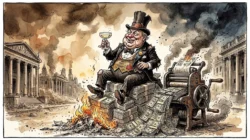
The empire was built by (mostly) honest trade, investment, and hard work. Then it was extended and exaggerated — on bubble credit… from fake dollars lent out at fake rates. After the introduction of the fake dollar in 1971, the bubble expanded while practically all of the measures of a free and prosperous society turned down.
America’s Golden Age may already be past tense. The bubble is losing air. American military power can’t plug the leaks. It can bomb and kill. But it can’t make the foreigners bend to its will.
Its forward bases… and giant WWII-era aircraft carriers… have become liabilities — targets for local bomb throwers. The empire becomes less creditworthy… and rivals get together in places we’ve never heard of to plot against us.
Even the map betrays us.
Regards,

Bill Bonner
Editor’s Post Script… The world rarely announces that it’s changing. Usually, the clues appear first – in markets, technology, and the companies quietly positioning themselves for what comes next. James Altucher believes he’s found one of those clues inside Apple’s supply chain: a tiny US$762 million company that could be involved in its next major hardware launch. See why he thinks investors should pay attention before Apple takes the stage tomorrow.