 In today’s Issue:
- What Rachel Reeves should’ve said in her budget speech
- Germany’s one-man economic coup
- One country is making the right reforms – time to invest
Budget chaos continues to engulf the UK. Not that we’re the only ones. Indeed, the world’s governments have a habit of getting themselves into trouble periodically.
But they usually have a decent excuse. A war that unifies the nation. A financial panic caused by greedy bankers needing a bailout. Quantitative Tightening by the central bank. Liability Driven Investments at pension funds. Or a pandemic that needs welfare spending.
Today, the UK’s budget chaos is caused by…well, I’m not entirely sure, to be honest. Nothing notable has happened in recent months. Just some updates to economic forecasts…
Can civil servants’ number crunching really cause this much trouble?
Actually, it can…
Echoes from OBRs past
In 1984, the German economy was in ruins. My German grandmother used to eat the entire apple, core and all, because of it. 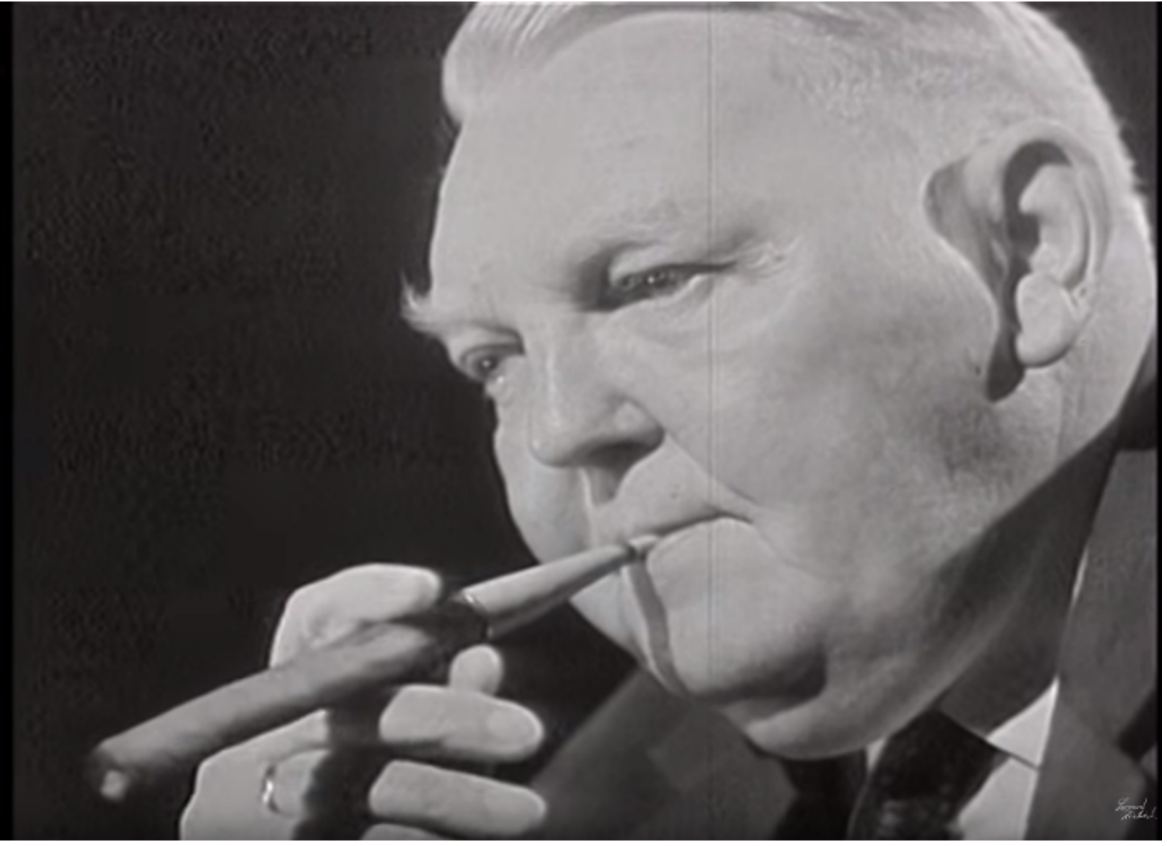
Reichsmark banknotes were worthless. People survived thanks to the black market. American cigarettes were the currency for small transactions. Cognac for large transactions. Nylon stockings for in between.
The Allied occupation government was led by military governor General Lucius Clay. You can think of him as the head of the German Office for Budget Responsibility back then.
In November 1945, Clay had agreed to keep Hitler’s price controls and rationing in place. He also continued the Nazi conscription of resources, including labour. It was the ultimate centrally planned economy. The British representatives in Germany supported this position. And even implemented much of the same policy back home.
But not everyone agreed. Especially not a certain…
Mr Fatty Wirtschaftswunder
Economist Ludwig Erhard had refused to join the Nazi Association of University Teachers during the war – a career ending move. He then published a manuscript advocating a free market economy in 1942. His co-author was interned by the Nazis for it.
But Erhard didn’t just talk the free-market talk. He walked the walk.
After the war, the Allies became aware of his manuscript and its anti-Nazi nature. And so they “asked” him to become their economic adviser for Bavaria. He soon became Bavarian Finance Minister and the head of the Office of Economic Opportunity. His anti-Nazi credentials made him popular with the Allied elite, compared to other German leaders with questionable wartime backgrounds.
As part of the Office of Economic Opportunity, Erhard became a close advisor to General Clay. He eventually convinced the General to undergo currency reform. They created the Deutschmark, replacing the Reichsmark, against the wishes of the SPD and many of the Allies’ economic advisors.
As part of the reforms, the currency supply contracted by approximately 93% — enough to make modern economists pass out in terror at the prospect alone.
But Erhard wasn’t finished. What he did next is shocking and legendary in Germany. And it explains precisely what our Chancellor should’ve done.
Germany’s one-man economic coup
Here’s how Erhard recalled what he did, in a TV interview 25 years later, as translated by me:
I knew exactly what the currency reform would bring. Also its consequences. But it could only work if we simultaneously enacted a decisive economic reform, from a completely centrally planned economy to one as free as possible.
But that had, because of its very nature, to include abolishing all rationing, price controls, economic controls and more. But the perception of this was, in people’s heads at that time, so unthinkable that it was only possible with a brave breakthrough.
Economic policy and bravery rarely go together. But Ludwig Erhard was special:
The Frankfurt Economic Council gave me a series of broad executive powers in the expectation that we didn’t know exactly what the currency reform would bring and, in the case of chaos, someone would have to react quickly.
At the time, as the director for policy in the economy, I had secretly and quietly in my desk drawers accumulated the documents needed to repeal all price controls by simple decree.
I scattered all the inclinations and suspicions of my staff as to whether I would ever use them. They said, “For God’s sake, you’re not actually considering doing it, are you?” And I told them, “No, no, it’s just in case…”
And of course I could never have told the [Allied] military bureaucracy. They would’ve had even less understanding for my plans, and I would’ve had even less influence with them.
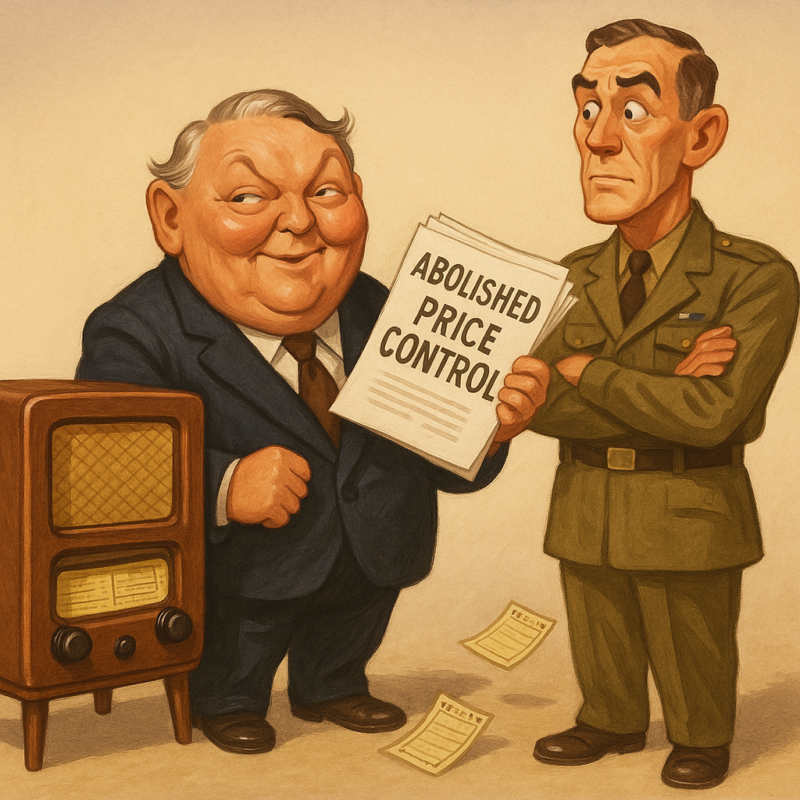
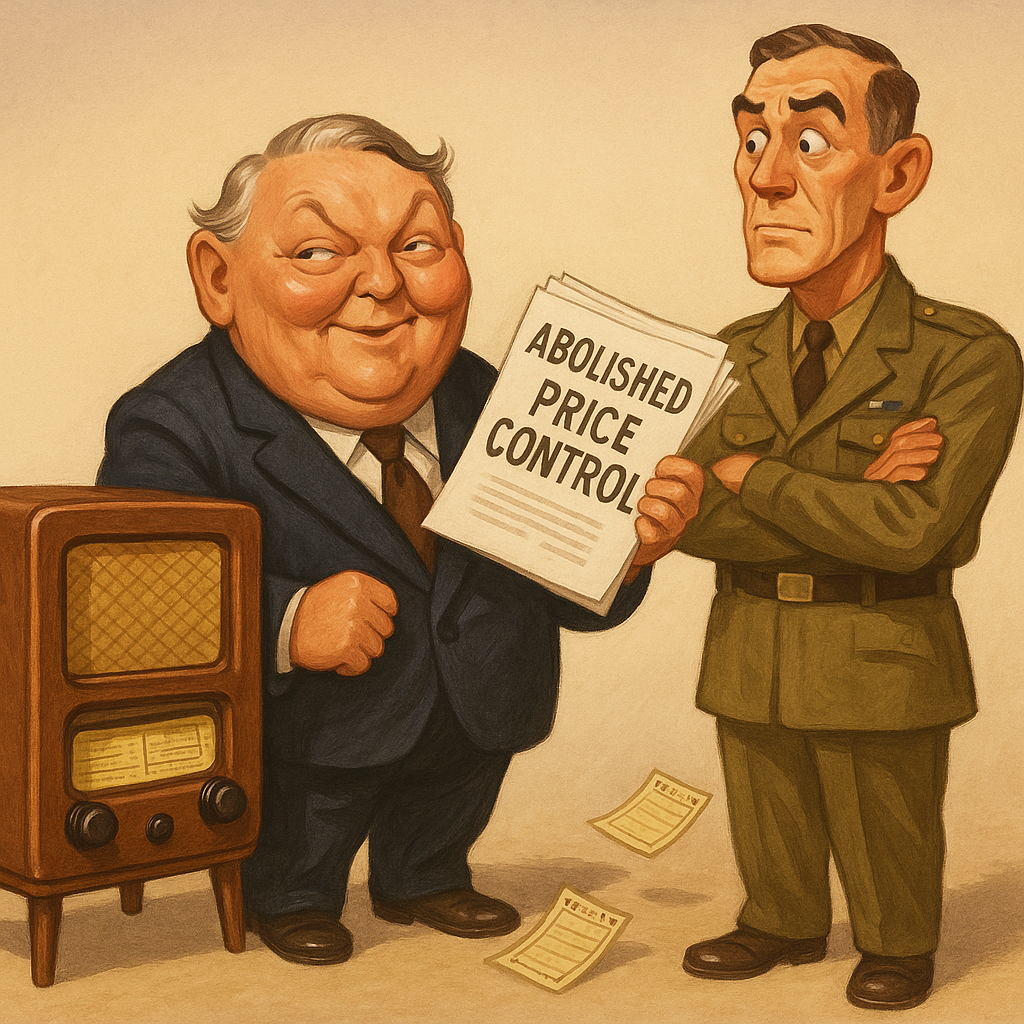
And then, on the Sunday of the currency reform, I announced it all [on the radio], in the correct assumption that, on a Sunday, no government bureaucrats are capable of work. And thereby it was done.
Erhard’s surprise radio announcement abolished the Nazi and Allied military government price controls and many other economic regulations. It was a shock move. He had no legal authority to do so. He just hopped on the radio and did it, of his own volition, in complete violation of the Allied military government in Germany.
It’s as if the head of the Resolution Foundation were to abolish the minimum wage on Twitter.
Free markets forbidden
Making his move on a Sunday bought Erhard some time. But not much, he explained in the interview…
The next Monday, at an early hour, I was brought before the military government. I was told that what I had done was impossible and unimaginable. That it was forbidden and all of it would have to be reimposed. That I had broken all sorts of Allied military laws.
When I asked which laws I had broken, “I’d like to hear them precisely”, they read to me that, without consent from the military government, no changes to price controls could be made.
And I replied, “but I didn’t change them, I abolished them.”
That was obviously not the answer they expected…
But I had, thank God, one man who stood by me. And he was the most powerful – it was General Lucius Clay. He helped me over this short period and put himself on my side.
But General Clay took some convincing when it came to Erhard’s economic policy coup.
What Rachel Reeves should’ve said
Journalist Edwin Hartrich described what General Clay asked his friend Ludwig Erhard that day:
“Herr Erhard, my advisers tell me what you have done is a terrible mistake. What do you say to that?”
“Herr General, pay no attention to them! My advisers tell me the same thing.”
Erhard’s point was that it was precisely the experts who centrally planned the German economy into a mess who were also against the free market reforms…
The journalist Hartrich also wrote about how a US Army colonel followed up later with another stinging rebuke:
“How dare you relax our rationing system, when there is a widespread food shortage?”
“But, Herr Oberst. I have not relaxed rationing; I have abolished it! Henceforth, the only rationing ticket the people will need will be the Deutschemark. And they will work hard to get these Deutschemarks, just wait and see.”
Do the warnings about food shortages sound familiar? But don’t get distracted by the Brexit parallels.
What happened next earned Erhard the nickname Herr Wirtschaftswunder – Mr Economic Miracle. His other nickname was “der Dicke”, meaning “the Fatty”. Which is why I call him Mr Fatty Wirtschaftswunder.
After Erhard’s reforms, the German economy…well his nickname gives it away.
The German Economic Miracle
Supposedly, Erhard’s timing was key. By the time the Allies got around to discussing how to reverse the liberalisation of the economy from economic controls, the effects were simply too strong to ignore.
Shops literally filled overnight as the black market came clean. The new money was worth enough to actually sell things for, instead of having to barter, which made transactions more efficient. And the market prices allowed supply and demand to balance. Profit became possible, encouraging production too.
“The spirit of the country changed overnight,” wrote author and historian Henry Wallich. “The gray, hungry, dead-looking figures wandering about the streets in their everlasting search for food came to life.”
Of course, abolishing price controls and currency reform were just the beginning. An economist at the Federal Reserve Bank of New York wrote that between June and August, “directive followed directive removing price, allocation, and rationing regulations.”
Erhard freed all the staples of life and manufactured goods from absurd EU like controls. Maximum prices on other goods were raised and, my personal favourite, a lot of the remaining controls were simply no longer enforced.
Erhard’s motto could have been, “Don’t just sit there; undo something,” wrote David R. Henderson, author of German Economic “Miracle“.
In three months, absenteeism at work halved from as high as nine and a half hours per week – time Germans had spent foraging or looking for the right person to barter with.
Industrial production increased by more than 50%. Ten years later it had quadrupled and was three times as high on a per capita basis. A productivity and employment boom, in other words.
Six million new jobs.
Wouldn’t Rachel Reeves like all that?
Why my English grandparents said Germany won the war
West Germany’s economic boom took place while East Germany’s economy stagnated. In fact, it didn’t take long for Germany’s economy to pass Britain by too. My English grandparents always said Germany won the war, in that sense. But they didn’t eat my apple cores. And I doubt they figured out why the Germans got ahead given it took the UK another 30 years to wake up.
Being like Germany wasn’t a winning political strategy in Britain (yet), so Britain’s much more interventionist governments continued to ruin their economy with central planning. The free market fell out of fashion, even as it proved itself in West Germany.
It took a long time for Britain to discover Erhard’s intellectual inspiration, FA Hayek. In fact, the Allies banned his book The Road to Serfdom in Germany. But eventually Thatcher carried around one of Hayek’s books too.
But those lessons have since been long forgotten. Today’s Office for Budget Responsibility is more like the British officials running the German economy in 1948.
The good news is that some countries are already waking up to what they need to do. And it’s creating an extraordinary set of investment opportunities.
What if you could’ve invested in Germany’s economic miracle after Erhard’s announcements? When every economist was busy telling you it would be a disaster?
You probably missed the opportunity in Argentina, where Milei’s similar reforms are causing a similar boom.
But another chance is unfolding right now in a country being just as harshly criticised as Ludwig Erhard was in 1948.
Until next time,

Nick Hubble
Editor at Large