In today’s issue:
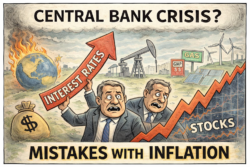
- How can you have a financial crisis when the central bank will print money?
- What central bankers will get wrong this time
- Demand destruction or a proper deflationary crisis?
Financial crises can only occur if central bankers make a mistake. After all, they can print money and lend infinite amounts.
The 2008 crisis only descended into a complete debacle because central bankers let Lehman Brothers fail. Once they realised their mistake, they vowed never to make it again.
The rolling European Sovereign Debt Crisis that followed was only a struggle because the European Central Bank wanted to pressure governments into austerity. Bailouts came with conditions — but they did come.
Meanwhile, countless crises were averted by central bankers’ largesse over the years. Even the pandemic and lockdowns did not trigger a full-scale financial panic.The banks didn’t go bust, for example.
It’s easy to conclude that another crisis is unlikely. But while central bankers may be all powerful… they are not very clever.
The risk of another terrible mistake
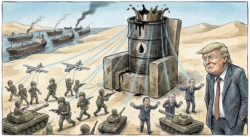
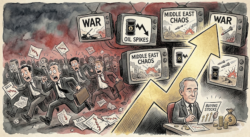
Central banks are panicking about inflation right now. They see energy prices spiking, which must eventually make its way to consumer prices.
Rising consumer prices is practically the definition of inflation. And it’s a central bankers’ job to keep a lid on inflation.
They have a hammer: interest rates. And the inflationary oil and gas crisis looks like a nail.
What do you think is going to happen?
That’s right. Central banks will hike interest rates on an economy struggling with a rising cost of living, debt, energy, and all the other things that make the world go around.
It will only make the problem worse.
As rates rise, oil companies face higher funding costs. People with a mortgage will have even less disposable income. Governments trying to put out fires will borrow at higher rates, saddling the taxpayer with higher interest debt.
The ultimate and painful irony?
Inflation from an oil shock really is transitory
Do you remember “inflation is transitory?”
That’s what central bankers told us during the pandemic, until they were proven wrong and had to catch up with rate hikes at a record pace.
But an oil crisis causes a one-off jump in prices, not an inflationary spiral.
It truly is transitory.
This isn’t inflation caused by exuberance. People are not earning too much, borrowing too much, or buying too much.
During an oil crisis, unemployment tends to rise with inflation, so you can’t claim low unemployment as the cause.
Our coming inflationary spike will be about rising costs. Raising interest rates does not address cost-push inflation — and may make it worse.
After all, interest is just another one of those costs. It’s not a policy lever to bring down inflation during an oil price shock. It will add to inflation.
Of course, higher rates can be good for investors. I’m even tempted by 5% rates on government bonds. The highest since 2008 – hint, hint.
But what the bond market gives, the equity market is likely to take away. Stocks are worth far less when bond yields are this enticing. The same applies to gold and silver, which can’t compete with 5% yields.
Higher rates could see stock markets broadly derated to lower levels as investors sell stocks and rotate into bonds.
But I’m worried about something worse.
Demand destruction or a full-blown financial crisis?
The optimistic scenario is hardly promising. Higher interest rates combined with higher costs will eventually crush our living standards, jobs, corporate investments, and borrowing. These are the components of GDP.
So we can add falling profits to the stock market’s woes.
Even the oil and gas sector will see what’s known as “demand destruction.” People buy less at higher prices, which means less oil and gas demand too.
But it’s the threat of a financial crisis that I’m most worried about.
Hiking interest rates is a classic trigger for financial crises, especially when those rate hikes come thick and fast.
That tends to occur when the inflation is caused by a surprise, like Covid and the current oil shock, or when central bankers are “behind the curve.”
In the run-up to the 2008 crisis, central banks around the world were slow to realise they had an inflation problem. That’s because most of the inflation showed up in house prices, where most government inflation statistics carefully ignore it.
Housing bubbles in Europe and the US made us look genuinely wealthy. In reality, it was just inflation. When other prices began to catch up, because the price of land eventually pushed up other costs, central bankers were exposed as being too slow to tighten.
Their attempt to catch up was what triggered the 2008 crisis. Quick rate hikes broke the US mortgage market, which broke the US housing market, and the rest is history.
The German Bundesbank is so famous because it erred on the side of being too quick to nip inflation in the bud. It had a reputation for being clever enough to be confident in pre-emptive strikes on inflation. There were no housing bubbles under the Deutschmark. But there were under the euro.
How will central bankers get it wrong this time?
Today, we face a bizarre mix of the two scenarios. Central bankers are panicking that they might be behind the curve on inflation. But we face a short-term shock too.
My worry is that they’ll be overzealous to “fix” the problem. They’ll overtighten to prevent a repeat of 2021’s inflation. They’ll get 2008 instead.
In an environment like this, stock market valuation reverts to utility, meaning usefulness. Coal and coal stocks are soaring because countries can pivot back to using coal. Oil and oil stocks are up because they sell a product we need. Gas and gas stocks are flying because keeping the lights on is a priority.
Are you positioned in the right assets?
Our newest edition to the Southbank Research brainstrust – resources expert Matt Badiali – knows which assets you should be investing in right now. Think “real wealth.” Things that generate their value from unambiguous utility. A utility that doesn’t evaporate when market sentiment shifts.
Until next time,

Nick Hubble
Editor at Large, Investor’s Daily
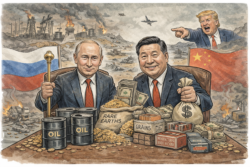
PS If you take one thing from today, it’s this: control over energy and resources is now shaping everything — markets, policy, and power.
And what comes next won’t play out where everyone’s looking… it’s already being set in motion behind the scenes.