
In today’s Issue:
- Stop ignoring your emotional state
- Irrational decision-making in an irrational market
- The eyebrow indicator that picked every stock market peak
My mum passed away last week after a brief battle with the German healthcare system. She leaves behind all sorts of legacies. One of which is a truly exceptional investment track record. The sort that would make you downright suspicious. How did she do it?
One of my earliest memories is hearing her “debate” about stocks with my grandparents and father. My mum always ended up being right, of course — at least it sounded like it from the safe distance of my bedroom, where I was trying to go to sleep.
As I grew up, I discovered that her returns matched her emphatic overconfidence. My sister was astonished by her net worth as we tried to figure out her affairs. But I’d suspected her hidden genius for a while.
Her various bankers, however, learned about it the hard way. She’d assign them some funds to put to work, then invite them to her kitchen table to report on their returns each year.
It turned into a humiliation ritual for some of Germany’s proudest financial institutions.
My mum would compare her personal portfolio returns to theirs and give them an absolute pasting for their trouble. Few could handle more than one round.
The secret sauce behind my mum’s outperformance is something I want to tell you about today.
But it’s a cautionary tale. Definitely don’t try this at home…
Timing the market versus time in the market
Some investors get wealthy by timing the market. They buy the dips and sell the rips.
Others use a more passive-aggressive approach – buying and holding on for dear life.
My mum was a master of combining the two like no one else.
On the one hand, she was very good at “set and forget.” I don’t think she bought or sold a stock since 2020. And her German-heavy portfolio has thrashed the rest of us as a result.
However, she also had the capacity to be impulsive. You simply wouldn’t believe what she got up to. My childhood babysitter told me some astonishing stories. And the surprises extended to her investment decisions.
I know of several occasions when she perfectly timed the stock market on pure emotional nous. Not just a bit, but with her entire fortune.
She sold the lot before the 2008 financial crisis, for example.
And she bought back in at the bottom in 2009, too.
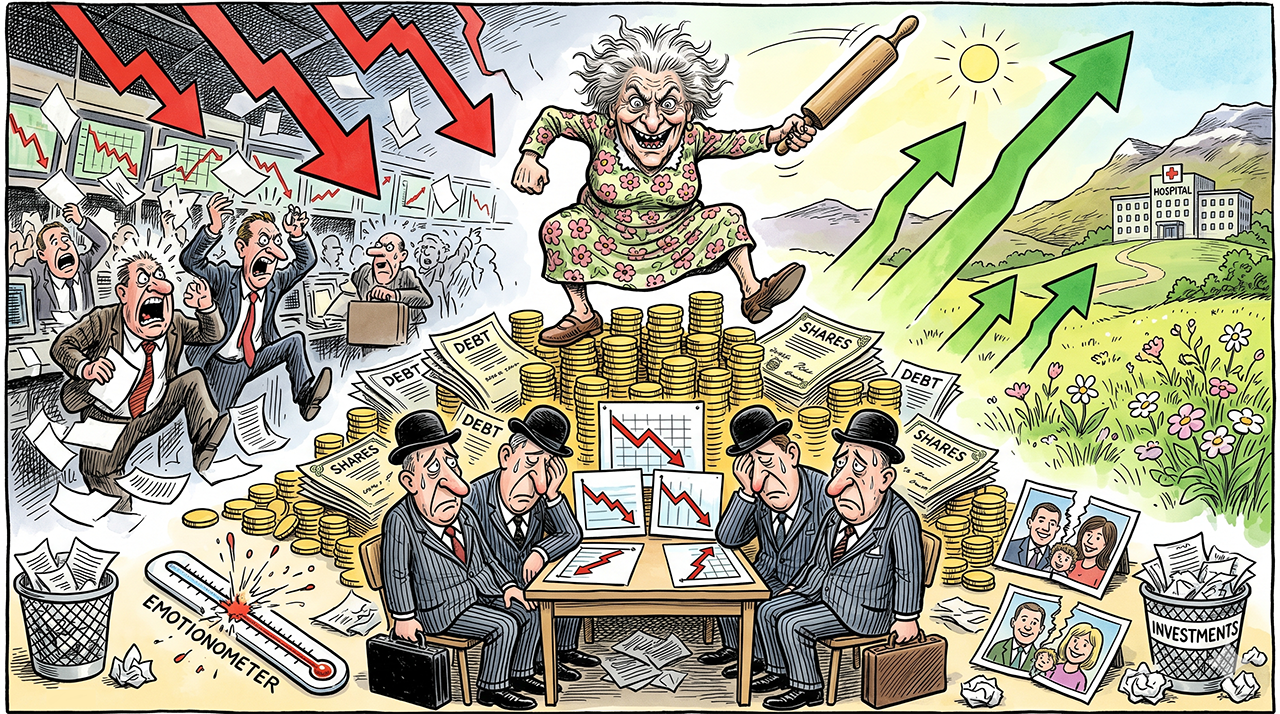
Such moments of genius were triggered by the strangest of investment signals: a serious mental breakdown. The sort that gets you locked up in a hospital in the Scottish highlands.
Irrational decision-making in an irrational market
My parents were the first generation in both their families with significant wealth. And the emotional rollercoaster of fluctuating values got to my mum. Looking back, it may have been what splintered our family 22 years ago.
For most people, large losses trigger panic. They make bad decisions as a result. Like selling after a stock market crash. That’s how they miss the rebound.
But my mum was different. The more her portfolio gained value, the less stable she’d become.
Watching her burgeoning portfolio gain and lose more money each day than her family had ever had would sometimes tip her over the edge. Her eccentric nature would turn into something more dramatic.
Each time the markets hit nosebleed levels, she’d have a meltdown and sell the lot.
While we were busy dealing with the emotional and legal fallout, my sister and I didn’t fully grasp the financial impacts of her panicked investment decisions.
But, looking back, a stock market crash would surely follow within a few months of my mum’s decision to sell everything…
My mum’s mental breakdown would eventually end…
And the bargains on offer would entice her back into the market.
It worked like a charm, compounding wealth at an extraordinary pace. Sadly, at the expense of everything else in her wild life.
What if the market stoics are wrong?
Financial advisors tell their clients to check their emotional baggage at the door of the stock market. The two don’t mix.
But what if this stoicism is throwing the baby out with the bathwater?
What if it discards an incredibly useful tool that can help you invest successfully?
The emotional intensity of the stock market might be an indicator you cannot afford to ignore — just as I should’ve listened more closely to my mum’s fluctuating mental health over the years. It may have been a signal for when to buy, sell, and hold.
You can almost smell the irrational nature of a buying frenzy at the top of a stock market boom. Sometimes, even central bankers know what’s going on.
In 1996, former Federal Reserve Chairman Alan Greenspan warned about “irrational exuberance.” And he would know. In 1999 and 2003, he funded such irrational exuberance with excessively low interest rates, first in the stock market and then in the property market.
The man responsible for inflating the tech and housing bubble was fully aware of the emotional frenzy he created.
It’s not just greed, though. Negative bond yields are an example of excess fear. People were willing to pay money to lend to a safe borrower. It had to reverse violently.
When I first came to Japan in 2020, nobody spoke about the stock market. Too many people had committed suicide over the crash in the 90s. But, looking back, the period of maximum disinterest was the time to buy.
The point is that you should endeavour to be fully aware of the emotional state of investors instead of trying to ignore emotions. That’s because turning points happen when emotions get the better of investors.
When things get as absurd as my mum’s life during a stock market peak, you know it’s a peak. When it’s rude to even mention stocks, you buy.
I wasn’t able to ignore my mother’s emotional state over the years, try as I might. Her increasingly bizarre comments on my articles led us to turn off the comments section on our website…
If we’d kept them, subscribers and I might’ve noticed a correlation between stock market peaks and how eyebrow-raising her comments were.
Speaking of which…
Emotions are a good indicator, but…
My mum’s extraordinary success was driven by her unique emotions. She was driven by fear when her gains got too large. And greed when others were fearful after a crash.
I don’t think it’s realistic for us to try to emulate my mum. And it definitely wouldn’t be healthy.
While it pays to pay attention to the market’s irrational fear and exuberance, we need to live and invest by other rules.
But what rules? Applied to which metrics?
Until next time,

Nick Hubble
Editor, Fleet Street Letter
P.S. Sadly, you’ve missed your chance to profit from my mum’s volatile emotions. I did pitch making her an editor at one point. The good news is that there are plenty of other emotionally driven people out there, setting investment trends. And we all know who the biggest one of all is…
What you might not know is that the investment trend creator that is President Trump has combined with the biggest investment theme out there, AI, to create a confluence that could send one stock soaring.