
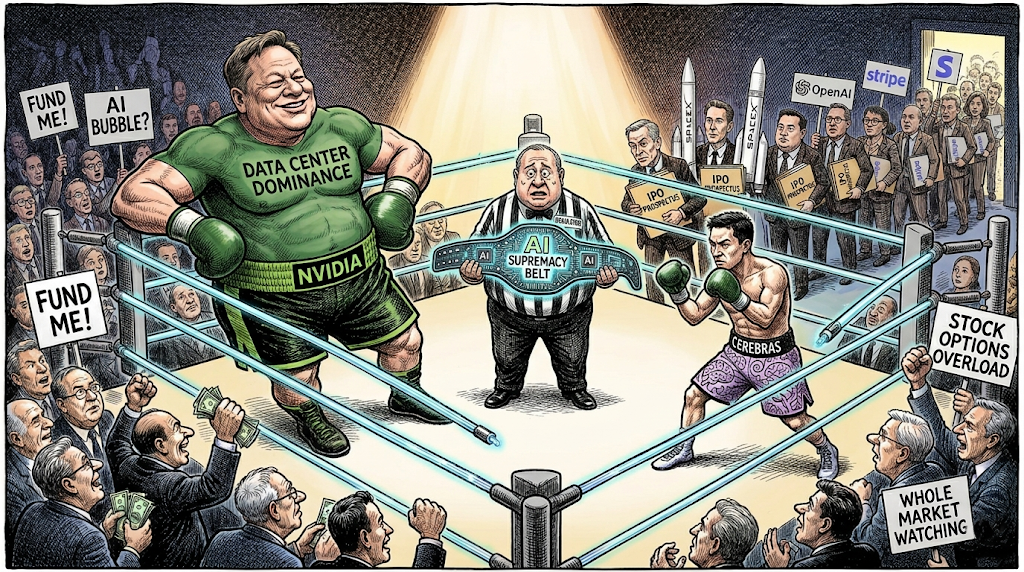
Let me tell you about the moment I hit “buy” on Cerebras.
For a while, I’ve known that we’re heading to a future where AI is as abundant in our lives as electricity.
Not everyone will even realise they’re using AI. It will simply exist everywhere.
Even now, you use it. It’s in the updated Google Maps. It’s coming to a wide rollout of updated Alexa applications for Amazon. Apple is beefing up Siri with it. Even when you do a Google search now, you get an AI response at the top of the page.
Sure, not everyone is going to build apps with it, and it sure as heck is not coming to my (or anyone’s) house to unclog the dunny (Australian-speak for toilet).
But it does probably help my tradie when he’s dictating his quote for me, and pricing things accordingly.
It helps the supply chains that get the plumbing supplies to my local hardware shop.
It helps to conduct the transactions and security checks for my banking to ensure he gets paid as he should.
AI everywhere, whether you like it or not.
But this isn’t a world of yesterday’s or today’s AI.
It’s a world of faster, “smarter” AI — AI driven by speed.
And as I’ve written to you about several times over the last year, the only way you get that kind of speed is with inference.
There aren’t many pure-play hardware companies aiming squarely at the inference hardware market. But in my research, two always stood out: Groq and Cerebras.
I had a view to investing in both using secondary private market platforms. I just had to wait for an opportunity for some stock to hit that secondary market at a price and volume I could afford.
I’m lucky enough that I qualify as a “sophisticated investor,” so I can access these private markets. I know that’s a privilege not everyone gets. But when a chance to grab some Cerebras came up, I had to jump at it.
Unfortunately for me, an opportunity to buy Groq shares never materialised, and then Nvidia bought it up. So that will always be a question of “what if.”
But for Cerebras?
Well, I took a big punt on it, and now it looks like it’s priming for the big time.
Last Friday, the reason I bought became more obvious to the wider market.
Cerebras filed its public S-1… its pathway to an IPO .
The company is heading to the Nasdaq under the ticker CBRS, targeting a mid-May listing at a $22-$25 billion valuation, raising roughly $2 billion led by Morgan Stanley, Citi, Barclays, and UBS.
Already, the secondary market pricing is implying $26-$28 billion, and there’s some suggestion that IPO could reach as high as $35 billion on day one .
So, is this a Nvidia killer?
I think so.
A real business, finally, in the AI chip war
It’s a term that is thrown out a lot: “Nvidia Killer.”
And it is, of course, incredibly hard to consider another company topping the might of the $4.9 trillion tech juggernaut.
But then again, many people once found it just as hard to imagine Nvidia becoming an Intel or IBM killer back in 2013, when Nvidia was a $15 billion company.
I say this because it was in 2013 when I first recommended Nvidia to my subscribers.
I won’t go into detail here as to why, but it was all based around the company’s potential for machine learning and AI. Thirteen years on, it looks like a pretty good call.
My point is this: Today, Cerebras feels to me like Nvidia did in 2013. It’s hard to consider it’s the future of AI, but once you understand how inference works, the company’s position in that market, and the deals it’s making… maybe it’s not so hard to consider that it could be more dominant in another 13 years.
I have more conviction now because last week OpenAI struck a deal with Cerebras.
Reports suggest OpenAI is set to spend up to $20 billion on Cerebras compute power.
Plus, if total spend hits $30 billion, OpenAI gets warrants for up to a 10% stake in Cerebras. OpenAI is also lending about $1 billion to Cerebras to build out the data centres to support it.
CEO Andrew Feldman put it bluntly to the Wall Street Journal, saying Nvidia didn’t want to lose the fast inference business at OpenAI, and Cerebras took it from them .
Cerebras now powers workloads for AWS, IBM, Meta, Mistral AI, Hugging Face, Cognition, and there’s even talk that Oracle is in the mix.
Oracle name-checked Cerebras alongside Nvidia and AMD on its March earnings call .
If you believe, as I do, that inference is what unlocks everything coming next in AI — from real-time agents, humanoid robotics, autonomous vehicles, to on-device reasoning — Cerebras is certainly putting itself in the right position.
This isn’t just a Cerebras story
There are, of course, risks with Cerebras, and many of them I won’t dive into today. Things like customer concentration and whether OpenAI itself proves durable are still something I think everyone worries about.
But what we’re seeing now is the opening of the IPO floodgates. That’s a good sign for where the market could head once the bulls get on a long run.
SpaceX filed for its IPO, which is coming imminently.
The targeted valuation sits at $1.75-$2 trillion. That’s the largest IPO in history by a country mile. A vertically integrated AI, space, and communications juggernaut is certainly something to behold.
Anthropic has hired IPO counsel and is eyeing Q4 2026, with talk of a valuation approaching $1 trillion.
OpenAI’s Sam Altman is also pushing aggressively for a Q4 2026 filing, targeting a similar valuation.
They’re effectively racing each other to snap up the immense retail demand.
Then there’s the rest of the queue. Kraken confirmed its IPO is back on with a (slightly decreased) $13.3 billion valuation – down from around $20 not long ago.
Anduril, valued around $60 billion in its latest round, is steadily laying the IPO groundwork.
Polymarket is reportedly in talks with Wall Street banks for north of $10 billion.
And Stripe, at a $159 billion valuation, is ready to sweep up the appetite for fintech at a moment’s notice.
The next 12 months will be extraordinary.
Trillions of dollars of private market value will finally hit public markets – concentrated in AI, defence tech, space, and crypto-fintech.
This is not a time to sit on the sidelines. Never mind the war and the inflationary impact it could have down the line. The opportunity is now.
I’ve put my money where my mouth is on Cerebras, fortunately, early.
But it’s not the only impending mega IPO that’s worth paying attention to.
Get your capital ready, 2026 (and 2027) is going to be mega.
Until next time,

Sam Volkering
Investment Director, Southbank Investment Research