 In today’s Issue:
- The UK was dominant…once
- Other countries are turning the corner
- Administrative growth is probably fake anyway.
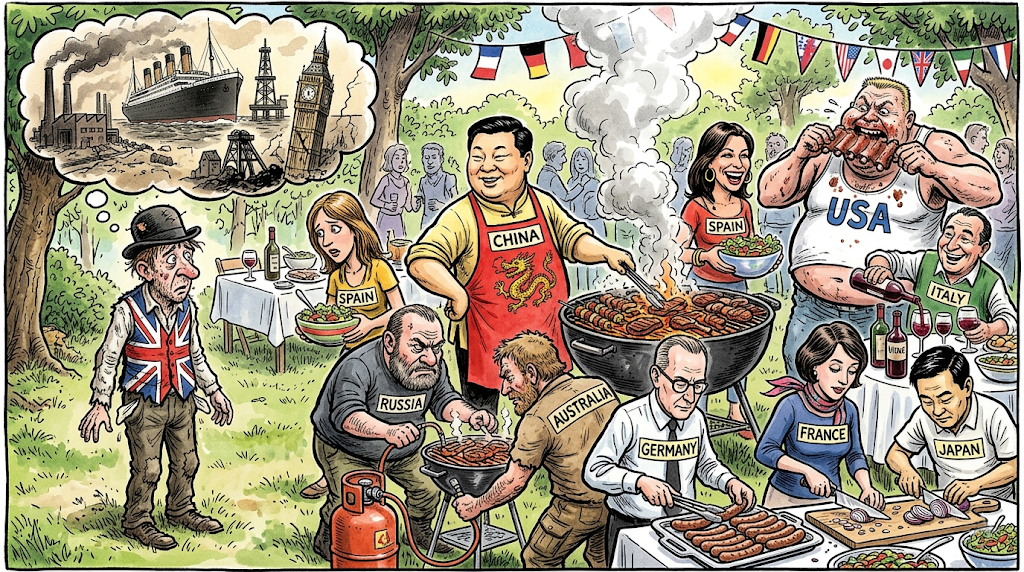
Imagine the world’s economies at a barbecue this summer.
China’s hosting. Spain brought the salad. The US is tucking into the pork already.
Russia and Australia hook up their gas to the Korean barbecue, and Germany unpacks the sausages.
Italy uncorks the wine and starts pouring out.
France, busy cutting the onions with Japan’s knife, turns to the UK and asks, “So, what do you do?”
Awkward silence.
“Well,” the UK hems and haws, “I’ve had all sorts of jobs over the years…
“Started out as a sheep farmer… but that dried up long ago…
“Tried engineering throughout the Industrial Revolution…
“Oh! I led the world in the shift from coal to oil. My North Sea oil industry revitalised us… for a bit.
“I’ve dabbled in chemicals. I produced more than half the world’s exported cars in 1950. I once built the great cathedrals and theatres of the world.
“My shipbuilding industry was legendary. Navy, the merchant marine, and luxury ocean liners. My dockyards ruled the ports.
“My defence industry packed a punch for a long time.
I used to build extraordinary infrastructure projects, many of which are still standing. Canals with navigable aqueducts and tunnels, a network of railroads across the country, and the world’s busiest airport for international travel.
“My last job was in finance. But things went badly in 2008.”
“That’s an impressive history,” France says. “But what do you do NOW?”
More awkward silence.
Forget AI, America’s No.1 forecaster says a bigger boom is coming:
“I’ve invested $1 million of my own money to prepare for this…”
He predicted the Financial Crash, both Trump victories and 2025’s record rare metals surge that saw stocks soar as much as 645%
Now discover the move he is making as America seeks to unlock a home grown fortune potentially worth trillions on Friday, May 15th
Find out what that move is right here >>
Capital at risk
Turning the corner
Am I being unfair? We aren’t the only country to be hollowed out.
But many governments are waking up to the consequences of decline. They are suddenly ambitious and competitive, instead of trying to offshore industries for the sake of environmentalism.
Italy is permitting oil and gas in the Mediterranean.
The US is raising tariff barriers to try to get local industry going again.
The Japanese are giving up on their experiment to import labour after seeing what happened to Europe.
Eastern European countries are emerging as the GDP growth example within Europe.
Ireland is sticking to its guns on low company tax, despite EU demands to “harmonise”.
China has been stockpiling resources to make sure it can keep its factories going in a pinch.
The Germans are giving up on their frugal ways to invest in infrastructure and industry.
The Australians are keeping their coal mines open, despite the hypocrisy.
Much of South America is in the midst of a full-blown capitalist revolution.
But in the UK?
How much longer will we get a seat at the table without bringing anything to it?
And what would we even bring?
Who’d invest here?
The UK is stuck in what I call administrative growth. That’s not a reference to the NHS, but the nature of what it takes to get a project off the ground. I’ve seen this firsthand.
The first thought of an entrepreneur in the UK is what subsidies, grants, and exemptions they can get. After all, nothing could get off the ground without that sort of support. It’s impossible.
The implicit result is that only government-favoured projects get anywhere. The government’s idea of growth is to exempt parcels of the UK from its absurd regulatory and tax burden, calling them special economic zones, port cities, or whatever.
Homes can only be built when and where they are approved. Then you’ve got to build an approved type of home, in an approved way, by approved people.
Ironically, this has left us with extraordinary substandard homes that can’t sell because no bank will mortgage them.
Why not?
Because nobody is willing to certify that they don’t have flammable cladding. Nobody has alleged that they do. But you’ve got to get someone to certify it.
Energy companies need contracts for difference and guaranteed minimum prices before building new projects. Nobody is dumb enough to gamble on building an uncontracted power plant, given how messed up government energy policy is.
The overall result is a form of state control over which parts of the UK can grow economically and how.
And you can’t blame the businesses. How many energy projects are still waiting to be connected to the grid because some bureaucrat failed to plan ahead?
But does the bureaucrat face any consequences, or does the energy project just get paid anyway?
Most countries trying to turn the corner are simply changing tack in their approach to administrative growth. They have new favoured industries that are now getting more support and exemptions.
That won’t work for the same reason the transition to green energy didn’t. It is administrative growth, not true growth.
But what does work is when the government gets out of the way. When it frees up resources, land, and regulatory burdens. When it stops interfering.
Not many governments are even aware that this is possible.
In fact, I can think of only one country that has even hinted it’s about to unleash the economy.
That’s why Jim Rickards is investing a million dollars in this opportunity. He believes President Trump is about to unleash one particular industry from the shackles that have held it back for decades.
Until next time,

Nick Hubble
Editor, The Fleet Street Letter