 In today’s Issue:
- AI won’t run on bunker fuel…or renewables
- Nuclear power exposed climate alarmism a long time ago
- The next AI-driven energy play is about to begin
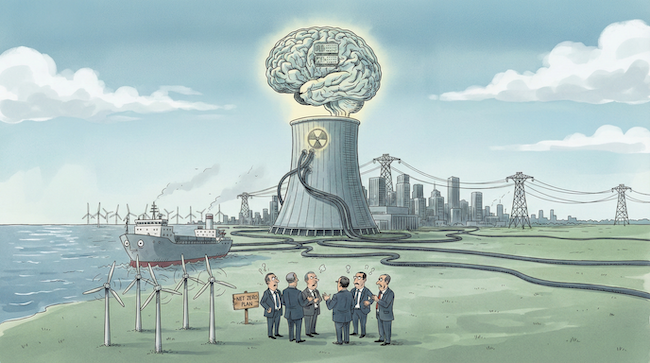
For years I’ve been wondering how the UK’s political class will weasel their way out of net zero. The law was never plausible. But what will the reckoning look like?
Will a new crop of climate sceptic politicians get elected?
Will we find something new and more important to worry about?
Will emissions targets be delayed endlessly as we keep falling short?
Will technology make net zero irrelevant?
Will net zero costs cause a sovereign debt crisis?
Will the government just make another U-turn?
So far, net zero is proving to be such a debacle that all of these are true.
Defeating Russia and closing down nuclear power plants was judged more urgent than cutting carbon.
Even Labour admitted, in leaked recordings, that the costs of net zero are absurd.
Climate sceptics are polling strongly across much of the world.
Some European parties are even considering fracking for gas these days!
Even the science of climate change is looking very unsettled — just as political winds begin to shift funding priorities.
So, change is afoot. And, as so often happens, financial markets cottoned onto this long ago. Green energy stocks peaked way back in 2021. The same month I warned subscribers of The Fleet Street Letter to avoid them.
Has peak net zero already passed?
Not so fast…
Energy systems have the turning circle of the Titanic
It takes a long time for energy systems to change course once we spot an iceberg. And so the full scale of the disaster is yet to become apparent.
We are getting plenty of hints though. The Telegraph reports on a wonderfully ironic tale:
British ports threaten to pull the plug on net zero charging
Ports are threatening to pull the plug on dockside chargers for electric ships after a jump in energy prices.
The ports in Aberdeen and Portsmouth say surging prices have made it cheaper for vessels to use their diesel engines when tied up at the quayside, rather than tap into the power networks.
Priceless.
But revealing.
This cuts to a concept we raised years ago: energy return on energy invested — EROI.
In its simplest form, the concept is a basic question: can a wind turbine produce enough power to reproduce itself?
Can it power enough mining trucks, manufacturing plants, and container ships to build a wind turbine? Indirectly, of course. But the accounting still matters.
If wind turbines cost more energy to build than it produces then each wind turbine we do produce is one step closer towards starvation.
It’s a cheetah burning more calories chasing a rabbit than it gains eating one.
If diesel remains cheaper than renewable power in UK ports, then fossil fuels still offer superior EROI. And that means the “transition” makes us poorer.
For a while this was masked by subsidies that governments borrowed to pay. But even that isn’t enough to hide just how inefficient the energy transition is making us. The lack of fossil fuels in the system can no longer make up for renewables’ low EROI.
The good news is that climate alarmism seems to be fading at the same time as the costs of net zero are exposed as insurmountable.
The US’ Environmental Protection Agency no longer considers carbon dioxide a danger to public health. And the US court system’s new Reference Manual on Scientific Evidence has removed its chapter on climate science. It is now a contestable scientific theory in American courtrooms. Good luck proving it.
Of course, many of us knew long ago that climate alarmism was on thin ice.
Nuclear power was the big hint
The vilification of nuclear power was proof that governments never truly feared climate change.
Germany tore down wind turbines to access the coal beneath their foundations — so it could fuel plants while shutting nuclear reactors.
These are not the actions of a world on fire because of carbon emissions.
My own obsession has long been the bunker fuel that moves our ships. Anyone who cares about climate change would make that a priority.
After all, the politicians most obsessed with climate targets are also among the most enthusiastic supporters of global trade. We’ve known that since Brexit and Trump’s tariffs.
Yet global shipping remains one of the highest-emitting industries on Earth. And remarkably little has been done about it.
The technology has existed for decades. Naval vessels have run on nuclear power since 1954. Nuclear-powered merchant ships have been around since 1959. Even Australia — hardly a bastion of pro-nuclear politics — is now buying nuclear submarines.
The reason why we haven’t converted global merchant shipping to nuclear is fairly simple. It wouldn’t show up as a carbon reduction on any particular nation’s balance sheet.
It makes more sense to ship Canadian wood pellets to Drax because that does count as a carbon neutral gold star for the UK under the rules.
But enough about net zero itself. Because something that could “solve” the problem of net zero is already hull-up on the horizon.
More energy means cheaper energy
The invasion of Ukraine woke up many politicians to the importance of producing your own energy. The claim President Trump made on Greenland made it blatantly obvious. Energy vassals don’t control their own foreign policy. Not without starting a war, anyway.
The AI race is another “must win” challenge for the West — and it, too, comes down to energy. Those who have enough energy can run AI. Those without energy must stick to writing regulations for a domestic AI industry that doesn’t exist.
But won’t AI only spike energy prices further?
That’s what I want to placate you about today. Sometimes, more demand makes things cheaper. Especially in energy systems.
In fact, one reason why the energy transition has proven so expensive so far is the general lack of power. A large chunk of our emissions reductions have come from producing less energy. From making ourselves poorer.
But electricity grids are dominated by fixed costs. The wires, substations and maintenance do not shrink just because usage does.
Spread those fixed costs over fewer users and the price per unit rises.
A surge in energy demand would distribute the fixed costs of a grid amongst more users, leaving us all with lower costs per unit of energy consumed.
Then there are economies of scale. Larger mines. Larger plants. Larger generating assets. All else equal, bigger output reduces per-unit costs.
And so we come to the next big revelation that’ll upend energy systems and end political careers.
AI’s voracious energy demand will actually cut energy bills
The idea that our economy must shrink to fit our energy capacity is a recipe for stagnation. It would have left us in the Stone Age — literally.
Instead, our energy system must produce what our economy needs. That is the order of priority. And AI could remind us it’s true.
AI has already brought a few nuclear power plants back from the brink in the US. It did more to advance small modular reactors than any government subsidy.
Politicians are demanding that AI data centres bear the burden they put on the grid by paying for it. The thing is, they can afford it. And they can probably afford it better than anyone else out there right now.
AI could save us from energy poverty by turning the ship before it hits an iceberg.
We made this call in March 2024 in both our Australian newsletter and The Fleet Street Letter: AI would power itself. Just like those diesel ships in UK ports. The only open question was which fuel would win.
In 2025, our Australian subscribers banked gains of 402% and 675% on the two investment plays chosen to profit from AI’s voracious energy demand.
But now it’s time for the next phase of the AI driven energy boom.
Given that energy is now the major bottleneck to expanding AI, the incentive for AI to grow more energy efficient is the key metric.
And that is where the next great opportunity lies.
Until next time,

Nick Hubble
Editor at Large, Investor’s Daily
P.S. In the article above, I explained why energy is becoming the single biggest bottleneck in the AI race…and why the next fortunes won’t be made in obvious places.
That’s exactly why James Altucher is watching signals like what he calls a “blue spike” so closely.
When AI demand collides with real-world constraints — energy, infrastructure, hardware speed — the companies that remove those bottlenecks can go vertical.
Just make sure you’re positioned before the rest of the market realises what’s happening.
Capital at risk