
 The future doesn’t just appear out of nowhere.
It’s often years in the making, then — BOOM — it’s in your hands.
The internet was a bit like that.Years of rumours and research inside DARPA… then suddenly the World Wide Web went live. Netscape became our portal to “surf” the web and we never looked back.
The iPhone was a bit like that too. Years of improving Nokia devices, Palm Pilots andSteve Jobs drops the iPhone and suddenly, smartphones were our portal into the app economy and we never looked back.
So, what comes next?
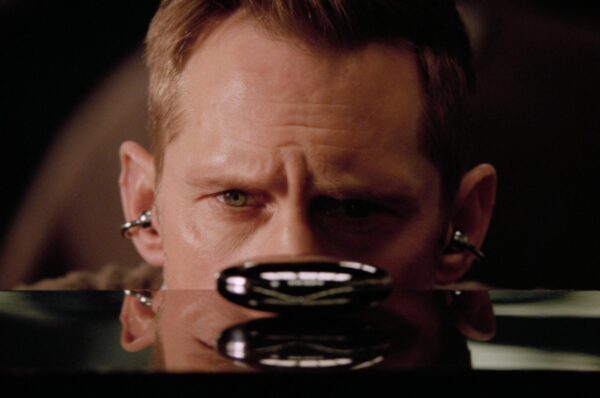
Maybe, after years of rumoured “AI devices” and a few false starts (see: the Humane pin), what you see below could be the next BOOM moment and we’ll never look back.
 Source: Lit Capital via X.com
The real AI story here is the AI used to fake out the world
First off…
What the heck is this?
Here’s what we know so far:
It’s a silver metallic looking mirror finish orb. With similar textured earbuds, nicely settled in the ears of Alexander Skarsgård.
Online there’s been Reddit posts claiming this is the tease of OpenAI’s new Jony Ive designed AI device.
Others are saying it is 100% AI generated and just a troll of OpenAI. Some say it’s a device from somewhere else entirely.
What made it more bizarre? It surfaced just as Anthropic launched ads mocking OpenAI’s rumored move into advertising. Then Anthorpic changed their adverts to not be so direct about it (probably because they’ll eventually do ads too).
OpenAi was said to be teasing the release of their new device in Super Bowl ads, then decided not to. And thus a Reddit post appeared with this, saying it’s the OpenAI ad they were going to play during the Super Bowl.
There was even a video that was doing rounds. And I’ll be honest it was as believable as anything else I’ve seen.
And therein lies the real story here…
OpenAI flatly denied it. Fake. A ruse. Nothing to see here.
Fine, that’s just fine.
But here’s the thing: whether it was real or fake, it could only exist because of AI. And there’s no doubt in my mind that when OpenAI does release their product, that it will be with the heavy use of AI to assist in the design and implementation.
And Alexander Skarsgård ads, real or fake, also lean heavily into the use of AI tools.
It’s the use and proliferation of AI tools that’s accelerating at a speed that even blows my mind. The ability to make something so real, that it’s for all intents and purposes real is easier than ever.
Go see what you can do with Grok, Gemini, or one of the 100 other video generation sites you can use. Can’t think of the right prompt? Ask ChatGPT, Gemini, CoPilot, or Claude to help out.
Or if you’re full of fun ideas like me, lean into what you can build with AI coding to explore all kinds of skills you never thought you’d be able to master.
Building the bowlers of the future
I’ve been using Claude Code (from Anthropic) and ChatGPT Codex (from OpenAI) for the last week.
It’s blown my mind. And I’ll give you a real world example of how.
A friend of mine built an app about eight or nine years ago. Poured a heap of cash into it, and got web developers and app developers to help him. He told me it took months of back-and-forth — and a lot of cash — just to get version 1.0 live on the App Store.
It was so much that the whole thing kind of fell away as other priorities took over. I asked him about it and he said it’d probably take him thousands to get it up and running again. So I said: what if we could rebuild it, better than ever, for basically nothing?
The app was a cricket app for bowlers. The idea was to provide elite level data and feedback to a bowler regardless of age or level. Maybe a kid starting out in under-10s. Maybe a grade cricketer practising in the nets. Maybe even a first-class or international player.
You might think they have good data now but maybe it’s not as good, or flexible, or as easy to use as it should be. Certainly not at grade level.
Anyway, I said, give me a shot at building the thing again. From scratch. With AI detection of swing and speed, pitch maps, session data, workload tracking, performance stats, coaching suggestions, and real-time, real-world insights for bowlers.
The kind of thing that took him nearly a year to build.
And in an evening I’d built a minimum prototype. An app for iPhone with stump detection, ball tracking, swing variation, pitch maps, speed data, and AI analysis. Even player registration from a spin bowler to a pace bowler, with automatic delivery detection.
And guess what…
I’ve never coded an application to that level of detail or complexity in my life. I’ve never built an app to deploy to an iPhone. I certainly don’t know how to code a physics engine or use pixel tracking to see how fast a ball is moving.
I don’t know any of this. But Claude Code does. And I know how to explain in detail what I want.
So, in an evening, Claude built me the app.
There were a few things I needed to do. For example, setting up a GitHub account so Claude could push the code to a repository, which I could then pull into Apple’s Xcode to deploy and test on an iPhone.
I was building all of this through a Terminal on my PC running Claude. I’d give it instructions, it would build locally, push the code to GitHub, I’d pull it into Xcode, then deploy and test.
Then I decided I wanted a web interface to access all the session data. Claude built that too. All I had to do was set up a Vercel account, grant access, and I could test it online.
So yeah, there’s a couple of steps in there that will block most people for now.. But I’m by no means some elite developer, I just know enough to ask the right things and to get it working in the right spots.
I’m not here to spruik a new app. It’s still a private demo. But I am here to show you how fast the world is changing right under everyone’s noses.
And this is happening NOW.
Give it six months and all this will be multiples of magnitudes better. I say this because six months ago, none of this was possible.
Give it a year, or two, or six… and I can’t even fathom the scale of disruption AI tools will unleash. Yes, it will create some negative disruption. But at the same time, anyone with drive will be able to build almost anything.
My kids will grow up able to create software and launch applications without writing a single line of code. Why would they need to?
What will matter isn’t syntax. It’ll be imagination. Independent thought. The ability to generate ideas worth building and then use the tools available to bring them to life.
Now zoom out.
Every company providing the compute, memory, storage, hardware, connectivity, networking, and speed behind this revolution is positioned for what could be the greatest expansion in valuations and wealth creation we’ve ever seen.
Nothing (not even crypto) matches the scale of impact that AI is unleashing.
Some people will look at all this and think, “Too hard. Not for me.”
But it isn’t too hard. The tools are already here.
The divide between the haves and have-nots won’t be about access.
It’ll be about effort. And creativity.
Two of the most deeply human traits we possess.
Regards,

Sam Volkering
Contributing Editor, Investor’s Daily
P.S. Jim Rickards rarely names a stock publicly. When he does, it’s because something material has shifted.
In this case, federal approvals tied to Alaska’s North Slope accelerated faster than expected following recent policy changes.
That changes the timeline.
If you want to understand why Jim felt compelled to go on record — and which company he believes is directly connected to this shift — you should watch his most recent briefing now.