 My wife walked in this morning after the school drop-off.
She’d spent a good chunk of time trawling charity shops and second-hand bookstores looking for a few books in the Diary of a Minecraft series our boys are devouring. Currently the boys are going through the Zombie ones.
If you know, you know.
She couldn’t find the ones the boys hadn’t read yet. Naturally.
And it got me thinking.
There are thousands of families sitting on kids’ books that will never be opened again. Not sentimental classics. Not first editions. Just paperbacks bought at a birthday party or picked up in a charity shop.
At the same time, thousands more kids are looking for exactly those titles that you no longer want..
But there’s no easy way to connect them. No easy way to know where the book you need next is waiting for you.
The library might have two out of twenty in a series. And even if you get them, you always have to take them back, usually half-read. The charity shop has random volumes, if any at all. Buying new books or even second hand books that’ll be read once feels wasteful.
So I thought:
What if there was an app that let families say, “I have these books. I want those.”
The system matches them locally.
They meet, swap, done.
What if…
So I built it.
In an afternoon.
From frustration to functional app in a few hours
The app is called BookRelay.
Parents list the books their kids are finished with and tag the ones they’re looking for. The system only matches perfect swaps. No one-way transactions. It opens a chat, verifies age for safety, tracks ratings, and closes the swap when complete.
I’m not a developer. I don’t write production code. I don’t know how to architect databases or configure authentication flows. At least, I didn’t until a couple of weeks ago.
What changed was Claude Code, Anthropic’s AI coding tool, and its recent upgrade to Opus 4.6. That combination has turned me, and millions of others, into functional software builders.
It would ask questions. I’d request a feature. It would test, refine, deploy. By evening, after another hour or two of fine-tuning, I had a working prototype.
User registration, book cataloguing, scanning barcodes to add books, location-based matching, swap initiation, messaging, all deployed.
There are a couple of things I still need to finalise. But I reckon I could walk into my kids’ school on Monday, hand them a QR code, and say, “Put this in the newsletter. The community can use it.”
That’s the speed at which this is moving.
The real investment story hiding inside all of this
The process of building BookRelay didn’t teach me to code. I still don’t know how to code. I never will. It made coding optional.
This won’t kill developers. It will make great developers exponentially more powerful. They become conductors of AI, orchestrating systems at a depth I’ll never reach.
But here’s what really struck me. I became a customer.
Claude Code pushed me to set up a GitHub account to manage the codebase. It introduced me to Vercel for web deployment. Supabase for the database. Cloudflare for domain management. Stripe for payments infrastructure on another project. All platforms I’d had zero experience with prior to a few weeks ago.
This is why last week’s selloff in Cloudflare caught my eye. Shares dropped over 15% in the last week, most of that on Tuesday after Anthropic released Claude Code Security, a tool that scans codebases for vulnerabilities.
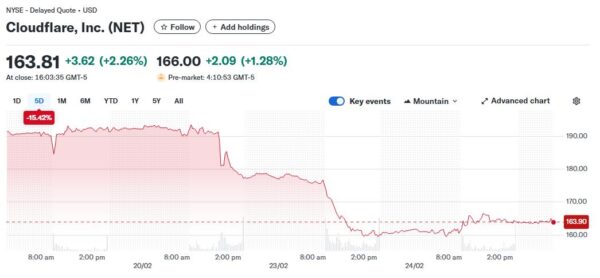
The market panicked, lumping Cloudflare into the “AI will eat software” narrative.
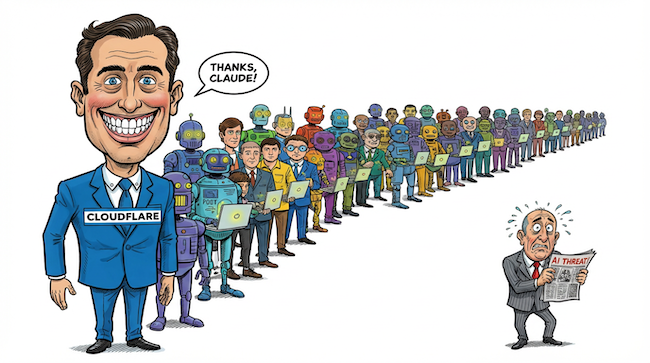
Meanwhile, I’m sitting here as a brand new Cloudflare customer, pushed there specifically because of Claude Code. The very AI tool investors panicked about was driving new revenue straight into Cloudflare’s business.
What makes this so exciting is this: When you see the market react to AI headlines in a way you know is an overreaction, that’s tradable.
I’m sitting here thinking not only does this make Cloudflare more attractive to me fundamentally, but from a short-term perspective, the bounce I expect looks too compelling to ignore — especially using options. And there are plenty of these setups right now.
IBM “crashing” because Claude can read COBOL. Adobe getting hammered because investors think AI will erase creative software overnight.
The market is pricing extinction.
Reality looks more like evolution.
And that gap — between panic and progress — is where the opportunity sits.
Like I said earlier, AI will make these companies and the experts that build things better
over the long term.
And let’s not forget about Stripe…
Yes, it’s private (for now). But reports surfaced just yesterday that Stripe, now valued at US$159 billion, is in early discussions to acquire all or parts of PayPal.
If that deal progresses, the company sits at the centre of AI-enabled commerce. Because every builder using Claude Code, ChatGPT Codex, or any other AI tool to create something needs payments infrastructure. And Stripe is where most of them end up.
That IPO screams opportunity.
AI coding tools are creating a new class of builders. Not developers by trade. But people with ideas.
Every one of them needs:
Hosting. Storage. Databases. Domains. Authentication. Payments
The infrastructure providers aren’t victims of AI. They’re beneficiaries.
When I look at how fast this is moving, and I emphasise that six months ago none of what I built today was possible at this level, I can only imagine what experienced engineers and developers will produce when they fully lean into these tools.
We’re not at the scary stage of AI. We are very much at the exciting early stage of understanding what’s possible with a bit of human input and creativity. Or maybe as my brother said, “you invented the library.”
I don’t know, but at least it’s possible.
Until next time,

Sam Volkering
Investment Director, Southbank Investment Research
P.S. Earlier I told you how I built an app in an afternoon because AI tools made it possible. That same shift is happening at the industrial level. AI is moving from experiment to infrastructure. And infrastructure needs speed. Nvidia knows it. The company our blue spike just flagged is already mass-producing the tech that makes that speed possible. When the plumbing changes, the headlines follow. See the full breakdown here before the market connects the dots.