 In today’s Issue:
- The AI bubble hits a wall
- Net zero exposed
- Labour discovers how hard it is to govern
Stein’s Law states that, “If something cannot go on forever, it will stop.” The poignant question for investors is always when.
J.M. Keynes argued that, “Markets can remain irrational longer than you can remain solvent.” But is it a good idea to bet on things getting even more absurd?
Turning points are notoriously difficult to get right. And yet, they are when the biggest gains can be made in financial markets.
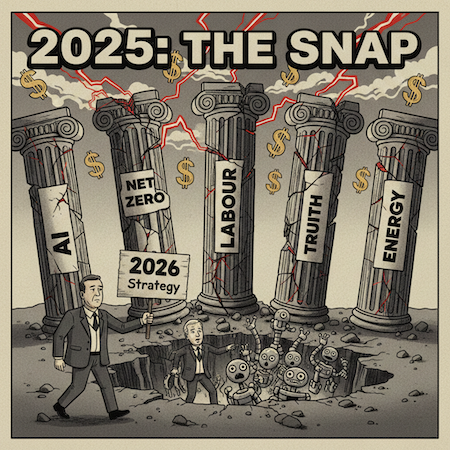
We can’t help but notice that 2025 was full of inflection points. When long-established trends began to wobble and then change course.
Are you positioned for what’s changed as we head into 2026?
The AI bubble hits a wall
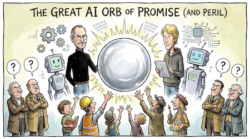
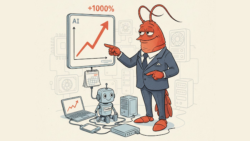
While AI stocks continued to soar in 2025, their data centres may have struck a hard constraint at last: electricity.
Grids are creaking and blacking out under the strain of AI data centre demand.
Voters are demanding that politicians halt the rollout of new data centres as power bills surge. And grid operators are refusing to guarantee power from the grid to new data centres.
AI developers have responded by trying to produce their own power. But gas turbines have been sold out for years. There are only so many coal and nuclear power stations you can extend. And you can’t run AI on intermittent renewable energy.
Could 2025 be the year the AI bubble peaked because of a lack of energy to power it?
Net zero exposed at last
Companies, countries, and celebrities are racing to abandon their climate alarmism, renewable energy projects, and net zero commitments. It’s as if the science was never settled after all…
In the US, the phaseout of combustion cars is off the books. In the EU, it’ll be delayed.
Few now believe the green energy transition will bring down bills.
And the fact that politicians forgot to build an electricity grid that can handle renewables is now common knowledge. When the cost of building one is priced in, the façade will fall.
Perhaps the most extraordinary revelation of the year came from the International Energy Agency. Its forecasts for the phase out of fossil fuels were revised dramatically. They won’t be phased out after all…
And wind and solar’s share of global energy supply will reach between 12% and 16% by 2050!
Commodities turn a corner…except oil
In the latter months of 2025, commodity prices finally began hitting new highs. Copper, aluminium, and even natural gas traded up.
Could this be the beginning of a new commodities cycle? Investors have been waiting for years.
If it is an inflection point, commodities certainly have a long way to go. Gold and silver are showing the way, having doubled.
The only major laggard is oil, which continues to fall behind. But that only makes it the opportunity for 2026…
Labour discovers how hard it is to govern
Pollsters are astonished at the fall of Labour and Sir Keir Starmer’s popularity this year. Nobody else is though…
Still, the plunge is breaking polling records. It reflects abandoned promises and a series of very odd scandals.
But perhaps 2025’s political shifts should be measured in the unprecedented rise of Reform UK and Nigel Farage?
Five years ago, Nigel assured me the first past the post system would keep him out of politics. Now it threatens to finish off his enemies.
Voters in the UK will soon have to ask themselves what Reform’s policies will actually be. More on that in next month’s The Fleet Street Letter.
Truths become too obvious to deny
In 2024, former President Joe Biden’s senility suddenly became common knowledge. A highly influential article back then pointed out that we had all known for years he was struggling. But, somehow, it only became ok to actually say so in 2024. Suddenly, everyone knew that everyone else knew.
The same effect dawned on several “truths” this year. They went from fake news to old news in the blink of an eye…
Earlier this month, former Biden advisor Amanda Sloat was caught admitting that giving up on NATO’s eastward expansion might have prevented the Russian invasion of Ukraine.
The BBC’s medical editor admitted that common surgical face masks are not effective at stopping viruses.
An internal memo from a high-level official at the US’ FDA claimed that COVID vaccines had killed 10 children. The FDA have also admitted that they can cause myocarditis.
The EU’s Ursula von der Leyen admitted that Trump is right about China’s unfair trade practices.
Economists admitted that tariffs are not necessarily inflationary.
Economists admitted that immigration can be fiscally net negative.
The Potsdam Institute for Climate Impact Research admitted that an estimate of the economic costs of climate change it published was flawed and retracted it.
Policy analysts admitted that the energy transition to renewables is driving up energy costs.
And the list of truths we all knew, but were not allowed to speak out loud until 2025, continues to grow.
I hope you’ve enjoyed the reckoning…
But the real question is whether you are positioned to profit from what has changed in 2025 to ensure you reap the profits in 2026.
Until next time,

Nick Hubble
Editor at Large
P.S. Writing this made one thing uncomfortably clear to me: a lot of the assumptions people are still clinging to didn’t quietly fade away in 2025 — they snapped. Energy. AI. Net zero. Politics. Commodities. The “obvious truths” that were once unsayable are now out in the open, and markets are already adjusting.
That’s exactly why I want you to see Jim Rickards’ latest briefing. He’s connecting these inflection points — energy constraints, commodity bottlenecks, and geopolitical reality — in a way that cuts through the noise. If you’re thinking seriously about how 2026 looks after these shifts, this is something you shouldn’t put off.