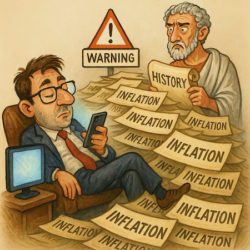
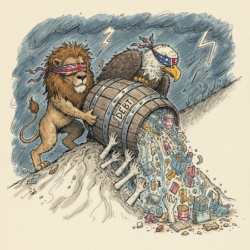
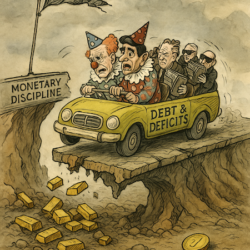
Almost all instances of imperial decline are accompanied by monetary decline, manifesting itself as inflation, corruption, and/or bankruptcy. But the real process is profound and mostly invisible
When leaders mistake short-term fixes for long-term strategy, the results are predictable: weaker markets, distorted prices, and growing costs for everyone else.
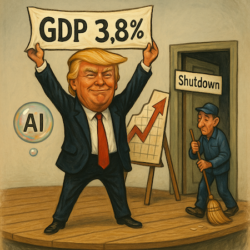
Of the entire GDP gain for last year — $174 billion — fully three quarters of it were from capital investment in the AI/high tech industry. Take it away...and most of the ‘growth’ vanishes.
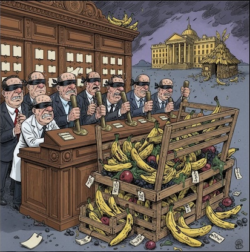
The US has become a banana republic without the bananas. The practical importance: shouldn’t its capital assets — its stocks and bonds, primarily — be marked down to banana republic levels?
Stock prices are ‘mean reverting,’ which is to say that they always go back to a ‘normal’ range. And when they are extremely overvalued as they are today, they have a lot of ground to cover (losses!).
No government has ever succeeded in improving an economy…other than by avoiding war, providing some rudimentary justice, and removing the impediments set in place by government itself.
Milei is doing something different. He’s cutting budgets, trimming employees, and chopping off unnecessary bureaucratic appendages. He’s been in office for a little shy of two years.
It looks like the administration is doing everything it can — including whimsical tariff threats — to make the value of the US dollar and US bonds go down.
There’s a corruption cycle too...roughly corresponding to the shift away from the ‘rule of law’ to the ‘rule of men.’ This appears to be a part of the life cycle of democracy.
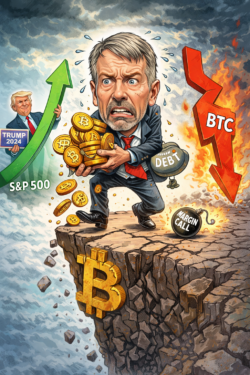
The S&P and the Dow are hitting new highs...with the S&P recording 32 new highs so far in 2025. The S&P has seen earnings grow 156% over the last decade. But stock prices have gone up 248%.
Both the stock market and the economy are now growing — but only because of a whirligig of ‘capex’ spending on AI...which is most likely money down the drain.
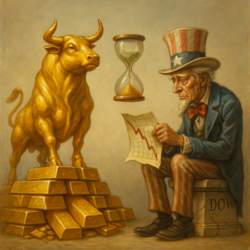
The real promise of gold is not just a rate cut or two...and not really ‘easier borrowing costs.’ Gold may be a good gamble now...but in the long run it is just a way not to lose money.
The gold standard came into being in the 18th century. It got gassed in WWI. Then, after WWII, it was re-established, sort of. The dollar was made the key financial reserve. It was linked to gold.
There’s a big difference between having the best growth rates and having the worst. And if you don’t know which you have, you’re probably headed to trouble. Which is exactly where the US is headed.
Gold is not an investment; it’s a place to put your money while you wait for a good investment to come along. It’s not a wealth creator; it’s a wealth preserver.
The new money system distorted just about everything, leaving the world with a vast fake economy...and more than $300 trillion in debt. In the US alone total debt rose from about $1.5 trillion in 1971
Thanks largely to the EZ money era wrought by America’s funny money, the world’s reserve currency, feds everywhere spend too much money. Economies adapted to the cash flow.
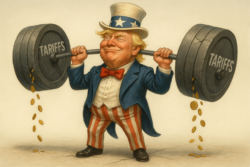
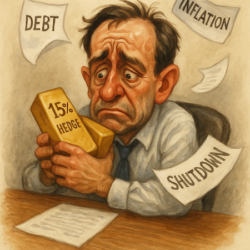
Tariffs are essentially a sales tax. And a sales tax — averaging maybe 15% — is going to reduce consumer purchasing power…and cut into sales and profits. That is, it will be downer.