|
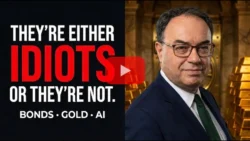
A Note from Elizabeth Cox Across Southbank, we’ve turned our attention to what we’re calling Turning Point 2026 — the idea that several major forces are colliding at once: AI, energy, geopolitics, inflation, and shifting monetary policy. To help investors make sense of it all, we’re hosting a live YouTube discussion on 9 July where Nick Hubble, editor of The Fleet Street Letter, and Sam Volkering, our Southbank Research investment director, will discuss where they see the biggest opportunities emerging next. The biggest question they will answer is: If you had £10,000, where should you be investing it right now. |
 In today’s Issue:
- Central bankers are in desperate need of a crash
- Cutting rates wasn’t an option for more than a decade
- The coming rate cuts will goose gold
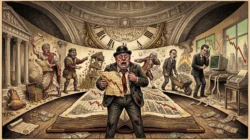
The world is panicking about the Strait of Hormuz, the private credit crisis, and, the popping tech bubble. But investors need to focus on the only thing that actually matters: central bankers have got a lot of ammo and they’re looking for any excuse to use it.
A private credit crisis, a bursting tech bubble, or another energy crisis…any justification will do.
Then we can get back to what central bankers do best: cutting interest rates to push financial markets higher.
Bad news will be good news again. Happy times for investors like me. We love doom and gloom stories as much as capital gains. We might get both.
Whoopeee.
Why have so much faith in central bankers?
Keep in mind that their favourite way to drug the economy has been denied to them since 2008. Interest rates remained at rock bottom levels for over a decade. In some countries, they even went negative.
A central banker with interest rates near zero is a bit like Guy Fawkes without gunpowder. They have to resort to dishonest means to destroy Parliament, like printing money.
But Bank of England interest rates made it all the way up above 5% in 2023. The last time central banks had that much room to cut rates was…2008.
Now, with interest rates still well above zero, they are locked and loaded. They have a solution in search of a problem. And wobbling financial markets are providing just that.
But we all know the real reason…
Forget AI, America’s No.1 forecaster says a bigger boom is coming:
“I’ve invested $1 million of my own money to prepare for this…”
He predicted the Financial Crash, both Trump victories and 2025’s record rare metals surge that saw stocks soar as much as 645%
Now discover the move he is making as America seeks to unlock a home grown fortune potentially worth trillions on Friday, May 15th
Find out what that move is right here >>
Capital at risk
Why central banks need to cut rates
How much of the government’s budget crisis was caused by the Bank of England’s rate hikes?
It might seem like a simple question. If the Bank hiked rates by 5.25 percentage points, then it’s responsible for a 5.25 percentage-point increase in government bond yields, right?
That would give Andrew Bailey roughly three times the moron premium of Liz Truss, by the way. Not that he’s losing any sleep over it.
Our Chancellor is.
She’s getting blamed for the Bank of England’s higher rates, even as those rates threaten to push the government’s finances into a fiscal black hole.
Which is precisely why rate cuts are likely.
The government simply cannot afford to refinance its debt indefinitely at these levels.
Do you really think the Bank of England is going to drive the government broke?
Historically, when forced to choose between fighting inflation and preserving government solvency, central banks have always sided with their paymasters.
The German Bundesbank was one of the few exceptions. During German reunification, it pushed back hard against political pressure to loosen monetary policy.
Even reunification wasn’t a good enough reason to sacrifice the Deutschmark.
But Bank of England Governor Andrew Bailey is definitely not German. He knows the government cannot afford high bond yields. And so he’ll have to reign them in. He just needs the excuse to do it.
Preferably a stock market crash to draw attention away from the government’s finances.
The Bank of England risks losing control of the bond market
The Bank of England’s policy rate only controls the short end of the bond market — government borrowing measured in months, not decades.
That’s why central banks have resorted to direct bond purchases in the past. They wanted to manipulate the long end of the market as well. They gave these schemes names like Operation Twist and quantitative easing.
But bond buying has fallen out of favour since it helped fuel the inflation surge of recent years. It was only considered acceptable when interest rates were already pinned near zero.
The point is that interest-rate policy alone does not keep a lid on long-term bond yields.
Out there, inflation is what matters.
And cutting rates into an inflation spike is exactly the sort of thing that spooks long-term bond investors.
Owning government bonds that yield 5% makes a certain amount of sense when inflation is running at 3–4%.
But we are about to face a pincer movement that would make Genghis Khan look indecisive.
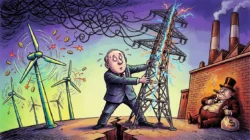
Thanks to the Strait of Hormuz, inflation could surge just as central banks begin cutting interest rates.
That’s a nightmare scenario for bond investors.
Potentially worse than 2022, which was already a record-breaking year for losses.
Meanwhile, the tech bubble and the private-credit boom risk imploding at precisely the wrong moment, hammering economic growth and tax revenues.
It’s the sort of Catch-22 central bankers dread.
A classic stagflation trap. But even that isn’t the biggest risk.
Usually, bond prices would rise when interest rates are cut. And that might happen at the short-term end.
But the Bank of England risks losing control of the long-end of the bond market by cutting rates when inflation is rising. It will undermine their credibility. Expose them as the government’s bankers instead of inflation fighters.
If investors panic sell at the prospect of higher inflation and lower interest rates to compensate them for it, the yields on long-term bonds could diverge from interest rates at the Bank of England. Long-term bond yields will go up even though interest rates are going down.
This could force the Bank of England to buy government bonds during an inflationary spike. A proper money-printing bailout of the government.
That’s when you get into banana republik territory. When the government suppresses bond yields while letting inflation run hot.
Why rate cuts will cut gold loose
When investors sell government bonds to escape high inflation and suppressed interest rates, they don’t stick around in the local currency to find out what happens next.
Their money leaves the country altogether. And so an inflation, interest-rate, and bond-yield crisis becomes a currency crisis next.
That’s why it was the exchange rate that recalled Chancellor Denis Healey from his attempted holiday in 1976.
And it was the exchange rate that invited the IMF to remove the punch bowl from the Labour party.
The alternative to government bonds is gold.
Both have one key advantage: neither carries meaningful default risk.
Gold has no counterparty. Government bonds have the strongest counterparty possible — one that can print money.
But when inflation is high and central bankers are more concerned with government solvency than fighting inflation, gold becomes the better bet.
It can’t be printed. That’s why central banks are buying so much of it right now.
They’re betting against themselves.
You should too.
I only know one person who predicted all of these converging trends. The bond market, the AI bubble, gold and central bank balance sheets.
Find out what he says happens next, here.
Until next time,

Nick Hubble
Editor, The Fleet Street Letter
PS If today’s essay got you thinking about where all of this leads, then you won’t want to miss our upcoming Turning Point 2026 live YouTube discussion. Remember, we’re having this discussion on 9 July at 3 pm GMT to show you where the best investment ideas are hiding right now and to answer the question:
If you had £10,000 to invest today, where would you put it?
The event is completely free.
Read more details here and secure an event reminder so you don’t miss it.