 In today’s Issue:
- The price of pretending economics is a science
- America is a fiscal Sweden – the counterfactual
- How to profit from having the right ideology
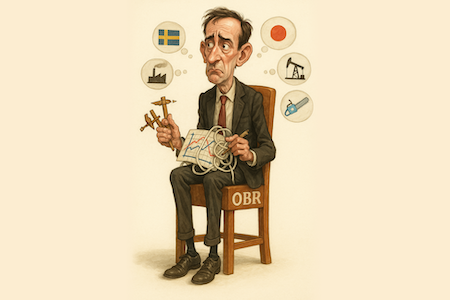
The premise of putting the Office for Budget Responsibility in charge of the country was simple. Number crunchers should prevent political ideologues from going on a rampage.
The trouble with this is now obvious. The number crunchers may be less likely to go on a rampage. But they are just as ideological.
Most of the criticism of the OBR has focused on who is in charge. And what side their toast is buttered on.
But this misses the point entirely. It doesn’t matter who you put in the chair.
Randian gold bug libertarian Alan Greenspan turned into his own worst enemy soon after being appointed to lead the Federal Reserve. As soon as he left, he was his own self again…almost.
Here’s what the discussion about the OBR is missing. Economics is not a science. It’s more of a joke.
We all disagree about what’s funny. And we likewise disagree about what economic policies work.
Heck, we even disagree about which policy outcomes are desirable.
How often have economists debated which policy is correct, only to discover they had completely different ends in mind?
For many people, taxing the rich is an end, not just a means. Arguing with them about the Laffer Curve is like arguing with your dog about opening a savings account.
And so, many goals that you and I might take for granted are actually considered a bad idea by others. Many economists believe that paying off the national debt would be disastrous, for example.
You and I might think inflation is bad. But in 2015, the IMF published a research paper explaining how high inflation was the preferable way to deal with too much government debt.
Some economists believe higher interest rates increase inflation, while others claim it reduces it.
The point is, we can’t agree on anything. Not the desirable outcome, not the outcome from any given policy, and not what policy should be.
Yet, in all its advice and analysis, the OBR has presumed that one set of economic ideology is the “correct” one. Which politicians must therefore follow.
But what if it’s wrong?
In need of a natural experiment
The recent report into the UK’s pandemic response was quickly discredited by international comparisons. Those of us who believe lockdowns don’t work could point to countries like Sweden. A place that was predicted to have a disastrous pandemic outcome.
It’s the same for economic policies today. Different countries are pursuing different policies to deal with their similar over indebtedness. And so we are going to find out who’s right and who is wrong…
The point of a democracy is that we can vote for change. We can give the policies of the 60s a go. If they don’t work, we can try the policies of the 70s. If they don’t work, we can try the policies of the 80s.
Placing the OBR and Bank of England in a position of conducting economic forecasts based on policy decisions undermines this.
They are not the arbiters. They’re the plonkers who get proven wrong each time. And yet, they decide what the future will look like under any given policy setting.
Of course, just like with COVID, the experts say entirely different things in each country…
Over in Germany, the Chancellor is busy asking German industry to be patient with his economic reforms. But the country’s economy is making Brexit doom predictions look boring.
In Japan, the new Prime Minister claims Margaret Thatcher is her idol. But she’s pursuing exactly the opposite economic policy: more stimulus and borrowing at cheap interest rates.
In Argentina, they’re taking the chainsaw to government spending. And it seems to be working rather well. Something all economists predicted would not occur.
The American solution is to embrace AI, “drill, baby, drill” for oil and gas, and permit a mining bonanza. Not only is the White House hoping to make investors rich quickly, but it’s also even investing in private companies itself!
The point is that the OBR’s policy prognostications show but one of many uncertain and debated possible outcomes. And yet, they are presented as gospel.
Would the OBR have approved Javier Milei or Margaret Thatcher’s reforms?
What would the OBR say about fiscal revenue from Ireland’s low corporate tax rate?
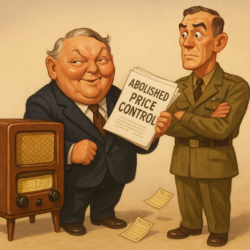
What would they have made of Sir John James Cowperthwaite’s advice to abolish the statistics office so that OBR types can’t cause trouble with their incorrect analysis?
Who wins?
In coming years, the fiscal fate of all these countries will diverge. But only those who compare and contrast will have a hope at diagnosing which policies worked and didn’t work.
The economic modellers within each country will get it hopelessly wrong, because their results will reflect their own ideological priors, not reality.
Our bet is that Trump’s strategy of engineering a resources boom works best. That’s why we’re launching a dedicated service to help people in the UK profit from the companies best poised to profit from Trump’s resources bonanza.
You can’t give up on the UK and go and live in a cave in America. But your money can invest in one…
Until next time,

Nick Hubble
Editor at Large
P.S. Seats for this event are already filling fast. If you want a front-row view into the companies set to benefit most from Trump’s resource boom, now’s the moment to lock in your spot. Once registration closes, that’s it.