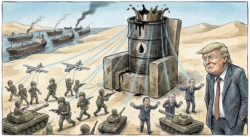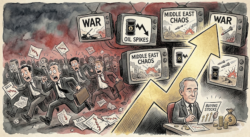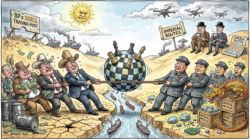
Publisher’s Note: Much of the global news right now feels theatrical. Loud statements. Diplomatic rows. Sudden shifts in tone. It’s tempting to dismiss it all as noise.
For investors, that would be a mistake.
Markets don’t respond to headlines. They respond to confidence, capital flows, and trust — especially trust between governments, central banks, and large pools of long-term money such as pension funds.
What we’re watching unfold is not simply a series of political spats involving the United States. It’s a broader reassessment, particularly across Europe, of how safe it is to rely on a single financial system, currency, or political partner.
For UK investors, this matters in three practical ways.
First, currency exposure. UK portfolios are often far more dollar-heavy than many people realise, through global equity funds, US-listed technology stocks, and international bond holdings. When foreign governments, central banks, and pension funds begin to question the dollar’s role as a long-term store of value, that risk doesn’t stay overseas. It shows up in exchange rates and in the real returns UK savers ultimately take home.
Second, capital flows. Large investors do not wait for crises to be obvious. They move early, quietly, and incrementally. When confidence shifts, capital is reallocated — away from crowded, highly financialised markets and towards assets and regions perceived as more stable or undervalued. That process creates both pressure and opportunity, often well before it appears in the mainstream press.
Third, policy alignment. The UK sits at a crossroads between the US, Europe, and Asia. As European nations reassess their financial and strategic dependencies, those decisions ripple through gilt markets, pension allocations, and the cost of financing government spending at home. These are not abstract concerns; they affect yields, inflation, and long-term portfolio construction.
This edition is not about predicting collapse. It’s about recognising early signals — the kind that matter most to investors who think in years, not news cycles.
When trust erodes, markets reprice.
And when markets reprice, those paying attention early are rarely the ones forced to react late.
 The war against ‘terror’ was always destined to blow back on the US. Now, we have ‘domestic terrorists’ on our streets. Or, so they say.
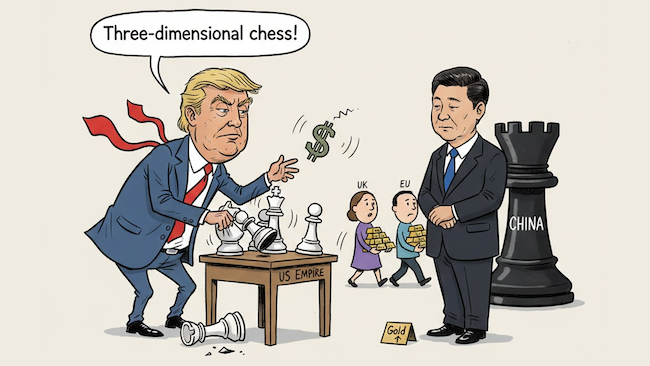
It seems so obvious. At least to those of us who still struggle with old fashioned two-dimensional chess and “first order effects.” Everything the Trump administration does has a coherent purpose.
In the headline news are the first-order effects…the American bishop blunders over to where it can be taken by China’s rook. Oops. ScandAsia:
Finnish prime minister arrives in Beijing for four-day visit to China
Asianikkei.com:
UK leader Starmer set to visit China to boost trade ties
Starmer’s visit — which will include a stop in Tokyo on the way back — is taking place a week after his government approved a controversial plan by China to build its largest diplomatic mission in Europe in London’s financial district, despite espionage concerns raised by local residents and the White House.
The Guardian:
‘Repatriate the gold’: German economists advise withdrawal from US vaults
Shift in relations and unpredictability of Donald Trump make it ‘risky to store so much gold in the US’, say experts
Bart de Wever, Prime minister of Belgium:
So many red lines have been crossed [by Trump]. Being a happy vassal is one thing. Being a miserable slave is another. If you back down now you are going to lose your dignity, probably the most important thing you can have in a democracy.
It used to be that foreigners were ‘happy vassals’ of the US empire, proud and content to do business with the USA, in dollars. Now, they have to be threatened. How? More tariffs, of course. Los Angeles Times:
Trump threatens Canada with 100% tariffs over its new trade deal with China
The first order effects are unmistakable; the American empire grows more isolated…and weaker. But the Trump Team is said to be looking beyond the obvious consequences…it is supposed to be playing ‘three-dimensional chess’ or looking at ‘third order effects.’.
That might be true. But our view — admittedly a small minority view — is that Team Trump is aiming for an outcome of which it is unaware…the destruction of the US empire. That is its true historical mission.
How else would you explain its foreign policy? And what about what is happening back in the homeland?
If you wanted to undermine the empire, what would you do? At home and abroad, you’d count on your deficits, inflation and tariff taxes to weaken the dollar and enfeeble the economy. But you’d also try to create fear, antipathy, and chaos so that neither allies nor citizens would trust your centurions.
Abroad, it would have been a piece of cake to negotiate quietly for more bases — or whatever — in Greenland. And at home, it would have been very easy, and un-provocative, to send out polite agents, properly dressed and properly trained to arrest real, illegal immigrant criminals. (By some counts, the Obama administration deported more illegal immigrants, with none of the hoopla.)
Both efforts would have cost peanuts and had the support of almost everyone. Nobody is against deporting violent criminals or setting up forward bases near the north pole, if necessary. Instead, Trump sent out threats and thugs, turned Europe and Canada against us…and much of the US population too. Now the foreigners are lining up to salute the Chinese premier…and back at home, Trump has become wary and restive.
But in his three-dimensional chess world…maybe that was the point?
Gold rose to almost $5,100 recently.
Stay tuned.
Regards,
Bill Bonner
Contributing Editor, Investor’s Daily
P.S. Periods of major debt, political strain, and global uncertainty don’t just end badly — they’re often followed by powerful waves of state-backed innovation and capital redeployment.
In a recent presentation, James Altucher explains why a once-in-a-generation government-led shift is quietly taking shape, how it echoes a proven historical playbook, and why investors who understand it early could benefit — while those who don’t may only see the consequences after the fact.