
Welcome to AI Collision 💥,

In today’s collision between AI and our world:
Our reader goes “full quant”
Legacy media tries to control learning
Peeping Darth
If that’s enough to get the calculations calculating, read on…

AI Collision 💥 Nvidia vs Pets.com
On Tuesday I finished up a discussion on “Cutting-edge chips are in short supply” by saying,
So Nvidia is going to make bank, no doubt. And its earnings release in a couple of weeks’ time will reveal more. I think it’s going to blow the market away again when it releases them and it may be the tipping point which sends the whole AI-focused market back into overdrive.
This comes as the stock trades at around $850 which is about 12.7% down from its 52-week high.
In dollar terms that’s about a $276 billion haircut on Nvidia’s market cap at the peak.
There are questions now being asked by the market about how a company like Nvidia justifies a $2 billion-plus market cap, and can Nvidia not only sustain that, but grow that all while maintaining a lead over the competition?
And increasingly the question is being asked, is the AI market in a bubble?
It comes as some fast, high-profile AI companies are beginning to realise that building out the most advanced technology in human history comes at some cost – and in a few cases it may appear like the cart is quite a few miles ahead of the horse.
Like how the founder of Stability AI, Emad Mostaque, decided to pull up stumps and depart the company because of his concerns about the centralisation of AI. We made note of this a few weeks back in our “From the Hive Mind” section.
Off the back of his exit, Stability AI then decided to axe 10% of its organisation which sounds scary but does only equate to around 20 people of its estimated 200 head count.
But then some wobbles have been felt as reports have circulated that Inflection AI has folded its original business. While technically that’s true, it is really a part of Microsoft making a move to absorb the company into its own AI domination plans.
All of this is catching the attention of regulators and government bodies. The UK competitions authority is looking closely at how Big Tech is increasingly dominating the move to AI. It is no doubt trying to ascertain whether or not they’re doing so unfairly – or at least doing it in a way where the government will make sure it gets its lick of the ice cream.
While there is a close eye on the likes of Microsoft, Google, Amazon and Meta, it’s not looking at the most dominating AI company of all – which is a good thing.
So, just how dominating is Nvidia? And how do we think its valuation looks?
In my view this is a company with a wide and well-fortified technology moat. While there is competition, and will be competition at all times, Nvidia is so far ahead because it made the call to head down the AI path well over a decade ago when it began to get heavily involved in deep learning and machine learning with its GPU-powered servers.
In a research report I wrote on Nvidia in 2013 I noted:
… mid [2013] NVIDIA trumped Google and created the world’s largest artificial neural network.
As a point of comparison, Google used 1,000 CPU based servers, about 16,000 CPU cores. NVIDIA, in collaboration with Stamford University, created an equally large network with only three servers… that’s right, three.
But by the time they’d finished, NVIDIA had 16 servers, all powered by NVIDIA GPU’s. The completed network was 6.5 times bigger than Google’s creation.
I think that puts Nvidia right at the pointy end of all this. And it looks like one of our readers here at AI Collision 💥 agrees.
After calling on feedback from you in the last couple of weeks I got a fascinating email from a reader who just went by the name “Viking Falcon”.
They sent me this (Note: some acronym explanations before you start – EPS: earnings per share; EBITDA: earnings before interest, tax, depreciation and amortisation; FCF: free cash flow; P/E ratio: price to earnings multiple):
1999-2000 High Profile Tech Wipe Outs
Pets.com (listed) – making no profit
eToys (listed) – making no profit
WebVan (listed) – making no profit.
1999 – 2000 Tech Crash 3 Largest Tech Companies
Microsoft
Peak Share Price 24/12/1999 -$58.38.
1/1/2003 $25.70 (-56%)
Market Cap 1999 $460B – 2002 $293B
EPS 2000 0.85, EPS 2001 P0.66, EPS 2002 0.70
EBITDA 2000 $12.25B, EBITDA 2001 $13.2B, EBITDA 2002 $12.9B
FCF 1999 $15.5B, FCF 2000 $10.5B, FCF 2001 $12.3B, FCF 2002 $13.7B
P/E Ratio 1999 65x, 2000 47x, 2001 55X, 2002 39x,
Cisco
Peak Share Price 1/4/2000 -$79.38
1/1/2003 $13.64 (-83%)
Market Cap 2000 $467B – 2002 $96B
EPS 2000 0.36, EPS 2001 None, EPS 2002 0.36
EBITDA 2000 $4.1B, EBITDA 2001 $1.4B, EBITDA 2002 $4.9B
FCF 2000 $4.6B, FCF 2001 $4.1B, FCF 2002 $3.9B, FCF 2002 $4.6B
P/E Ratio 2000 181 x, 2001 NEG, 2002 53X, 2003 38x,
Intel
Peak Share Price 22/3/2024 – $924.89
Market Cap 2001 $210B – 2002 $102B
EPS 2000 1.51, EPS 2001 0.26, EPS 2002 0.46 EBITDA 2000 $15.3B,
EBITDA 2001 $9B, EBITDA 2002 $9.7B, EBITDA 2003 $12.6B
FCF 1999 $8.7B, FCF 2000 $6.1B, FCF 2001 $1.4B, FCF 2002 $4.4B
P/E Ratio 1999 39.2x, 2000 20x, 2001 165X, 2002 34x,
NVIDIA
Peak Share Price 1/4/2000 -$79.38 1/1/2003 $13.64 (-83%)
Market Cap 2022 $613B – 2024 $2.2T
EPS 2022 3.85, EPS 2023 2.17 EPS 2024 12
EBITDA 2022 $11.3B, EBITDA 2023 $5.9BB, EBITDA 2024 $35.5B
FCF 2022 $8.1BB, FCF 2023 $3.8B, FCF 2024 $B, FCF 2002 $27B
P/E Ratio 2022 63 x, 2023 112x 2024 51x
Here’s the thing with NVIDIA, 3 year revenue growth rate 54.3%
3 year EBITDA growth rate 84.6%
3 year EPS growth rate 84.6%
3 year FCF growth rate 79.6%
10 year revenue growth rate 27.2%
10 year EBITDA growth rate 37%
10 year EPS growth rate 42%
10 year FCF growth rate 35%
Current Price $877 Using Reverse DCF.
The 10 Year EPS growth rate required to justify the valuation is 39%. The Historical 10 year EPS growth rate is 42%.
That growth had benefited from the GPU demand for gaming, then crypto mining. Until recently it did not include AI, which will possibly be the fastest growing technology since the internet.
Hypothetically If NVIDA grew at its historic average of 42% for the next 10 years that supports a valuation of $1,612
The expected growth rate of the AI industry is expected to be anywhere from 28%-40% to 2030.
Assuming (and a big assumption) if NVIDIA grew above market, for the next ten years, which theoretically, given their existing wide moat should remain the major player in the space, if they could grow at 40% that would support a valuation of ~$1,400
So NVIDIA is nothing like Cisco in the late 90’s / early 2000’s. Their price justifies their growth.
I’m not going to lie, that’s probably the most well researched bit of feedback I’ve ever received from a reader. It reinforces my point that those of you who read this Substack and understand how big the AI revolution is going to be are a bunch of smart cookies indeed!
Quantitative or qualitative analysis aside, what’s clear is that as per my essay on Tuesday, cutting-edge chips are in short supply, and right now there’s really only one dominant player that’s fulfilling that demand.

AI gone wild 🤪
This isn’t so much AI gone wild, but legacy media gone wild.
I read this week that a bunch of newspapers are annoyed at Microsoft for using their articles to train their AI.
As per The New York Times,
Eight daily newspapers owned by Alden Global Capital sued OpenAI and Microsoft on Tuesday, accusing the tech companies of illegally using news articles to power their A.I. chatbots.
The publications — The New York Daily News, The Chicago Tribune, The Orlando Sentinel, The Sun Sentinel of Florida, The San Jose Mercury News, The Denver Post, The Orange County Register and The St. Paul Pioneer Press — filed the complaint in federal court in the U.S. Southern District of New York. All are owned by MediaNews Group or Tribune Publishing, subsidiaries of Alden, the country’s second-largest newspaper operator.
In the complaint, the publications accuse OpenAI and Microsoft of using millions of copyrighted articles without permission to train and feed their generative A.I. products, including ChatGPT and Microsoft Copilot.
This is nuts. And likely not the last time we’ll see something like this.
I guess you’ve got to ask the question: how different is this to say a child learning from reading the paper and then going on to build a multi-billion-dollar business?
So let’s say Microsoft did let its AI access and read and learn from new articles. And that learning (amongst other avenues I’m sure) led to the AI becoming smarter, and then helping Microsoft to monetise that AI to provide services to other businesses.
What’s the difference between that and my kid reading the paper, learning from these articles (amongst other avenues I’m sure) and then becoming smarter and deciding to create their own digital media company, which then grows and sells services and products to people and becomes a multi-billion-dollar success?
It feels like legacy media is trying to put a copyright claim on learning.
I wonder if you can delineate between man and machine even when it comes to learning and say it’s OK for that but not OK for that?
I suspect this media case, and others that will come like it, are going to play fundamental roles on just how much on an impact AI does end up having on the world.
What can you learn from? Who controls information? What rights do you have to that information?
Seems almost like not just an AI problem, but an “all of us” problem and a not surprising stance from legacy media.

Boomers & Busters 💰
AI and AI-related stocks moving and shaking up the markets this week. (All performance data below over the rolling week).

Boom 📈
Tesla (NASDAQ:TSLA) up 25%
WiMi Hologram Cloud (NASDAQ:WIMI) up 29%
iRobot (NASDAQ:IRBT) up 23%
Bust 📉
Wearable Devices (NASDAQ:WLDS) down 20%
Appen Ltd (ASX:APX) down 10%
Quantgate Systems (OTCPK:QGSI) down 13%

From the hive mind 🧠
Ok, this probably could have made it into AI gone wild…except it’s really just one thing and not much to think about. AI priests…yeah that’s a bad idea. Gatorade baptism and all!
Amazon is up, up and away…thanks to AI. No great surprise there. And perhaps a foretelling of what’s in store for Nvidia.
First it was Tom Hanks for a dental commercial, now a BBC news presenter for insect repellant spray. Deep fakery and AI spoofing is all the rage, and I can’t see it slowing down any time soon.

Artificial Polltelligence 🗳️
In this week’s poll I’ve become a little more curious about your thoughts on the political landscape that we might see unravel in 2024 in the US.
I know this is somewhat of a departure from our usual polls, but it’s been percolating in my head this week about the impending US elections.
I think that it will be a significant outcome either way for the direction of the AI industry in the US. It’s a topic I’m going to look at more this year as I have no doubt it’s going to affect the market and AI stocks in particular.
But I’m curious at this juncture, which way you think this election sways…
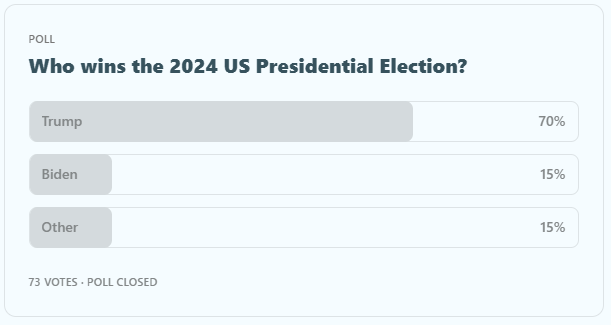
If “Other” is a preferred choice, I’d love to hear your thoughts on that and what other alternatives, shocking or otherwise, we may see spring into the conversation.

Weirdest AI image of the day
________ watching you through the gap around the door in a public toilet cubicle – r/Weirddallee


ChatGPT’s random quote of the day
“Don’t become a slave to technology – manage your phone, don’t let it manage you.” — Richard Branson

Thanks for reading, and don’t forget to leave comments and questions below,
Sam Volkering
Editor-in-Chief
AI Collision