 I’ve been putting money into private markets for years.
Crowdcube, Seedrs, Republic, EquityZen (the latter where I recently was able to snaffle a small parcel of Cerebras stock one year ago.)
I like private market investing. But I like it for the right reasons.
I go into it with my eyes wide open, fully aware of both the upside and, more importantly, the downside that comes with this often murky corner of the market.
The attraction is obvious.
Every private investor is chasing the elusive 10-bagger, the Series A or Series B company that eventually rings the bell on the Nasdaq a few years later.
That upside is real.
Right now, I’m sitting on roughly a four-bagger in Cerebras Systems, and if this week’s IPO goes the way the order book suggests, it could end up being significantly more than that.
But for every Cerebras, there is a Freetrade, an Imagen, or a BrewDog.
I invested in Freetrade through a Crowdcube raise and watched it climb to a paper five-bagger during the 2021 fintech mania. Then I watched the 2022 bear market drag it almost all the way back to my original entry price.
And all I could really do was watch, because there was no meaningful secondary market to sell into during either the boom or the collapse.
Eventually the company sold, investors got paid out, and I got my original capital back. No profit. At least it was not a loss.
Then there was Imagen, a small biotech I eventually had to write off entirely after it entered liquidation.
As the email bluntly put it…
“We would like to remind you that the Company was put into Creditors’ Voluntary Liquidation, and that the liquidator’s statement was made available at Companies House.
Shareholders / members are the last class of stakeholder to receive a distribution and they will only receive a distribution after everyone else has been paid in full. Unfortunately, given that the Company is in creditors’ voluntary liquidation, a form of insolvent liquidation, it is very unlikely that shareholders will receive a distribution.”
And like every other “Equity Punk,” I took the BrewDog haircut, which ultimately turned into a full wipeout when Tilray Brands bought what was left of the business for £33 million earlier this year.
Nil points there.
So I write this as someone who genuinely loves the asymmetry of private markets, but also has the scars to prove the risks are very real.
If you qualify to invest in this part of the market, I absolutely think it worth considering. The upside can be extraordinary.
But you also need to understand exactly what can go wrong.
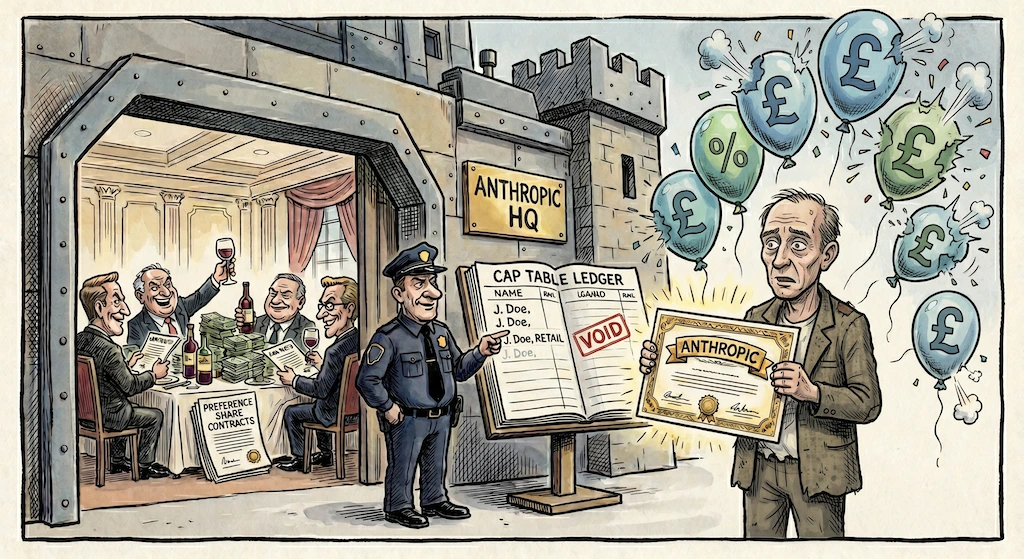
And I say that because this week, a whole group of private investors in Anthropic discovered that the “shares” they thought they owned are apparently void and not recognised by the company at all.
Britain’s Investment Letter Since 1938
In 1938, The Fleet Street Letter warned its readers that war was coming to Europe — and even identified September as the critical month.
Since then, its readers have been warned ahead of Black Monday, the dotcom crash and the 2008 financial crisis.
Today, Britain’s longest-running investment advisory is still looking for the “news behind the news” — and the investment opportunities others could be missing.
Click here to discover what The Fleet Street Letter sees coming next.
Capital at risk.
What Does Britain’s Oldest Investment Letter See Coming Next?
It warned readers ahead of Black Monday.
The dotcom crash.
And the 2008 financial crisis.
Now, nearly 90 years after it was founded, The Fleet Street Letter is still searching for the “news behind the news” — and the investment opportunities that could emerge from the next major turning point.
Click here to discover what its editors are seeing now.
Capital at risk.
The Anthropic shares that aren’t shares
Anthropic published a notice this week that I saw one investor describe as “the 9/11 moment for pre-IPO stocks.”
The company issued an update stating that both preferred and common shares are subject to strict transfer restrictions under its bylaws, and that any sale or transfer not approved by Anthropic’s Board of Directors is considered void and will not be recognised on the company’s books and records.
In plain English, if you bought “Anthropic stock” through a third party and the board never approved the transfer, you may not actually own the shares at all.
You own a line on a screen the company itself refuses to recognise.
Anthropic went even further.
The company stated it does not permit special purpose vehicles, or SPVs, to hold its stock, and that any transfer into an SPV structure is also considered void.
It also warned that any third party claiming to sell Anthropic shares to the public, whether through direct share sales, forward contracts, tokenised securities, or “other mechanisms,” is, in the company’s words, either potentially engaging in fraud or offering an investment that “may have no value” because of these transfer restrictions.
And they did not keep it vague, either.
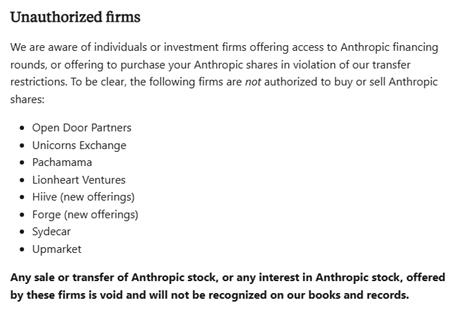
Anthropic named names.
Imagine seeing an advert back in March 2025 offering access to Anthropic at an implied US$61 billion valuation.
The pitch sounds straightforward.
You’re told the fund holds a forward contract tied to shares owned by an existing employee, or perhaps access through an SPV structure that itself supposedly owns the stock. You wire over £10,000.
A few months later, quarterly statements begin arriving. The position gets marked up as new funding rounds push Anthropic’s valuation higher. First US$350 billion. Then whispers start circulating about private market bids implying valuations north of US$1.2 trillion.
You start doing the maths in your head.
Twenty times your original investment.
£200,000 sitting there on paper.
Then Anthropic finally IPOs, and reality arrives.
The employee never had board approval to transfer the shares in the first place. The SPV’s claim was invalid from day one. The fund manager either knew this and sold the investment anyway or failed to understand the structure they were marketing.
Either way, the outcome is the same.
You are not on the cap table. The mark-ups were effectively fictional. And your £10,000 is gone.
That is counterparty risk in its purest form.
The other risks people don’t talk about
Beyond outright fraud, there are two major risks in private market investing that deserve far more attention than they usually get.
The first is that preference shares absolutely eat ordinary investors alive.
When serious institutional money invests in a private company, those investors are almost never buying the same class of shares you or I would buy.
They receive preference shares, which typically come with guaranteed returns, liquidation preferences, and a long list of protections ordinary shareholders never see.
BrewDog’s deal with TSG Consumer Partners is a textbook example. TSG invested roughly £213 million and secured an 18% compounding return on top.
By the time BrewDog eventually sold, TSG was owed more than £800 million.
And they got paid first.
Everyone else, founders, employees, and the “Equity Punks,” effectively got wiped out.
That is not unusual in private markets.
And if things deteriorate badly enough, as happened with Imagen in my case, shareholders are simply at the bottom of the food chain.
As the liquidation email bluntly stated: “Shareholders/members are the last class of stakeholder to receive a distribution.”
In other words, when a company sells cheaply, restructures, or liquidates, preferred investors get paid in full before ordinary shareholders see a penny.
In a bad exit, there is often nothing left.
The second major issue is liquidity, or more accurately, the lack of it.
You cannot simply decide to sell whenever you want.
A private company’s valuation is not a true market price. It is simply the value one investor agreed to pay during a specific funding round at a specific moment in time.
If you wake up tomorrow wanting out, there may be nobody willing to buy your shares.
And even if you do find a buyer, they will probably demand a steep discount.
In many cases, the company itself also has to approve the transfer before it can even happen.
Compare that with public markets, where you can press “sell” and have cash in your brokerage account the same day.
The dream scenario, of course, is that the company eventually goes public and your shares become freely tradable.
Except even that is not always straightforward.
Most pre-IPO holdings come with lock-up periods. It’s very common for early shareholders to face restrictions preventing them from selling for 180 days or more after the IPO.
So you can end up in a brutal position where the public market is freely trading the stock while you sit trapped in restricted shares, watching the price collapse in real time.
Private markets can still be one of the best ways for retail investors to swing for the fences.
But you need to understand exactly what you’re buying, who you’re buying it from, and whether the company will even recognise you as a legitimate shareholder.
Anthropic’s update this week is a timely reminder that all investing carries risk, and that even when you think you’re sitting on a fortune on paper, the reality can turn out very differently.
Until next time,

Sam Volkering
Investment Director, Southbank Investment Research
PS Private markets can absolutely create life-changing wealth. I’ve seen it myself with names like Cerebras Systems. But this week’s Anthropic chaos is also a reminder that paper wealth and real ownership are not always the same thing.
That’s why I still like having exposure to trends where you can buy real, liquid, publicly traded companies tied to the same underlying boom.
And right now, one of the biggest themes developing is the scramble for energy, metals, and industrial capacity as governments attempt to rebuild domestic supply chains and industrial independence.
One investor with deep political and intelligence connections believes that shift could trigger a genuine supercycle, and he has already committed more than $1 million of his own money positioning for it.
He is now showing readers exactly where he thinks the biggest opportunities could emerge.