 In today’s Issue:
- Andy Burnham can’t tax Americans
- Tech adoption is a proxy for prosperity
- Consumer jealousy will save the UK… eventually
The UK is gripped by an outbreak of envy. Politicians are trying to “fix” inequality. Its source and causes are never mentioned.
With welfare hitting dangerously unaffordable levels already, Labour is shifting its focus. It wants to drag down the rich instead of lifting up the poor.
But at what cost?
That’s irrelevant too.
It’s easy to understand what’s happened. Envy is just part of human nature. The only question is who it’s directed at and what you do about it.
If you’re envious of your neighbour, you seek to expropriate their wealth.
All you need to do in a democracy is gather enough votes and it becomes legit. Then you can make a tiny proportion of the population pay the bulk of taxes. Usually, they oblige.
But it’s hard to expropriate a foreigner’s wealth in this way. No matter how hard you vote, they’re beyond your reach.
And so you’re forced to compete instead… To try to grow wealthy by honest means.
This creates a paradox.
Many people accept being poorer, as long as the rich suffer disproportionately. But this only works as a political pitch as long as we’re still richer than the French.
Once your neighbouring country is wealthier than you, taxing your neighbours starts to feel a little hollow. It might improve inequality statistics. But you aren’t better off.
This explains why small nations tend to succeed. They compare themselves to other countries. Then they try to come up with better policies for the country as a whole instead of for income quintiles within a country.
There is no better example than the US.
The Differentiated States of America
Andy Burnham wants to encourage more devolution of powers. This is a wonderful idea because it creates competition between regions.
The US’ success was made possible by such competition. The US’ political system gives states a lot of power. That’s the purpose of its constitution.
Any given state can come up with bad policies. But they’re soon exposed as such. People, business, and tax revenue just leave.
This isn’t just theory. The US has experienced vast migration patterns within states during its history.
Today, the immigration from high-cost-energy states to low-cost ones is at an extreme level. Similarly, the wealthy are moving to low-tax and low-regulation states.
The same works within the EU. The nations that got their act together over the last 10 years are now seeing an influx of wealthy, productive, hard-working people.
Those that have adopted poor policies see an exodus.
The ability to arbitrage governments is the key. It keeps politicians honest.
As the EU’s centralisation and “harmonisation” grows, the ability to vote with your feet becomes less effective.
As technology improves, it becomes easier to separate your source of income and the nation you pay tax in.
But there’s something I want to caution you about…
The published comparisons between nations are terribly flawed.
Portugal, for example, supposedly ranks as a great destination for wealth. But that’s only true on paper. In practice, it is an extraordinary nightmare. The bureaucracy takes so long to process basic procedures that you fall afoul of their own rules.
Similarly, destinations must be ranked based on how hard they are to leave. Exit taxes play a crucial role.
Last but not least, the question is how long the friendly and unfriendly policies will last. The prospect of a Reform UK government likely matters a lot in the UK, for example.
Forget AI, America’s No.1 forecaster says a bigger boom is coming:
“I’ve invested $1 million of my own money to prepare for this…”
He predicted the Financial Crash, both Trump victories and 2025’s record rare metals surge that saw stocks soar as much as 645%
Now discover the move he is making as America seeks to unlock a home grown fortune potentially worth trillions on Friday, May 15th
Find out what that move is right here >>
Capital at risk
What defines the Wealth of Nations?
Most people who set out to answer this question start at the wrong end. They ask what makes some nations poor. But that gives away just how entitled they are about the source of their own prosperity.
Indeed, the abject failure of Western economists to make poor nations rich proves they haven’t the foggiest idea what’s behind prosperity.
The correct question to ask is what makes nations rich. How do they succeed?
The most important part of the answer today is the ability to adopt technology despite the disruption it brings.
Prosperity comes from doing more with less… from producing more with less land, labour, and capital.
This might sound like a ripoff for those relying on their income from land, labour, and capital. But in a free economy, those resources don’t sit unused. They go on to do something else that’s useful. That something else they do is the net addition to the economy from productivity gains.
The challenge is that the two are not obviously related. Few point to soaring productivity in agriculture as the reason why the Industrial Revolution happened. But it freed up the land, labour, and capital to make the Industrial Revolution possible.
Tell us, which breakthrough do YOU think made the Industrial Revolution possible?
Which breakthrough made the Industrial Revolution possible?
Nobody will point out what GDP was created by freeing up taxi drivers to do something new once self-driving cars are common. It’s hard to track. Yet it is the key.
Countries that protect incumbents grow slower because their economy doesn’t convert technology into productivity gains. The new GDP is never created for fear of having to reassign land, labour, and capital.
Which countries are able to adopt technology fastest today?
The answer is obvious. The US remains dominant. It’s the home of countless innovations the rest of us will have to wait years for.
Self-driving cars, the use of drones, the space economy, and countless other cutting-edge creations.
The biggest give-away is stock market listings. The US now accounts for nearly half of global stock market capitalisation.
Serious innovators now go to the US. That’s where their ideas are allowed to succeed. The innovators aren’t hindered to protect the incumbents.
A good proxy for the prosperity of nations is how far behind they are in adopting US technology. How long consumers have to wait before their local regulators approve the gadgets that are already selling in the US.
The good news is that technology is improving at an extreme pace. Consumer products are now global, but for government interference. People won’t accept falling behind for long. They’re now far more aware of what they’re missing out on than in the past.
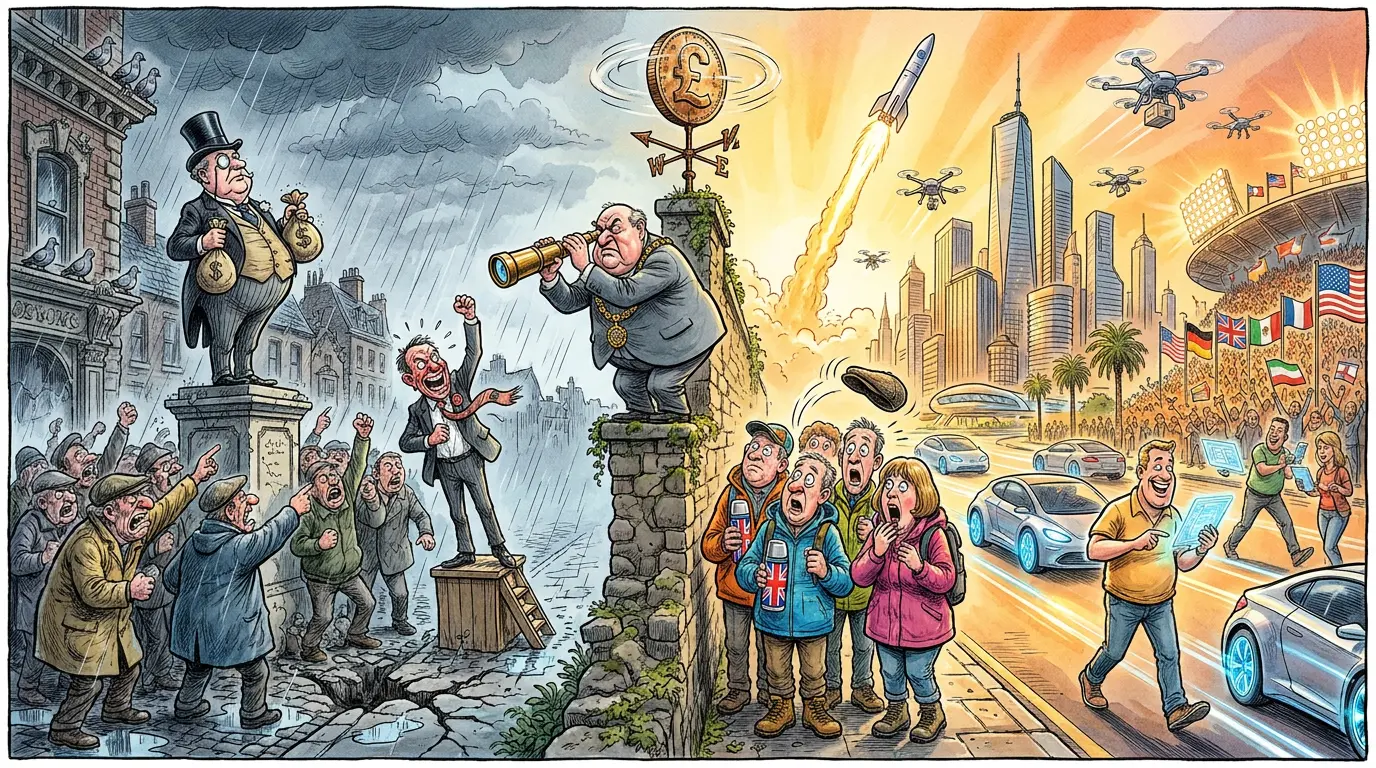
And the world cup may well be a breaking point for UK voters. The culture shock of discovering how advanced the US is compared to Europe will force change. Envy will shift from the rich in the UK towards the median in the US. And it’ll bring out the best in us, because Andy Burnham can’t tax or regulate them.
The question is, what should YOU do about it?
How should you invest if we’re at this cultural turning point?
Find out at 3 pm GMT on Thursday.
Until next time,

Nick Hubble
Editor, The Fleet Street Letter
PS Of all who answered yesterday’s poll about whether we can bring home the World Cup trophy, 56.7% said yes.