 A Bellingham double, a Quansah red card, Kane scoring a penalty then gifting one straight back. A 3-2 scoreline in a stadium where the visitor has only been victorious twice.
Scratch that. Now three times.
It’s exactly what you want to see from a World Cup knockout game, and England managed to get the job done.
They are and were always clearly the better side, so a win was expected. But being better itself doesn’t assure victory on the day. And the game was incredible to watch.
So, they got it done, and England is one step closer to it, “coming home”.
Next up is Erling Haaland’s Norway in Miami on Saturday, fresh from dumping Brazil out for their first ever quarter-final.
That game is going to be phenomenal. England vs. the English Premier League’s most impactful player (and the rest of his Norwegian team, including an on-fire goalkeeper).
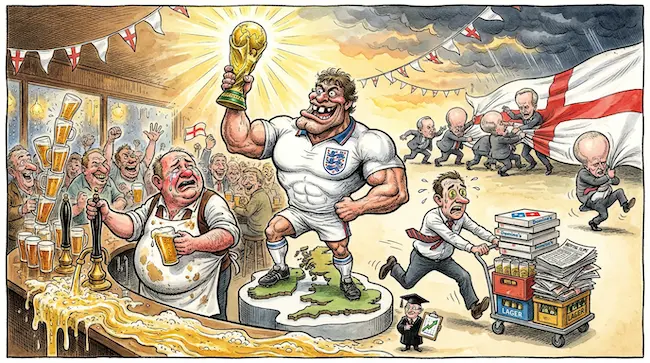
That game vs. Norway will be a huge boom for the British economy. But like every World Cup, if we dream a little… What if the Three Lions beat Norway, make the semis, win that, and go on to make the final, and then win it?
The World Cup Final is on July 20. Two weeks away exactly. So there’s plenty of football left.
But that also gives you two weeks to make some money from England’s progression… and I don’t mean through creative sports betting.
Britain’s Investment Letter Since 1938
In 1938, The Fleet Street Letter warned its readers that war was coming to Europe — and even identified September as the critical month.
Since then, its readers have been warned ahead of Black Monday, the dotcom crash and the 2008 financial crisis.
Today, Britain’s longest-running investment advisory is still looking for the “news behind the news” — and the investment opportunities others could be missing.
Click here to discover what The Fleet Street Letter sees coming next.
Capital at risk.
What Does Britain’s Oldest Investment Letter See Coming Next?
It warned readers ahead of Black Monday.
The dotcom crash.
And the 2008 financial crisis.
Now, nearly 90 years after it was founded, The Fleet Street Letter is still searching for the “news behind the news” — and the investment opportunities that could emerge from the next major turning point.
Click here to discover what its editors are seeing now.
Capital at risk.
Follow the pints
When England reached the semi-finals in 2018, the Centre for Retail Research estimated there was an additional £2.45 billion in consumer spending across the country.
Around £1.9 billion of that went through the tills of shops and roughly £510 million over the bar.
This time the forecasts are bigger: £7.6 billion in additional economic benefit from this World Cup.
Had it been in Europe, or a more friendly timezone, the benefit may be even bigger.
But, as the tournament is in North America, England’s early games kick off in the middle of the UK night. A 1 am start does not fill a pub, it fills a fridge.
Those late kick-offs pushed spending out of the boozer and into supermarkets, corner shops, and delivery apps.
That makes a difference for this World Cup, because you can trade stocks that will see a boost to their bottom line from England’s action here.
But, the obvious trade and the smart trade are not the same thing.
The obvious trade is the pub part of the market. JD Wetherspoon (LSE: JDW.L) is the name everyone reaches for, and fair enough. Alongside ‘Spoons sit Mitchells & Butlers (LSE: MAB.L), owner of All Bar One and Harvester, the pub group Marston’s (LSE: MARS.L), and pure-play London landlord Young & Co.’s Brewery (LSE: YNGA.L).
When the government relaxes closing times to 2 am for the big games, these are the tills that ring.
But in my view, the smarter trades are the at-home lot.
That means, Tesco (LSE: TSCO.L), Sainsbury’s (LSE: SBRY.L), Greggs (LSE: GRG.L) and Domino’s Pizza Group (LSE: DOM.L), which holds better than half the UK takeaway pizza market.
Add the bookies, Entain (LSE: ENT.L) and Evoke (LSE: EVOK.L), the old William Hill and 888, because World Cup betting here runs to billions.
These all get a boost from the World Cup as it stands.
However…
What I don’t think the market is fully pricing in, and what makes these stocks all great ideas, is what happens if England wins it all?
What if this time, it really is coming home?
What a win is actually worth
Someone has done the proper work on this.
Marco Mello, an economist at the University of Surrey, studied every World Cup winner from 1961 to 2018 and published the results in the Oxford Bulletin of Economics and Statistics.
Winning the World Cup lifts year-on-year GDP growth by at least 0.48 percentage points in the two quarters after the final.
On Britain’s roughly £2.8 trillion economy, that’s in the order of £6 billion of extra output over six months after the games are done.
Interestingly, the boost comes mainly from exports, not pints. A win is a global advert for the country that lifts the trophy, and the winner’s goods sell better abroad in the months that follow.
The effect fades from the third quarter, when growth drops back to trend. Hosting, Mello found, delivers no boost at all.
So, there’s a tangible benefit to the whole country economically with a win. But then you also need to factor in the intangible, social factors.
The Norway quarter-final is a 10 pm GMT start. The semi (assuming they make it through) is 8 pm. The final, if we get there, is 8 pm on a Sunday.
Those are prime pub hours, on the biggest nights, with the whole country watching one screen.
The British Beer and Pub Association reckons each pub could pour an extra 1,240 pints per England match, building to 55 million extra pints nationally if England reach the final (I reckon they’re understating it).
Also worth factoring in is the lift in places like Scotland and Wales too, where they’ll turn out just to see England get beaten.
Hospitality spending across the tournament is forecast at around £898 million, double 2022, and almost all of it lands in these knockout rounds.
Just imagine…
England in a first World Cup final since 1966, on a warm July Sunday, the country pouring itself into pubs and living rooms for one night. The final alone could plausibly deliver a single-day surge worth a billion pounds.
A win might even change the entire social dynamic and unite the country in a way we’ve not seen for many years.
But, can it save the government?
The deeper England goes, the better it looks for Andy Burnham.
Who?
Exactly.
With England now igniting hope amongst the populace, the whole political debacle has fallen to the wayside, if only for two more weeks.
Labour’s leadership contest is live as I write, with nominations opening this week and closing on the 16th. Set those dates against the football. The quarter-final is the 11th. The semi is the 15th. Whoever wins that contest could be moving into Number 10 on the very weekend England plays a World Cup final.
Let me ask you this, what takes more attention in that case?
England in a World Cup Final or a new PM?
You can see why a new Prime Minister would want to drape themselves in the flag, and for once there could be substance under the photo op. If the predicted numbers hold, the incoming leader inherits two quarters of handy GDP growth.
The government, of course, will claim the credit… at least that’s how they’ll spin it. But the reality is it will be Thomas Tuchel and his troops.
We’ve been here before. In 1966, Harold Wilson basked in England’s World Cup win and later joked that England only ever win it with Labour in power. His election that year, though, came three months before the Wembley final.
So can football save the government?
It can lend one a decent autumn. And the social and economical boost does give a shine to things.
But if they push the boat out on an election to 2029, it’ll be a distant memory by then… until England wins the Euros too in a trophy brace of their own!
Until next time,

Sam Volkering
Investment Director, Southbank Investment Research
PS This Thursday, Nick Hubble (Editor of The Fleet Street Letter) and I are hosting a live YouTube event to answer the question we get asked most: If I had £10,000 to invest today, where would I put it right now? Keep an eye on your inbox for the date, and bring your questions. Click here to get a reminder of the event so you don’t miss it.