
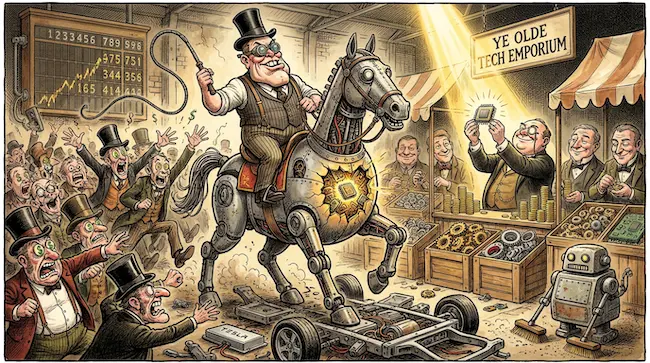
 The first pure-play humanoid robotics company is heading to the Nasdaq. Tesla has torn out one of its most famous production lines to build Optimus. And I continue to believe the biggest investment opportunity sits not with the robots themselves, but with the component makers underneath it all.
Last week, I promised we’d get stuck into robotics. And judging by the responses I received, people are still split on one simple question: are humanoid robots inevitable, or are they just Silicon Valley’s latest expensive obsession?
It’s a fair question. After all, the idea of a human-shaped machine walking around your house still feels a little strange.
The funny thing is, we’ve been imagining robots for far longer than most people realise.
People tend to think robots are a modern invention. In reality, the idea is thousands of years old. The word itself, however, is only about a century old.
|
Of course, a humanoid robot is only as useful as the things it can pick up, turn, press, and carry.
Legs get the robot to work. Hands do the work. AI tells it what work needs doing.
The company that cracks all three at once — in a way that’s useful, affordable, and unthreatening — may well come to dominate the biggest consumer device market we’ve seen since the smartphone revolution.
The question is: What’s really going on in the robot market right now?
And more importantly, where should investors be allocating capital today?
Britain’s Investment Letter Since 1938
In 1938, The Fleet Street Letter warned its readers that war was coming to Europe — and even identified September as the critical month.
Since then, its readers have been warned ahead of Black Monday, the dotcom crash and the 2008 financial crisis.
Today, Britain’s longest-running investment advisory is still looking for the “news behind the news” — and the investment opportunities others could be missing.
Click here to discover what The Fleet Street Letter sees coming next.
Capital at risk.
What Does Britain’s Oldest Investment Letter See Coming Next?
It warned readers ahead of Black Monday.
The dotcom crash.
And the 2008 financial crisis.
Now, nearly 90 years after it was founded, The Fleet Street Letter is still searching for the “news behind the news” — and the investment opportunities that could emerge from the next major turning point.
Click here to discover what its editors are seeing now.
Capital at risk.
Digit gets a ticker
Agility Robotics, the Oregon company behind Digit, the warehouse humanoid already working shifts for Amazon and Toyota, has signed a definitive deal to merge with Churchill Capital Corp XI (Nasdaq: CCXI).

The deal values Agility at US$2.5 billion pre-money and is expected to raise more than US$620 million, making it the largest capital raise in humanoid robotics history. The combined company will trade under the ticker AGLT, with backers including Amazon, Nvidia, SoftBank, and Foxconn.
This is not a concept company. Agility says Digit has logged around 65,000 hours of real-world work across nine US states, with roughly US$300 million in booked revenue covering around 1,000 robots.
As rumours of the listing began to circulate — and following the eventual announcement — CCXI shares hit a high of around US$19.50, a gain of 95% in a matter of weeks.
The combined business hasn’t begun trading yet, but it is going to be the first pure play humanoid robot company on the Nasdaq.
And suddenly, this entire investment idea finds its way into a singular ticker, almost like how in the early early days of the ChatGPT release we saw C3.ai explode simply because it was one of the few pure-play AI companies.
If there’s a hype train to ride early, this may be the one.
Then there’s Tesla.
From cars to robots
In May the last Model S and Model X rolled out of Fremont, and Tesla took just 46 days to tear down the original assembly line… the line that built the company. That floor is being converted into Optimus production, with limited output of the Gen 3 robot expected to begin about now, and a long-run design capacity of one million robots a year.

Worth noting, each Optimus contains roughly 10,000 unique parts, and there’s no established supply chain yet for a product Tesla wants to build by the million. Musk himself concedes early output will be slow.
A million-unit product with no defined supply chain. If that doesn’t get your investor spidey-senses tingling, I don’t know what will.
Because when you break it down, there’s an opportunity to get ahead of the trend and pick the suppliers before the entire humanoid robotics market gathers momentum.
Buy the shopping list, not the robot
Every technology platform I’ve lived through — from the beige PCs I experimented with as a kid to the smartphone revolution — has followed the same pattern.
Device makers fight brutal battles for market share. The component makers sell to everyone.
So rather than trying to pick the winning humanoid robot manufacturer, let’s break a robot down into its shopping list of components and invest there.
Start with motion.
Each robot needs dozens of actuators, which means motors from companies like Nidec, the world’s largest motor manufacturer. Inside most rotary joints sits a harmonic reducer — a precision gear that turns fast motor spins into strong, accurate movement — a niche that Japan’s Harmonic Drive Systems has dominated for decades, with Nabtesco and THK supplying bearings and guides around it.
Supply chain reports suggest Tesla wants Gen 3 component makers ready to support production of 1,000 robots a week by September. You’d naturally look first to the established players capable of meeting that kind of demand.
The problem? Most of them are Japanese and can be tricky for UK investors to access directly.
So where else do you look?
Well, anything that moves needs magnets, and magnets need rare earths. That puts MP Materials in the US and Lynas in Australia firmly in the mix.
A robot also has to see and feel. Cognex’s industrial vision systems and Ouster’s lidar technology cover the eyes, while Allegro MicroSystems makes the magnetic sensors inside robotic joints that help position limbs with precision.
Then there’s the brain.
Nvidia’s Jetson Thor is rapidly becoming the default compute platform for humanoid robotics.
Blackwell architecture, 128GB of memory, 2,070 teraflops of AI compute in a 130 watt package, with modules from US$2,999 at volume. Agility is putting Thor into the next generation of Digit, and Boston Dynamics is putting it into Atlas.
Nvidia doesn’t need to win the robot wars because it has more or less already cornered the market on what they use to think.
And then memory. If you bought into the memory market fears in the last couple of weeks, I’m here to let you know it’s all a storm in a teacup.
Demand is increasing. And robotics is only going to exacerbate the demand supply imbalance.
Micron’s CEO told investors last month that a humanoid carries ten times the memory of an advanced driver-assisted vehicle, and that a multi-decade memory demand cycle begins in the latter part of this decade.
So, yes, Micron and SK Hynix are absolutely two of the market leaders there.
SanDisk, Kioxia, and Samsung ride the same wave in storage. If you’ve been reading my work on this during the year, you’ll know memory and storage has been my big theme all year. Robotics extends it by another two decades (at least).
How big does it all get? Goldman Sachs says US$38 billion by 2035. Barclays says US$200 billion by 2035.
And if you love a big multi decade thematic opportunity, then Morgan Stanley says over US$5 trillion by 2050, with a billion humanoids in service.
When serious institutions differ by a factor of five on the same date, the truth is nobody really knows.
What is clear, however, is that if humanoid robotics gains the traction I expect, the asymmetric opportunity is enormous. Getting positioned early could prove to be one of the most important long-term factors in successfully investing in this space.
It might still feel a little weird. It might be difficult to comprehend just how ubiquitous humanoid robots could become. But that’s true of almost every transformational technology before it reaches the mainstream.
The internet sounded ridiculous to some. Smartphones seemed unnecessary. Even electric vehicles had their doubters.
The investors who benefited most weren’t necessarily the ones who predicted every detail correctly. They were the ones willing to keep an open mind, understand the opportunity, and take sensible risks before everyone else arrived.
Until next time,

Sam Volkering
Investment Director, Southbank Investment Research
PS While I’m looking at the future of robotics, Jim Rickards is focused on a very different trend — one he believes could have an even bigger impact on Britain’s future wealth and prosperity.
He believes we’re standing at the beginning of what could become Britain’s next great oil boom. If he’s right, the earliest investors could have an extraordinary opportunity on their hands.