
 Computer storage has spent the past 70 years trying to inch its way closer and closer to the processor.
In 1952, IBM shipped the 726 tape drive. Data lived on giant reels in another room, every request meant waiting while the tape spun past to find what you needed.
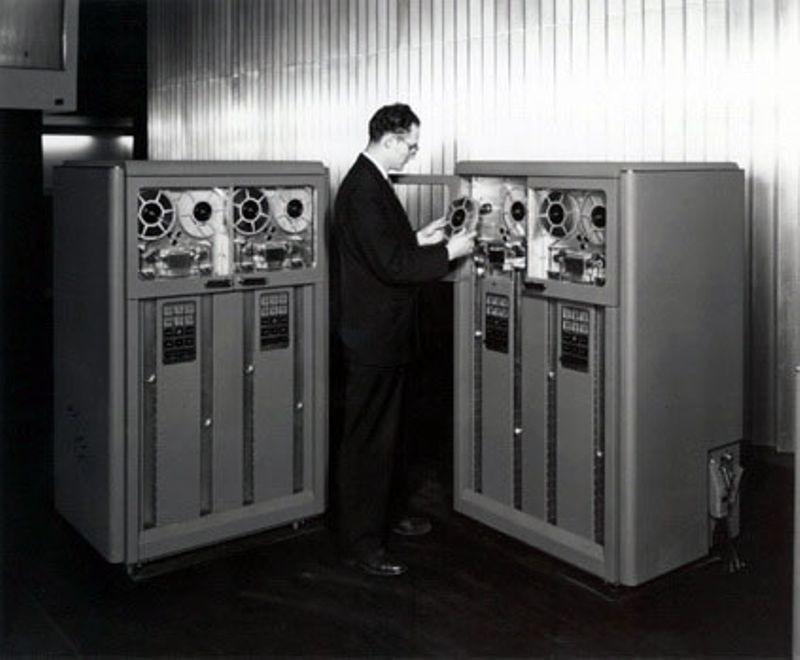 Source: Computer History Museum
Four years later came RAMAC, the first spinning disk. It stored five megabytes, weighed more than a tonne, and was about the size of two wardrobes.
But it was a genuine miracle because, for the first time, you could ask for any piece of data and get it almost instantly.
It was like wizardry, at the time of course. Today, you’ve probably got more storage in your fridge. (Seriously.)
Hard drives then shrank from rooms into cabinets, from cabinets into desktop PCs, and eventually onto a small spinning platter inside your computer.
Then, in 1987, Toshiba invented NAND flash memory. The spinning disk disappeared, and storage became just another chip.
Every step traded a bit of cost for a lot of location and size.
And yesterday, at the Future of Memory and Storage show in Santa Clara, it all took another monumental step forward.
A new floor between HBM and the SSD
SK hynix and Sandisk published the first ever standard specifications for High Bandwidth Flash (HBF).
Strip the acronyms away and HBF is the same flash memory sitting in the SSD in your laptop. What’s changed is where they put it, and hence, how it works.
Instead of living at the end of a cable, the flash is stacked in layers and mounted directly onto the processor package, millimetres from the chip doing the thinking.
That change of address does something remarkable.
A fast NVMe drive, like the one you might have in a desktop PC, moves data at about 7GB per second.
HBF, at its highest specification, is designed to move data at 3,000GB per second.
Same basic technology, but more than 400x the speed. And a single stack holds up to 512GB, which is 16 times the RAM found in a typical PC with 32GB installed.
I have been saying for over a year that we’re in a memory and storage crisis. We simply can’t build enough of either to power today’s AI boom.
Yes, there’s a compute shortage too. But compute is useless without memory and storage. HBF is the next evolution in solving that bottleneck, and that’s a huge opportunity for the companies developing it.
That’s because AI is moving into the inference era. An era where computers aren’t learning so much as thinking.
Inference is incredibly memory-hungry.
Every time an AI model responds, it has to revisit everything stored in its context window. It may also retrieve documents, databases and other information you’ve pointed it towards. All of that has to be accessed, processed and returned almost instantly.
Agentic AI demands even more. An agent that remembers yesterday has to store yesterday. A humanoid robot raises the bar again, relying on local models, sensor data, video feeds, and learned experiences stretching back days, weeks, and eventually years.
None of that works if memory and storage can’t keep up.
Britain’s Investment Letter Since 1938
In 1938, The Fleet Street Letter warned its readers that war was coming to Europe — and even identified September as the critical month.
Since then, its readers have been warned ahead of Black Monday, the dotcom crash and the 2008 financial crisis.
Today, Britain’s longest-running investment advisory is still looking for the “news behind the news” — and the investment opportunities others could be missing.
Click here to discover what The Fleet Street Letter sees coming next.
Capital at risk.
What Does Britain’s Oldest Investment Letter See Coming Next?
It warned readers ahead of Black Monday.
The dotcom crash.
And the 2008 financial crisis.
Now, nearly 90 years after it was founded, The Fleet Street Letter is still searching for the “news behind the news” — and the investment opportunities that could emerge from the next major turning point.
Click here to discover what its editors are seeing now.
Capital at risk.
Why these two giants teamed up
On NAND market share, SK hynix has almost 20% and Sandisk close to 13%.
Samsung leads with about 32%.
On their own, SK or Sandisk aren’t the biggest. Together they are.
Write the standard first and everyone else either adopts your architecture or builds a fragmented alternative. Google and Tenstorrent have already joined the consortium.
|
New technologies only become true industry standards when the biggest platform builders adopt them. If Nvidia adds HBF alongside HBM in future AI chips, it would validate the technology and likely accelerate adoption across the entire AI ecosystem—exactly the catalyst Sam argues investors should be watching for.
Samsung and Micron haven’t. At least, not yet.
I expect HBF to become a significant part of the growth story for both companies. Combined with demand that continues to accelerate, I think there’s still substantial upside in each.
Sandisk (Nasdaq: SNDK) closed at US$1,288 yesterday, up more than 2,000% over 12 months but it had been trading 50% below its July high of US$2,354.
I think you need to somewhat ignore the last 12 months, because it can cloud judgement about the potential of the company still going forward.
It reports fourth-quarter results on Wednesday, with analysts expecting revenue of more than US$8 billion, compared with just under US$2 billion a year ago.
NAND is essentially its entire business, so HBF matters more to it than to SK hynix, where NAND is about a third of revenue.
Even so, for SK hynix it’s potentially a big push for the stock price.
SK hynix ADRs are trading around US$146, after having raised US$26.5 billion just a couple weeks ago. Second-quarter revenue of 79.3 trillion won was up 257% year on year, at a 76% operating margin.
It’s insanely profitable too.
SanDisk expects to ship its first HBF samples in the second half of this year, with inference devices following in early 2027. That means large-scale commercial adoption is still more likely towards the end of the decade.
If Samsung or Micron joins the consortium, HBF stops being a two-company standard and starts looking like the industry standard. At that point, the race is really on.
And if an Nvidia or AMD accelerator roadmap shows an HBF slot sitting alongside HBM sites, that end-of-decade timeline for scale probably comes in a year.
You won’t read much about HBF today, but I believe it could prove to be one of the most important developments in AI infrastructure this year.
Until next time,

Sam Volkering
Investment Director, Southbank Investment Research
PS Everyone is watching Nvidia. Far fewer investors are paying attention to the technologies that make the next generation of AI possible. James Altucher, editor of Altucher’s Investment Network, believes one breakthrough could become just as important – and he’s identified the company he thinks could benefit most. Click here to see why.