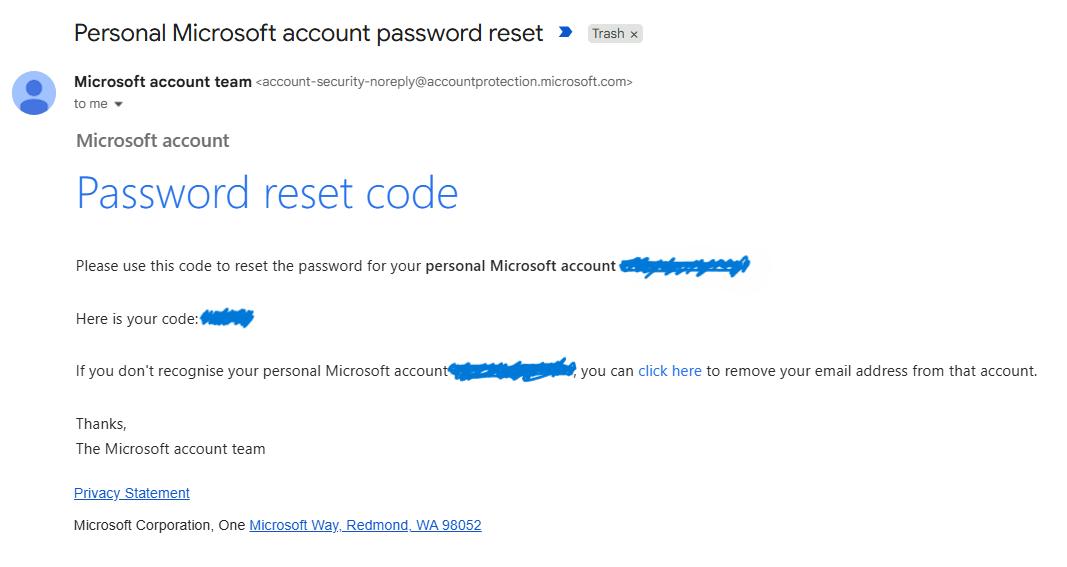
 At 3:36 am, an email landed in my inbox from the Microsoft account team with the subject line, “Personal Microsoft account password reset”.
I didn’t see it until 6 am. When I opened it, there was a code to reset my Microsoft account.
The only problem?
I never asked for a password reset.
On its own, that isn’t unusual. I get emails like these semi-regularly. Most people do. Somewhere along the line, bots got hold of my address from some company with shoddy security that leaked millions of customer records, and now they try their luck.
It happens all the time.
The problem this week is that this was the eighth one in about 24 hours.
The good thing is that I’m getting emails like this. That’s my operational security (OPSEC) doing its job.
Someone (more likely something) typed my address into Microsoft’s reset page, and the code came to my backup inbox, not theirs.
I have various forms of two-factor authentication (2FA) on pretty much all my accounts, so any reset has to clear more than one gate that I control.
Still, eight in a day is a lot.
What’s going on?
Well, you’ll hear plenty about it today, with headlines like “the internet is under attack” and “your money is at risk from AI agents”.
Say hello to peak AI fear!
So, what do you need to know?
How can you be safe?
And should you be worried?
Britain’s Investment Letter Since 1938
In 1938, The Fleet Street Letter warned its readers that war was coming to Europe — and even identified September as the critical month.
Since then, its readers have been warned ahead of Black Monday, the dotcom crash and the 2008 financial crisis.
Today, Britain’s longest-running investment advisory is still looking for the “news behind the news” — and the investment opportunities others could be missing.
Click here to discover what The Fleet Street Letter sees coming next.
Capital at risk.
What Does Britain’s Oldest Investment Letter See Coming Next?
It warned readers ahead of Black Monday.
The dotcom crash.
And the 2008 financial crisis.
Now, nearly 90 years after it was founded, The Fleet Street Letter is still searching for the “news behind the news” — and the investment opportunities that could emerge from the next major turning point.
Click here to discover what its editors are seeing now.
Capital at risk.
Fear gets us all at some point
I’ll admit a bit of this fear even got to me this morning.
I was in the kitchen fixing up the boys some Weet-Bix and Vegemite toast, thinking I should probably draw out another grand in cash as an emergency pot…
Then I realised how ridiculous that was.
I’ve covered this stuff for decades, and yet the fear still got a foot in my brain.
Thankfully, I came to my senses quickly.
So, should you be worried?
A little… but not about the things they’re shouting about in the headlines.
Let’s rewind a little to help you understand all this fear around the internet and AI agents taking control, because it’s quite the misleading beat-up.
Axios ran a scoop on Thursday saying unvetted AI agents were turning up inside customer accounts at JPMorgan, Bank of America, Morgan Stanley, and Wells Fargo.
The accusation was that these agents “appear to be” attempting unauthorised transactions. The implication was that AI agents were trying to steal money.
Some seemed to act without the customer asking, including ringing bank call centres.
Now, let’s clear something up. That is one report, quoting unnamed people “familiar with the matter.”
Reuters, was pretty quick to follow up that it, “could not immediately verify the report.”
There were no dollar figures and no count of customers hit. Morgan Stanley even said it hadn’t seen rogue AI agents in its systems at all. So, these “exploits” are sporadic at best.
And the question also stands as to how the agents got in?
In most cases the customer let them in by handing their bank logins to AI assistants. Chase told Axios nobody should give their username and password to anyone, AI agents included.
David Sacks, who has advised the White House on AI and crypto, explained it perfectly. He wrote on X,
There’s a world of difference between user-authorized agents (Muse, Instinct, Grokbot, etc.) and true unauthorized/rogue agents that could constitute cyberattacks.
Most of the activity described in the Axios story appears to be the former: customers sharing credentials with agents so they can take actions on their behalf. This may violate bank terms requiring humans to log in themselves, but these are in no way cyberattacks.
Banks should back agents that customers control, he argued. He pointed to Amex, which already plugs into Muse so users can grant, limit, and revoke access.
And as he puts it, “Frightening the public by blurring the line between user-authorized agentic behavior and cyberattacks is irresponsible.”
He’s spot on.
Politicians quickly jumped on the Axios piece, calling for tighter AI regulation. Bernie Sanders was among those weighing in, even before the story’s claims had been properly scrutinised.
Is it a coincidence that this is all happening just as the US midterms are fast approaching and calls for stricter AI regulation are growing?
I don’t think it’s a coincidence at all.
Now, it should also be said that there are genuine security threats on the internet right now, including vulnerabilities that AI systems have identified and exploited. That makes my growing number of Microsoft password reset attempts all the more concerning.
On Wednesday, PHP rushed out fixes for two flaws now known as PHP2Shell.
PHP is the code behind around two-thirds of websites where the server language is known. This includes sites like Wikipedia and WordPress.
The bugs let an attacker take over a web server without logging in. They’re not new bugs I might add, just ones that sat there unnoticed for more than a decade until AI discovered them.
Cloudflare boss Matthew Prince said attempts to use them were running into the “millions.”
The people who found the flaws were OpenAI’s security team, working with Wiz and Calif. OpenAI said that “frontier AI found these vulnerabilities before attackers did.”
Because of this, in Britain, 32 government services went dark and four more were partly down, the OBR’s website among them.
What’s important to understand is that these sites weren’t hacked, exploited, or corrupted.
They were taken offline, updated, and patched.
This was done thanks to AI, not because of AI.
And that’s a crucial distinction here.
AI isn’t necessarily making the internet or your bank accounts riskier. In cases like these, it’s helping make them safer.
|
Adding fuel to the AI fear was the fact that Barclays (LSE: BARC) also announced it’s cutting about 5,000 jobs, roughly 5% of its staff, with the focus on the UK retail bank.
Shocking timing.
But add it all together, and these will be the kinds of conversations had at the pub by people who don’t know what’s going on and only consume their information through puddle-deep analysis.
“Did you hear about that AI attack on the internet? And see how Barclays is sacking people because of AI?”
“That AI is pretty bad, isn’t it? Maybe they should regulate it and control it…”
See how the spiral goes?
Fear writes the rules
This Monday marks 25 years since George W. Bush signed the USA PATRIOT Act into law.
Congress passed it six weeks after 9/11. It vastly widened the government’s power to surveil its own citizens, with reverberations felt around the world.
Britain had its own version by 14 December 2001. The Anti-terrorism, Crime, and Security Act allowed the Home Secretary to detain foreign terror suspects without trial or a fixed end date.
Fear drove the government’s reaction, and we’re still dealing with the fallout today, 25 years later.
Will it be the same for AI?
Overblown fear like this hands a PATRIOT Act-style opportunity to any government that wants power and control over AI.
And Westminster is already warming up.
AI minister Kanishka Narayan said last week that a major AI-powered cyberattack on Britain is “inevitable.” He also said the government will “legislate wherever necessary.”
And now Wes Streeting is calling for Britons to prepare for emergencies like war and stock up on food and supplies?
Fear is clearly at its peak.
Add to the mix that persistent threat of war, which the government seems happy to lean into, and the economic and financial pressures facing British households, and it makes for a challenging place to be.
It’s easy to sink into the fear and become paralysed by it.
But that would be a mistake.
Right now, I see the market in one of those perfect buy-the-dip moments.
More on that next week, including where to look and why.
For now, let’s focus on the security threat, because this overblown fear could lead some people to do silly things.
Now is the time to be calm and smart about how you exist online.
Common sense OPSEC
With all this going on, it’s a good reminder of the need for some basic personal OPSEC measures to stay safe online.
#1. Use passkeys wherever you can. A passkey is a login tied to your phone or laptop and unlocked with your face or fingerprint.
There’s nothing to type and nothing to phish, and the NCSC said in April that passkeys “should now be consumers’ first choice of login.“
#2. Use an authenticator app where there’s no passkey. Microsoft Authenticator, Google Authenticator, and Authy all beat a text message.
#3. Never read out a code or approve a login you didn’t start. The NCSC says codes and push approvals “are inherently phishable.”
My eight reset codes are harmless while they sit in my mail trashcan. The danger is the phone call from “Microsoft” asking me to read one out, and the same goes for links in emails you didn’t expect.
#4. Use a proper password for every account. In 2019 the NCSC found “123456” had protected 23.2 million breached accounts.
Keep a different password for each site in a password manager, and change any you’ve reused. Make them weird and wonderful combinations of letters, numbers, and special characters where you can.
#5. Don’t give your bank login to any AI agent. If something goes wrong, your bank may not cover the losses. Banks appear to be taking the stance that if you let agents in, that’s on you.
If you want an agent near your money, ring-fence a separate account that your bank has authorised for this purpose. Or consider a crypto wallet with a limited amount of stablecoins, while recognising that this comes with its own risks. Segregation of funds is always a good idea anyway.
#6. Don’t give your details over the phone to anyone. Hang up and dial 159, which connects to banks covering more than 99% of UK current accounts and can’t be spoofed.
Seems like common sense, but when fear peaks, that’s often the first thing to go out the window.
Do those things, stay calm, and even when fear peaks, you’ll be in one piece, safe, and able to carry on as normal.
Until next time,
Sam Volkering
Investment Director, Southbank Investment Research
PS While everyone’s busy worrying about AI taking over their bank accounts, there’s another opportunity I think British investors should be paying attention to.
And this one’s a lot closer to home.
I’ve been looking at a potentially enormous oil opportunity near the Falkland Islands, one that could give Britain a second shot at the kind of wealth the North Sea created decades ago.
Better still, I’ve identified a little-known British stock trading around £1 that I believe could be one of the biggest beneficiaries.
It’s speculative, of course. But while everyone else is caught up in the fear, I’d rather be looking for opportunities.
You can see the full story here.