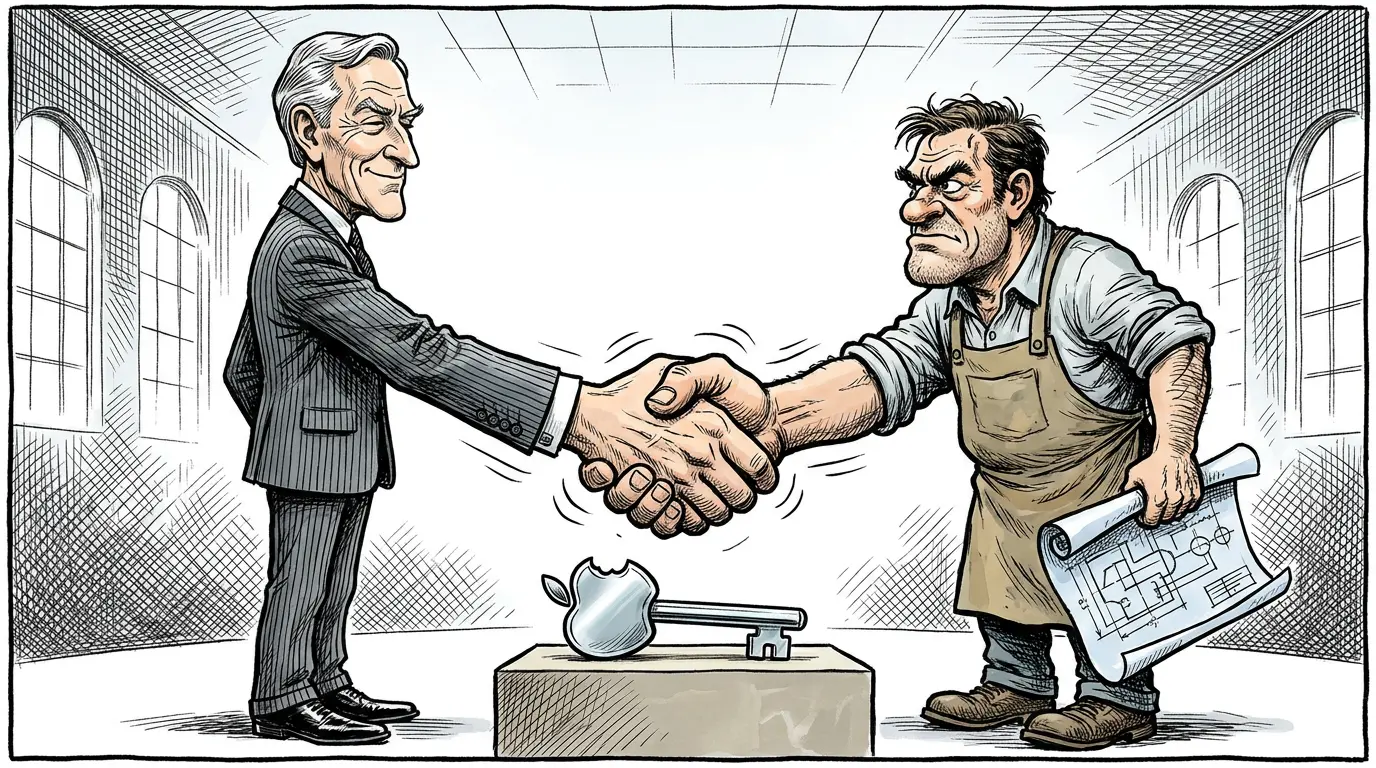
 On 24 August 2011, a gravely ill Steve Jobs handed Apple to his operations chief, Tim Cook.
The company was worth about US$350 billion that day.
Plenty of clever people called Cook a caretaker, keeping the seat warm until a real visionary showed up…
Some caretaker he turned out to be.
This week, 15 years later, Cook is handing over the reins of Apple again. This time, Apple is worth around US$4.7 trillion.
One CEO led the company to a market value north of US$4 trillion. That works out to be about US$31 million every hour of every day for 15 straight years.
Another way of looking at it is that Cook grew Apple by roughly the value of the entire UK economy.
But Cook was no product genius in the way Jobs was. He accomplished this by perfecting what Apple already had, with better iPhones, fatter margins, and a services business now doing more than US$100 billion a year.
Now it’s time for a new era…
And perhaps it’s an engineering era…
One that could have an impact on Apple akin to Jobs’ own.
And it might mean the next decade delivers another US$4 trillion to Apple, and trillions more to the companies that it drags along…
The product guy gets the keys
John Ternus is no operations guy. He’s a mechanical engineer who joined Apple’s product design team in 2001 and spent 25 years building the hardware that has helped make Apple the company it is today.
iPad, AirPods, Apple Watch, generation after generation of iPhone.
Cook sold and refined what Apple already had. Ternus is the one who builds what comes next.
And “next” is coming at us ridiculously fast.
On Wednesday, 9 September, nine days into the job, Ternus will front his first Apple event, called “Surprise and shine.”
If the rumours are true, we’re going to be looking at one of the most radical design changes in Apple’s history.
So, it’s no great surprise that this is the timing of the handover.
Because in a matter of a week or so, we might be looking at a folding iPhone.
The rumoured device opens like a book, with a 5.5-inch outer screen and a 7.8-inch display inside. That is close to an iPad mini folded into your pocket.
Reports point to a titanium frame and crease-free screen, the recurring flaw in every rival foldable smartphone so far.
IDC reckons it could ship 10 million units in its first year at around US$2,500 apiece, which is US$25 billion of new revenue from a brand new line of Apple devices.
Alongside it come the “regular screen” iPhone 18 Pro models running the A20 chip on a two-nanometre process, and another entirely new device line for Apple… a home hub.
Amazon has somewhat cornered the market on home hub devices. But Apple is set to make a massive splash with a new and improved Siri.
Picture an Alexa-style device, a seven-inch screen running the new AI Siri, with facial recognition so it knows who in the family is looking at it, available in tabletop and wall-mounted versions.
It’s not reinventing the wheel, but it will be done with Apple flair.
The fact that a product engineer with 25 years inside Apple’s hardware labs is now at the helm, I think, tells the market Apple is priming itself for another device revolution.
And I think we’ll see a whole suite of massive changes to Apple’s design line-up that pulls in the next US$4 trillion or US$5 trillion (or more) of market cap.
But, that is not the really big opportunity for investors.
Apple is big, arguably too big, to really make a seismic dent on your portfolio. To really chase the trillions that Apple is lining up, you have to look smaller… at the companies that will rise as Apple devices rise again to the pinnacle of technology.
In 1938, The Fleet Street Letter warned its readers that war was coming to Europe — and even identified September as the critical month. Since then, its readers have been warned ahead of Black Monday, the dotcom crash and the 2008 financial crisis. Today, Britain’s longest-running investment advisory is still looking for the “news behind the news” — and the investment opportunities others could be missing. Click here to discover what The Fleet Street Letter sees coming next. Capital at risk. It warned readers ahead of Black Monday. The dotcom crash. And the 2008 financial crisis. Now, nearly 90 years after it was founded, The Fleet Street Letter is still searching for the “news behind the news” — and the investment opportunities that could emerge from the next major turning point. Click here to discover what its editors are seeing now. Capital at risk. Britain’s Investment Letter Since 1938
What Does Britain’s Oldest Investment Letter See Coming Next?
The companies inside the machine
Apple doesn’t make most of an iPhone. It designs, it assembles, and brands it…
But the hinge, the folding glass, the lenses, the sensors, the acoustic parts, and the laminates come from suppliers most people have never heard of.
A folding iPhone needs parts that have never existed at Apple volumes before.
Who makes a hinge that survives a few hundred thousand folds without a wobble?
Somewhere, a small company is tooling up for exactly that. And when Apple picks that one, the price could go vertical.
One of the great examples of this is Cirrus Logic (Nasdaq: CRUS).
Thanks to Apple’s confidentiality terms, for years Cirrus could only refer to “our largest customer.” It makes the audio codecs and amplifiers in the iPhone… parts that cost only about a dollar.
Today, Apple accounts for roughly 91% of its 2026 net sales.
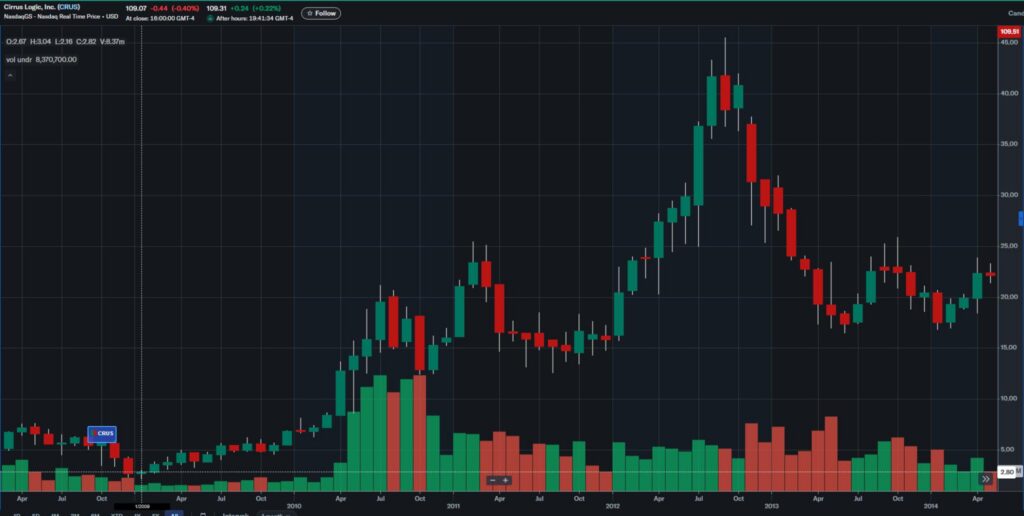
But things went parabolic for Cirrus as we entered the 2010s.
Apple standardised on Cirrus audio chips around 2009-2010. As this became known to the market, the stock went from around US$2 in early 2009 to over US$45 by 2012.
What can make winning a contract with a giant like Apple surprisingly dangerous for a small supplier?
Find out what your friends and family think as well. Share this email with them so they can answer today’s poll and subscribe as well. |
As Apple climbs towards its next US$4 trillion, an entire ecosystem of component makers climbs with it.
The smallest of them, the microcaps building the parts you never see, and the ones just mentioning “our largest customer” in their filings, are where the explosive returns will hide.
In the coming days, you’ll hear more about this as we prepare to show you exactly which companies are doing this, including one we would call Apple’s “secret supplier.”
Apple, while still large and profitable, isn’t the awe-inspiring company it was in the late 2000s. I think that’s set to change under Ternus.
And as that plays out, we will show you how to get a slice of the action as Apple hunts its next US$4 trillion.
Keep an eye on your inbox.
Until next time,

Sam Volkering
Investment Director, Southbank Investment Research
PS Apple may be hunting its next US$4 trillion. In the meantime, there could be an even bigger opportunity sitting much closer to home. I’ve uncovered a potential 511-billion-barrel oil opportunity beneath British territory – worth an estimated £45 trillion at today’s prices. There’s a catch, of course. But an event this October could begin to change everything. I explain the full story – and the name of one company positioned to benefit – for free here.