|
Editor’s Note Bill writes from a US perspective, but the warning he lays out today should feel uncomfortably familiar to investors here in the UK. After years of rising asset prices, enthusiasm over AI, and extraordinary valuations at the top of the market, the question of whether we’re approaching another major bubble isn’t confined to Wall Street. British investors have plenty riding on US markets too – whether through individual shares, pensions, funds, or simply the effect Wall Street has on markets around the world. And as Bill explains below, identifying a bubble is only half the problem. The more important question is what happens when it bursts. History suggests the biggest losses tend to arrive quickly, before most investors have had time to react. But the consequences don’t necessarily stop with falling share prices. A serious market correction can spread into credit, businesses, employment, property, and eventually the wider economy. So while Bill talks about the Fed, Wall Street, and Washington below, don’t mistake this for an exclusively American story. If he’s right about what comes next, investors on the UK side of the Atlantic won’t be watching from the sidelines. |
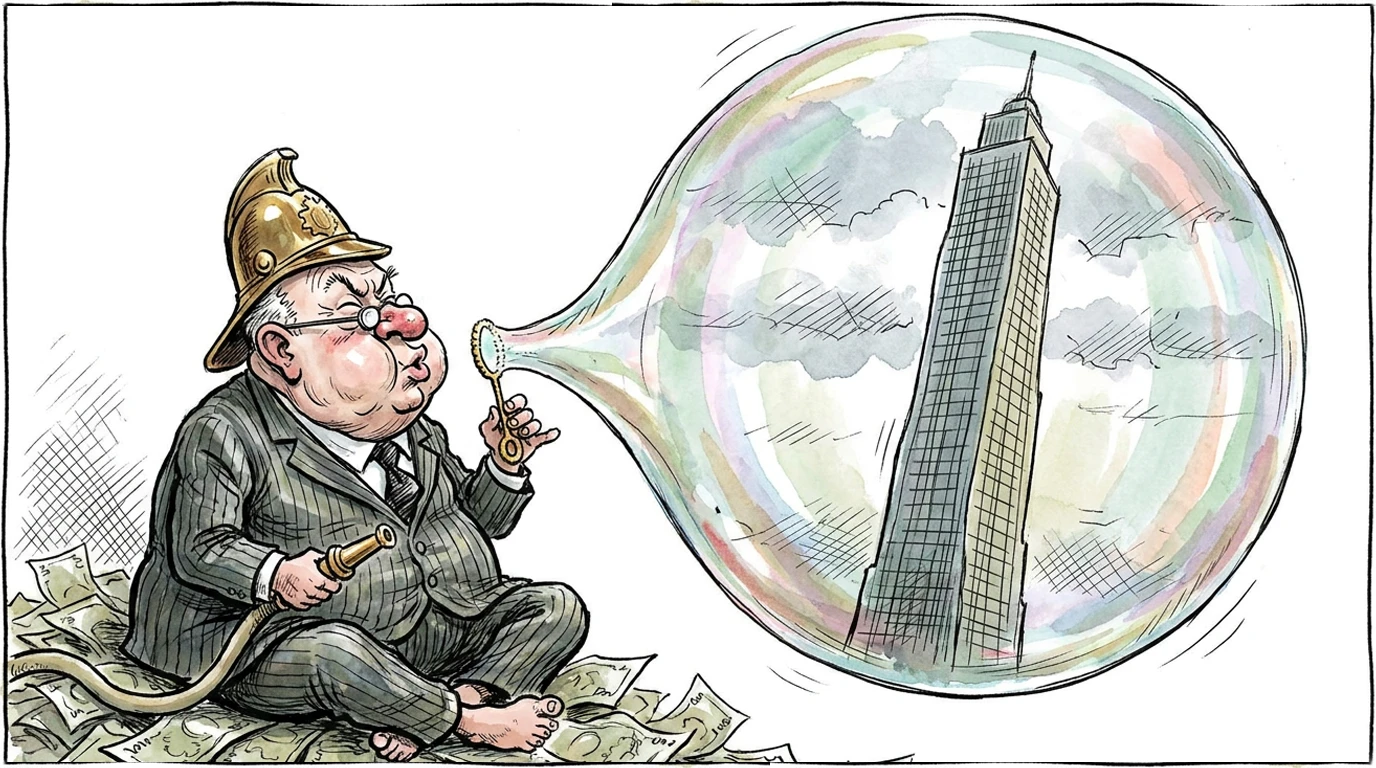 Our question for today is: Have we reached Peak Bubble… and if so, what happens next?
The answer is important. Because our top goal is to avoid taking the Big Loss.
And the Big Losses come hard and fast at the top of a bubble.
And like a sheriff with a summons, they can be hard to dodge.
As long as you can avoid the Big Loss, you’re still in the game. Then, you can let time and luck do their magic. Unglamorous and slow, it’s not like buying the “next Nvidia.” But it works better: Buy profit-making companies when they are reasonably priced… sell them when they become unreasonably overpriced.
So simple, you could ink it on your palm.
So, let’s presume we are at… or near …peak bubble.
What to do now?
When a bubble pops, the immediate result is deflation. Prices of key bubble assets go down. Later, everything goes down.
The damage rarely stays on Wall Street.
Businesses can no longer raise money. Projects are cancelled. People lose their jobs and their incomes. They have less money to spend so “demand” goes down… and with it go prices for almost everything.
People postpone their vacation plans. They shove plans for a beach house into the desk draw. And after spending years discussing the relative merits of Perrier compared to San Pellegrino, they drink from the tap!
Which unusual sign has historically been associated with an economic boom nearing its peak?
Find out what your friends and family think as well. Share this email with them so they can answer today’s poll and subscribe as well. |
But what about the debt?
What about the Fed?
Where’s that inflation we’ve been warning about for the last 27 years?
So glad you asked…
In 1938, The Fleet Street Letter warned its readers that war was coming to Europe — and even identified September as the critical month. Since then, its readers have been warned ahead of Black Monday, the dotcom crash and the 2008 financial crisis. Today, Britain’s longest-running investment advisory is still looking for the “news behind the news” — and the investment opportunities others could be missing. Click here to discover what The Fleet Street Letter sees coming next. Capital at risk. It warned readers ahead of Black Monday. The dotcom crash. And the 2008 financial crisis. Now, nearly 90 years after it was founded, The Fleet Street Letter is still searching for the “news behind the news” — and the investment opportunities that could emerge from the next major turning point. Click here to discover what its editors are seeing now. Capital at risk. Britain’s Investment Letter Since 1938
What Does Britain’s Oldest Investment Letter See Coming Next?
The natural tendency of a bubble is to deflate.
Typically, debt deflates with it.
The same business that finds spiders spinning their webs in its entryway… even despite its “Going Out of Business Sale” sign… also finds it hard to repay the bank.
And the corporation that sold bonds to raise capital for investments that never panned out finds it must default on its coupon payments.
Debt shrinks along with everything else.
People go broke.
Businesses declare bankruptcy.
The total of debt, payable and outstanding, goes down… along with the pile of “paper” assets it once supported.
This is as it should be. Bad investments are purged. More importantly, so are bad ideas.
In 2000, for example, some internet businesses were destined to be great successes. But not every crackerjack dot-com dream would be successful.
And no, information does not “want to be free,” as Michael Saylor claimed.
And no, no… the internet did not cause the economy to lift off into escape velocity, unbound by the old rules of gravity and compound interest.
The truth comes out.
That’s what busts are for.
You can’t really make people richer by printing more pieces of paper or lowering their interest rates. Those truths are only whispered softly at the beginning of a bubble. Later on, they speak with a stentorian voice – after the bubble blows up.
The collapse of a bubble is the collapse of prices.
And the way down follows the same path as the way up, but faster.
Stocks lose as much as half their value in just a few days. Real estate is marked to market much more slowly… but the direction is the same.
Bond yields, however, follow a special route…
At first, they rise sharply.
In a major correction, everybody gets scared.
Every price defines a relationship between those who are short and those who are long. Who owes what to whom? And with prices in free-fall, the questions become more urgent… the voices more desperate.
The lights are still on at the bank… is it still solvent?
Why isn’t the hedge fund answering the phone?
Damn… I wish I had retired and sold those options when I had a chance.
They couldn’t go lower, could they?
Is it a buy?
No… SELL!
Trust declines as yields and interest rates shoot up. A good suit is no guarantee of solvency.
“Who will still be upright when the dust settles?” investors wonder.
Then, as the panic burns itself out, yields begin to go down. A boom produces higher rates. In a bust, rates go down. That is the natural pattern. No Congressional approval needed.
As an economy heats up, demand for loans increases. As it cools off, people become much less expansive… more wary… and unwilling to sign anything. They hold cash tight… and let go of the cabin cruiser.
Booms bring on innovations and debt.
Corrections (busts) clear away those that don’t actually work.
That is the way it’s s’posed to work. And it does work that way… sort of… for a while.
It’s either “inflate or die.”
Either the bubble keeps expanding – or the air goes out… it deflates… and prices go back down.
Then come the authorities…
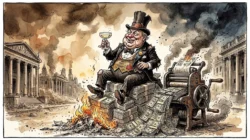
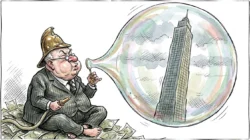
Like the arsonist who puts on his firefighter coat and directs the hoses… they rush into the market to restore order. Their aim is to protect the big banks… and make sure that neither they, nor their insider cronies, take the losses they deserve.
And then… it’s a whole new ballgame.
Stay tuned.

Bill Bonner
Publisher’s Note: Bill’s warning is about what happens when a bubble bursts and the easy money disappears. But there’s another risk British investors can’t afford to ignore: energy. Britain’s gas storage is at its lowest August level on record, bills are still rising, and its largest storage facility is scheduled to close next year. Our Investment Director Sam Volkering believes the answer could lie in an extraordinary 511-billion-barrel oil discovery beneath British territory – potentially worth £45 trillion. There’s a major catch though. And Sam believes an event this October could begin to change everything. He reveals why – and names one company positioned to benefit – in this free briefing.