
 Think of the most unloved town in England.
Apologies if you live there, but for many people that just might be Slough.
John Betjeman published a poem in 1937 inviting bombs to flatten the place.
Ricky Gervais parked David Brent there because nowhere else sounded so beige.
Yet walk the Slough Trading Estate today and you’re standing in Europe’s largest cluster of data centres. More than 30 of them, humming away between the parcel depots.
And Slough, of all places, is the shape of what comes next in the AI buildout…
Last week, CNBC reported that Anthropic had been sounding out data centre deals across the UK and the Nordics.
Not the US$50 billion gigawatt monsters you’ve been reading about, but smaller deals of 20 to 30 megawatts (MW).
OpenAI has been shopping for the same size over in the Nordics, and no doubt that too would find its way into a conversation with the right people in the UK.
That’s a big change of appetite.
The deals these labs signed over the past year ran from hundreds of megawatts to full gigawatt campuses. These are the kinds of sites that drink as much power as a decent-sized city and cause more than enough outrage among people near to where these data centres are going.
Even the good people of Slough aren’t all that impressed that their city has become a hub of AI factories. A new one proposed by Microsoft is not being received well.
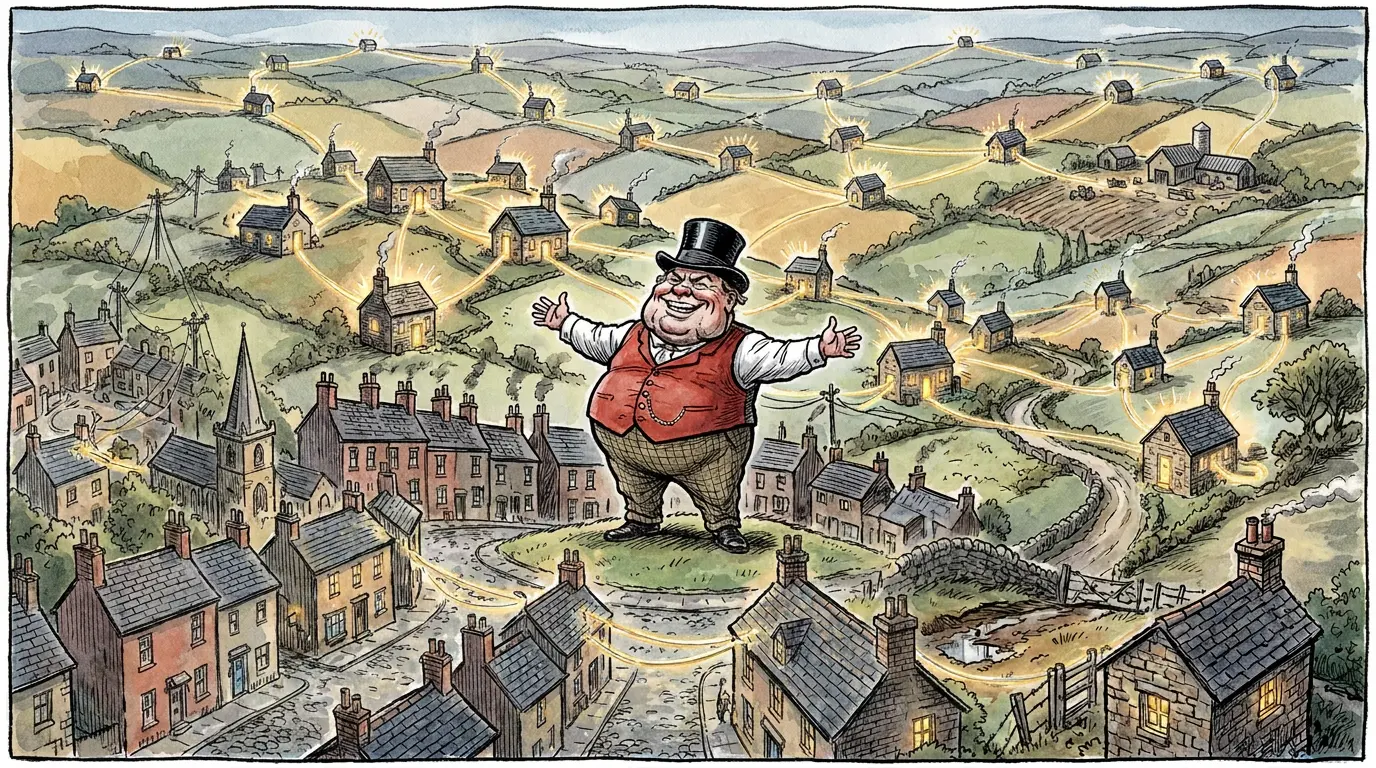
But perhaps smaller, less intrusive AI factories are more amenable to the quaint villages and towns of the UK.
If last week’s referendum in Piddington is anything to go by, I would hazard a guess that a 30MW data centre would be more warmly received than what’s currently getting dumped there…
It’s not all about size!
So why would the frontier AI labs want sites 20 times smaller?
Speed, mostly.
Jabez Tan of Structure Research told CNBC the appeal is “speed to usable capacity.”
A small site with power already flowing beats a giant one still waiting on land, grid connections, approvals, community, and environmental impact statements, and a heck of a lot of concrete and infrastructure to lay down.
There’s another reason too.
Training a model needs tens of thousands of chips wired together in one building. Inference, the part where the model actually answers you, can be spread across lots of small clusters in different places and connected like a brain connects via neural networks.
And inference is where the demand is going…
Every prompt you type is an inference request, and there are billions of these requests a day now.
Small sites, close to users, switch on fast and deliver inference faster.
As I’ve written time and time again, speed is everything in the future of AI, so every improvement on speed is a win.
The good news is that smaller, in this case, is better, and it’s the first version of the AI infrastructure race where Britain can actually be competitive.
We were never going to win the gigawatt game, but 20MW to 30MW sites that already have power and can stretch across the country?
We have those, and Slough (of all places) is the current epicentre of it.
Britain’s Investment Letter Since 1938
In 1938, The Fleet Street Letter warned its readers that war was coming to Europe — and even identified September as the critical month.
Since then, its readers have been warned ahead of Black Monday, the dotcom crash and the 2008 financial crisis.
Today, Britain’s longest-running investment advisory is still looking for the “news behind the news” — and the investment opportunities others could be missing.
Click here to discover what The Fleet Street Letter sees coming next.
Capital at risk.
What Does Britain’s Oldest Investment Letter See Coming Next?
It warned readers ahead of Black Monday.
The dotcom crash.
And the 2008 financial crisis.
Now, nearly 90 years after it was founded, The Fleet Street Letter is still searching for the “news behind the news” — and the investment opportunities that could emerge from the next major turning point.
Click here to discover what its editors are seeing now.
Capital at risk.
Who profits in the UK?
Now if this is such a British opportunity, then it stands to reason there should be a few British companies that could benefit if smaller is better.
And there are. The first of which is a bigger one…
Rolls-Royce (LSE: RR) is increasingly getting into the power game. Not only through its longer-term innovation in nuclear technology like small modular reactors (SMRs), but also from its diesel generators and turbine units.
It has sold mtu diesel generators into hyperscale data centres for nearly two decades. Ready-to-go power at ready-to-go sites certainly puts it right at the top of the pile.
But as I mentioned, there is a bigger prize: nuclear power.
In April 2026, Rolls-Royce SMR signed with Great British Energy to build the UK’s first three small modular reactors at Wylfa, backed by £2.5 billion of programme funding. Each unit makes 470MW.
A single one of those reactors could feed a whole county’s worth of 20MW sites.
Segro (LSE: SGRO) is another interesting way to think about this future.
It owns the Slough Trading Estate and holds the land bank of more than 2.5 gigawatts of compute.
Its sites are exactly the size Anthropic is shopping for. And there’s more coming online. The idea of a contract announcement between Segro and Anthropic you’d think would light the proverbial fire under the stock price.
Volex (LSE: VLX) is a smaller but equally important company for a future of mini-AI factories.
Not overtly flashy, but this cable maker builds the power cords and high-speed interconnects that live inside data centre racks.
In the year to March 2026, revenue rose 14.4% to US$1.24 billion, and data centre revenue roughly doubled from US$118 million the year before.
It moved up from AIM to the Main Market in July. Its August update showed organic revenue up 28% in four months, and it’s now trading at over 630GBp with a market cap of over £1.15 billion.
It’s very possible a handful of 20MW to 30MW deals get inked on British soil over the next year.
But, as always it does come with the caveat that energy prices must come down in the UK. If energy prices continue to skyrocket, the attractiveness of even smaller data centres isn’t so grand.
The opportunity and potential are there.
Now Westminster just needs to make the economy pretty enough to attract the right suitors.
Until next time,

Sam Volkering
Investment Director, Southbank Investment Research
PS The harder question isn’t whether smaller AI factories are coming. It’s figuring out which companies could benefit most if they do. I mentioned a few above that I’m watching closely. But I’m continuing the hunt with a stock-picking system I built to rank opportunities across the market using five different signals.
It boils thousands of securities down to the handful I think are worth paying attention to. And there’s one part of the formula I haven’t explained yet.
I’ll show you what it is – and what the system is finding – here.