Source: Mayor of London via X
 Is this the image that reignites Britain’s growth engine?
It could be…
Though maybe not in the way Westminster hopes…
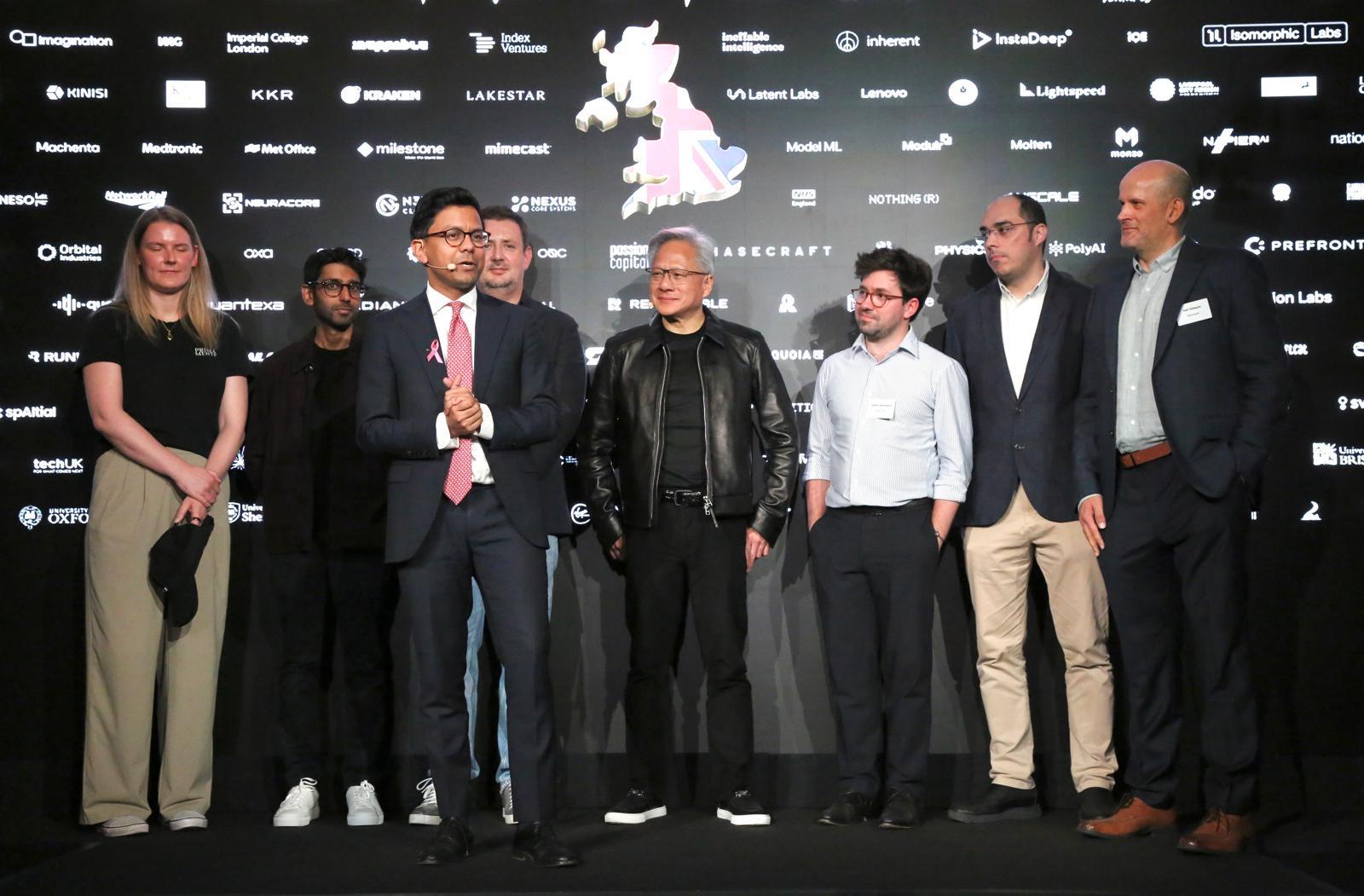
The man in the pink tie, with the Madonna-in-concert microphone wrapped around the side of his face, is Kanishka Narayan, Britain’s AI minister. Andy Burnham created the position as soon as he stepped into power.
Beside him, in the famous black leather jacket, is Jensen Huang, founder and CEO of Nvidia (Nasdaq: NVDA), the chipmaker behind the AI boom.
On that giant advertising wall behind them… you’ll find names like Imperial College, Oxford, Isomorphic Labs, Monzo, and dozens more British names.
But why was Huang in town?
Well, he was touring Europe leading into this week’s Nvidia GTC Berlin conference.
He started in Barcelona and Paris last Tuesday and met Emmanuel Macron at the Élysée Palace that night.
His message in Paris was that Europe needs to “join the race” rather than slow it down.
He also said Nvidia would announce about $2 billion worth of European deals within a week. That’s on top of the $8 billion it has invested in the continent over the past year.
Then he rolled into London.
Through Nvidia he announced an investment of $250 million of computing power over five years to British research on keeping AI agents safe. Part of it goes to labs at Oxford, UCL, and Imperial.
Narayan called it, “a vote of confidence in our world-leading strength and expertise in AI research.”
Nvidia also showed off British firms already using its kit. Lloyds, Revolut, and Starling have built or are building AI models on banking data. A primary care triage model built on Nvidia software now supports millions of NHS patients.
And he named five British startups Nvidia plans to invest in.
Boltz and Prima Mente build AI models of biology and disease in London.
Hiverge, from Cambridge, writes AI that designs better algorithms.
Foresight predicts when giant projects like data centres will be finished.
Riverlane, also from Cambridge, fixes the errors quantum computers make.
Reports put the investment in these companies at $1 billion. That’s quite the endorsement for British tech.
But for all the investment, Huang was also what you might call… blunt… about the problem facing British tech. As the media throngs surrounded him, he made some very direct comments about the UK, saying, “If there were a million ways to win, you find the one reason not to do it,” when referring to the growth opportunities AI and tech present to the country.
He went on to say that he thinks the thing that separates the US and the UK – and what’s lacking and standing in the way of opportunity in the UK – is the “entrepreneurial spirit” that is in abundance in America.
And therein lies the problem.
In 1938, The Fleet Street Letter warned its readers that war was coming to Europe — and even identified September as the critical month. Since then, its readers have been warned ahead of Black Monday, the dotcom crash and the 2008 financial crisis. Today, Britain’s longest-running investment advisory is still looking for the “news behind the news” — and the investment opportunities others could be missing. Click here to discover what The Fleet Street Letter sees coming next. Capital at risk. It warned readers ahead of Black Monday. The dotcom crash. And the 2008 financial crisis. Now, nearly 90 years after it was founded, The Fleet Street Letter is still searching for the “news behind the news” — and the investment opportunities that could emerge from the next major turning point. Click here to discover what its editors are seeing now. Capital at risk. Britain’s Investment Letter Since 1938
What Does Britain’s Oldest Investment Letter See Coming Next?
Britain makes, someone else owns
The UK government’s own venture arm, the National Security Strategic Investment Fund, put money into Riverlane’s 2023 and 2024 funding rounds.
Prima Mente was in the first batch of the £500 million Sovereign AI programme in April.
Now both have an American chipmaker lining up to buy in.
We’ve seen this play out before, when Google bought DeepMind for a reported $400 million in 2014.
Yes, DeepMind is a British company. But Google saw a great opportunity to buy the future, and that’s exactly what it did.
Nvidia tried to buy Arm for $40 billion and walked away in February 2022 when regulators dug in. Arm then floated in New York at $51 a share in September 2023.
Again, a very British company courted by the Americans and ending up on the capital-rich US market.
Wise, one of Britain’s great fintech stories, moved its main listing to Nasdaq back in May.
Nscale, the London AI factory company, which Nvidia already heavily backs, has filed for its estimated 35 billion to 40 billion IPO… in the US.
Even Nvidia’s £2 billion pledge to British startups last September said the money would be “domiciled in the United States and activated in the United Kingdom.”
Britain is the epicentre for ideas and innovation, but inevitably, the Americans come in and either buy these companies before they can ever get to market, or the companies go to the US to find the capital they can’t find at home.
The London market keeps shrinking as a result. It had 1,534 listed companies this year, down from 2,429 in 2015.
London managed seven IPOs in the first half of this year. The US had 72.
In 1997, UK pension funds invested 53% of their assets in British shares. Roughly how much was left by 2021?
|
I wonder, does this frustrate you?
Do you look at the shrinking number of listed companies, the buyouts and takeovers of British companies by US firms, and the listings that bypass the local market and go overseas?
Do you think there’s a solution?
What policy would you put in place to retain these companies and encourage them to grow at home?
Let us know, investorsdaily@southbankresearch.com
One way to own great British innovation
The good news is there’s a way to still get a slice of some of these great British companies without having to wait for the government to sort its head out.
Molten Ventures (LSE: GROW) is one of the names on that wall in the photo up top.
It’s a London-listed venture fund that led Riverlane’s £15 million round in April 2023.
Riverlane is now one of its core holdings, alongside Revolut, ICEYE, and Ledger.
Molten closed at 669p this week. With estimated net assets of about 760p a share, you’re buying the portfolio at roughly a 12% discount.
Of course, venture valuations are not always accurate or up to date. There’s no minute-by-minute valuation as there is with listed companies (hence the discount).
But when you’re looking at some of these early, exciting British companies that are innovation leaders globally, these kinds of venture funds are an easy way to get exposure.
That said, remember that investing is always risky and you should never invest more than you can afford to lose.
I don’t think we should ever write off the potential the UK has. It can build, it can innovate, and it has some of the brightest and sharpest minds in the world. Whether that can translate into hard-earned and optimistic growth is another matter.
But even if it can’t and the US continues to run the show, at least there are interesting ways into the future of British tech.
Until next time,

Sam Volkering
Investment Director, Southbank Investment Research
PS Finding the next great British technology company is one thing. Knowing when to invest in it is another. That’s one of the reasons I built Hyperion, my AI-powered stock-ranking system. It analyses 1,796 UK and US stocks, looking for signs of upward momentum that most investors might miss.
I’ve put together a presentation showing you how it works, and I’ll even reveal the name and ticker of one of Hyperion‘s top-ranked stocks right now.