
 Joseph Weizenbaum’s secretary had been typing for a few minutes when she asked him to leave the room.
She wanted a private word with a program her boss had written himself.
Yes, that’s right, a private word with a program.
With this program, you typed a line into a teletype, and a mainframe on the other side of campus typed a reply back. It played a therapist, mostly by turning your own words into questions.
That program was ELIZA, and Weizenbaum published it in January 1966 at the Massachusetts Institute of Technology (MIT).
It was one of the first chatbots ever built.
So, yes…
What you see today has its origins going back 60 years.
Every chatbot since is a grandchild of that mainframe.
This week, you’ll hear us talk a lot about MIT, particularly because of the “Godfather of AI investing” I managed to track down and secure an interview with.
But some people might wonder: How important is MIT really to the AI we know and use today?
Let me try to answer that for you…
Britain’s Investment Letter Since 1938
In 1938, The Fleet Street Letter warned its readers that war was coming to Europe — and even identified September as the critical month.
Since then, its readers have been warned ahead of Black Monday, the dotcom crash and the 2008 financial crisis.
Today, Britain’s longest-running investment advisory is still looking for the “news behind the news” — and the investment opportunities others could be missing.
Click here to discover what The Fleet Street Letter sees coming next.
Capital at risk.
What Does Britain’s Oldest Investment Letter See Coming Next?
It warned readers ahead of Black Monday.
The dotcom crash.
And the 2008 financial crisis.
Now, nearly 90 years after it was founded, The Fleet Street Letter is still searching for the “news behind the news” — and the investment opportunities that could emerge from the next major turning point.
Click here to discover what its editors are seeing now.
Capital at risk.
The dorm room that led to ChatGPT
Marvin Minsky and John McCarthy started the MIT AI Project in 1959. We have McCarthy to thank for the words “artificial intelligence.”
The field of AI research was effectively born there… and it never really left.
Sure, the giant models like GPT and Claude are trained inside companies like OpenAI, Meta, and SpaceX.
But trace the people and ideas inside those companies back, and a remarkable number of them lead to MIT.
Start with Greg Brockman.
At MIT, his classmate was Patrick Collison, who left to start Stripe with his brother John.
In 2010, Brockman dropped out of MIT to join them. He became Stripe’s chief technology officer in 2013.
When he left Stripe in 2015, it was Collison who introduced him to Sam Altman.
That December, Brockman and Altman co-founded OpenAI. It started out of Brockman’s living room and on 30 November 2022, it released ChatGPT and changed the world forever.
Alexandr Wang was also at MIT.
He left after a year to start Scale AI, “right out of freshman year of MIT and never looked back.”
In June last year Meta (Nasdaq: META) paid $14.3 billion for a 49% stake of Scale and hired him to run its superintelligence project.
Then there’s Cursor…
Four students who met at MIT started Anysphere in 2022 to build Cursor, an AI code editor. On 14 August this year, SpaceX (Nasdaq: SPCX) closed a $60 billion all-stock takeover of it.
The fixes inside everyone else’s models
Ideas travel the same way as people.
In 2023, Song Han’s lab worked out why chatbots kept falling apart in long conversations. His student Guangxuan Xiao found the models dump a pile of attention on the first few words, whether those words matter or not.
They call this “attention sink”.
It’s a spot where a model parks focus it doesn’t need. Keep those first words in memory, and the model stays steady for millions of words.
It doesn’t seem like that big a deal, but to AI, it’s critically important.
So important, in fact, that it sits inside Nvidia’s (Nasdaq: NVDA) TensorRT-LLM software. And when OpenAI put out its first open-weight models in August 2025, its model card pointed back to the MIT paper.
Drug discovery got the same MIT AI treatment.
In November 2024 MIT’s Jameel Clinic released Boltz-1, a free model that matched Google DeepMind’s AlphaFold at predicting how molecules fit together.
More than 200 biotech companies then put it to work.
In June 2025 came Boltz-2, built with Recursion (Nasdaq: RXRX).
It guesses how tightly a drug grabs its target about 1,000 times faster than the physics-based method the industry relies on.
James Collins took it a step further.
His team had generative AI dream up more than 36 million compounds, then found two that killed drug-resistant gonorrhoea and MRSA in mice.
Sure, that’s what I call “mice news” but they’re expecting these drugs will reach human patients a lot faster than the market considers.
|
|
Different approaches…
Daniela Rus, who runs MIT’s big AI lab, backed a different idea.
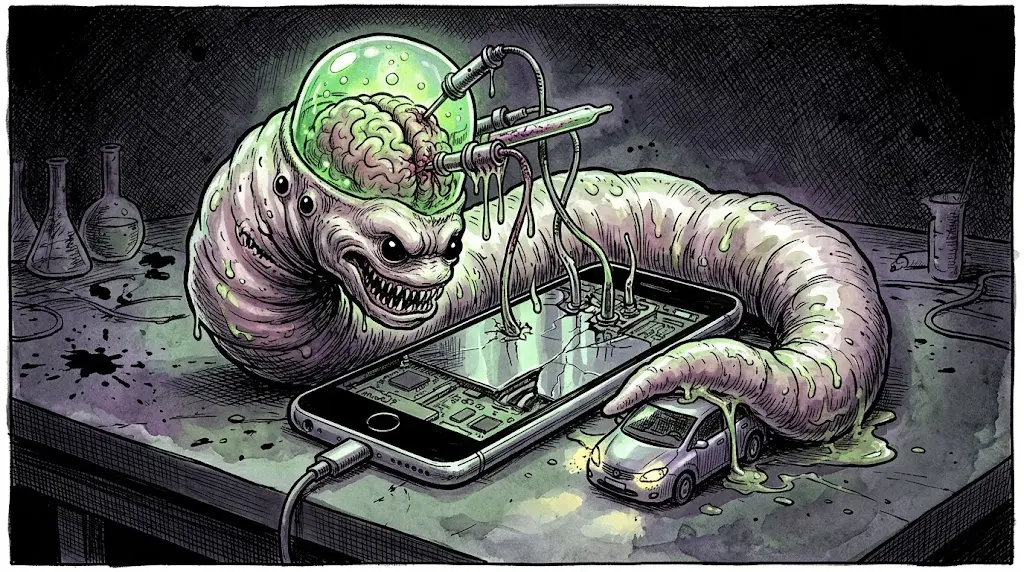
Her team built “liquid” neural networks, modelled on a roundworm’s brain, and drove a car with just 19 neurons.
That work became Liquid AI. It raised $250m in December 2024 in a round that AMD (Nasdaq: AMD) led, at a $2.35bn valuation.
Its models run on phones, laptops, and cars rather than in the cloud.
AI worm brains forming neural networks running on a phone…
Yep, I think it’s fair to say MIT certainly is and always has been the epicentre of AI.
Which brings me to “the Godfather of AI investing,” an MIT man who got into AI and investing long before either was fashionable.
He studied computer science at MIT, then took an MBA at Harvard. He holds two US patents in automated stock analysis.
Since 2003 he’s turned the methods of Warren Buffett, Peter Lynch, and Benjamin Graham (among others) into “AI brains” and we managed to sit him down to unpick everything about his work.
What did I ask him?
How those models think…
What the AI brains behind them do now…
And most importantly, where they’re pointing.
You’ll be able to see the whole thing, directly from him, on Tuesday 3 November.
Join the invite list here to make sure you get your viewing pass. When you click on that link, you’ll automatically be added.
You don’t want to miss it.
Until next time,

Sam Volkering
Investment Director, Southbank Investment Research
PS There’s a reason I’m calling him the “Godfather of AI investing.” Back in the 1980s, this MIT scientist trusted someone else with $100,000 to invest in the stock market. He lost every penny.
Rather than give up, he went back to MIT’s AI lab and started working on a way to take the guesswork out of investing. That decision eventually led him to build an AI-powered system that, according to his track record, has beaten the S&P 500 by 1,467% since 2008.
Now, he’s shared details of that system in that interview, which I’ve called The MIT Code.
Click here to secure your free viewing pass.