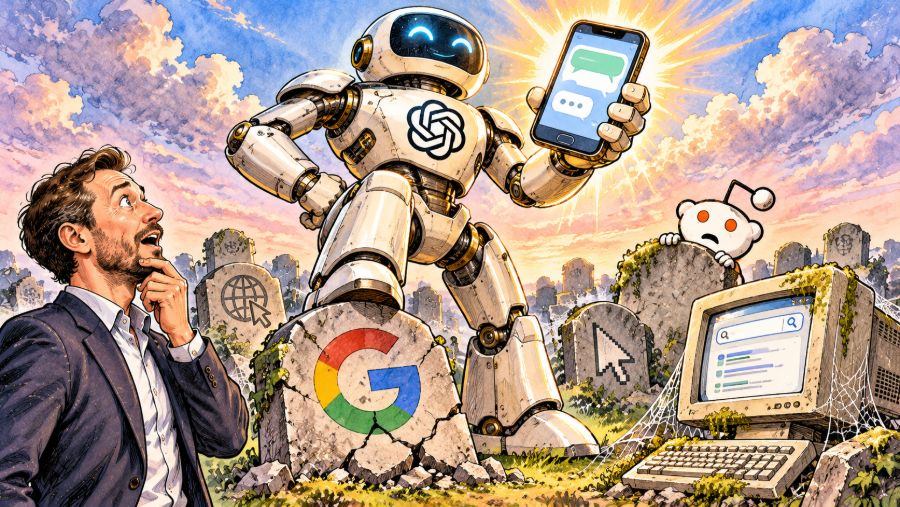
 Back in the olden days, we used to use this thing called “Google Search.”
It was so useful that “Google” became a verb.
You would type in something you wanted to know about, like “best child car seat for a newborn,” and then it would give you all these websites where you could buy a car seat and some where you could read reviews.
You’d then spend an inordinate amount of time going through those sites to find one that was the best for you.
Then, you’d buy it.
Online.
Never having to go to a shop.
A couple of days later, there it was on your doorstep.
What wonderful times those were.
And boy! How things change, right?
Those “olden days” were, oh, I don’t know… about two months ago.
Today, in these “modern times,” we don’t use “Google Search” to find things anymore, do we?
Noooo.
We just fire up ChatGPT or Claude and ask it for stuff.
“How long do I need to roast my 1.6kg pork shoulder for?”
“How does the VAT refund in Japan work?”
“What’s the best way to prepare a pizza stone for homemade pizzas?”
Real prompts, all of those, by the way. I guess a lot of the things I ask my AI are food-related (ahem)!
Seriously though, the more you think about it, and the more I’ve been thinking about it, the more applicable it becomes to the direction things are heading.
And all weekend, I’ve been asking myself: Is the internet as we know it over?
Is “search” dying?
Britain’s Investment Letter Since 1938
In 1938, The Fleet Street Letter warned its readers that war was coming to Europe — and even identified September as the critical month.
Since then, its readers have been warned ahead of Black Monday, the dotcom crash and the 2008 financial crisis.
Today, Britain’s longest-running investment advisory is still looking for the “news behind the news” — and the investment opportunities others could be missing.
Click here to discover what The Fleet Street Letter sees coming next.
Capital at risk.
What Does Britain’s Oldest Investment Letter See Coming Next?
It warned readers ahead of Black Monday.
The dotcom crash.
And the 2008 financial crisis.
Now, nearly 90 years after it was founded, The Fleet Street Letter is still searching for the “news behind the news” — and the investment opportunities that could emerge from the next major turning point.
Click here to discover what its editors are seeing now.
Capital at risk.
Google’s downfall is… Google
That idea of searching for a child car seat (as I did when the boys were little)… five years ago you’d wade through four sponsored ads and a “top 10” list from a site that had no idea what your needs actually were.
With luck, you’d then find a Reddit thread by a dad in one of the home counties and it’d be close enough.
Now, an AI writes the answer at the top of the page. It names two buggies, says which one folds with one hand, and you never leave ChatGPT or Claude. Maybe they link to the e-commerce site. But even then, only to the one with the buggy it suggests you need.
One click, one site.
And that’s now.
Soon enough, you’ll just say, “Cool, go buy it,” and you’ll never actually go to a webpage. You won’t ever know where the buggy comes from. Maybe it’s dropshipped directly from the buggy manufacturer’s factory.
Even now, ask yourself: When did you last click through to the site behind an AI answer?
We’re not far away from a possible future where kids today never “surf the web” like we’re used to.
“What a waste of time,” they’ll remark. They’ll just have their “agents” do their surfing for them.
And the internet won’t be a place where people go. It’ll be a domain almost exclusively for agents and AI.
But don’t take my word for it.
Just look at the 30% demolition of Reddit’s stock price last week.
After reporting results, its shares fell 30% the next day, marking their worst day ever.
The company said search visits were down by more than a million a week.
Steve Huffman, Reddit’s CEO, gave it some context:
The reality is the AI Mode does not drive traffic, not for us and not to anybody as far as I know.
What he’s saying is that AI was supposed to direct traffic more efficiently to websites. Instead, it’s not directing anyone anywhere.
Find out what your friends and family think as well. Share this email with them so they can answer today’s poll and subscribe as well. |
Even Google is potentially undermining its own business model.Search revenue was up 12% to $63.35 billion in the third quarter, but that’s well down from 19% growth in the first quarter.
Growth is slowing. The market is worried it will shrink.
Buy the destination
So the big question is: Is search dead?
Short answer: No, it’s not.
But it is certainly changing.
It’s turning into a conversation, a hyper-personalised set of outcomes, some of which require no further action. Others do and will always require some human input and a pathway to a destination.
Forget the dreaded second page of Google search. How about the dreaded second result?
If you’re not the top and primary answer when AI coughs up a response, then you’re simply not good enough.
I reckon that we’ll end up seeing a return to quality over gigantic ad budgets. That’s ultimately a good thing.
The internet has become a monstrosity, with corporations willing to spend ridiculous amounts of money on ad budgets to drive “sponsored” traffic and deliver actual slop.
But what if AI is the panacea for “sponsored” slop?
What if, for businesses, your AI rankings end up being a measure of the value and quality you bring to the end user?
Of course, the alternative is that the “sponsored” ads simply shift inside AI, and the problem ends up getting worse.
If that’s the case, then Google might shoot itself in the foot now, only to have it pay off multiple times over in the long term.
It also stands to reason, then, that Anthropic and OpenAI could be heading the same way.
Regardless, I do believe that how we navigate the world, online, the internet, and our investments all requires a much deeper engagement with AI because it’s already changing how the world functions.
Increasing productivity for adopters, decimating the value of companies like Reddit in one swift afternoon, pumping up the hardware makers in one corner, and ripping the rug out from under those who can’t keep up in the other.
Embracing AI, using AI, is akin to being among the early internet users of the 90s.
The more comfortable you get with it all now, the more relevant you’ll stay in the years to come…
Until next time,

Sam Volkering
Investment Director, Southbank Investment Research
PS AI isn’t just changing how we search the internet. It’s changing how we find investment opportunities, too. And while some companies are being left behind, others could be presenting opportunities that traditional investors are missing. That’s why tomorrow, I’m introducing you to a man whose stock-picking system has delivered some extraordinary results over the past 18 years, albeit with some painful losses along the way. He’ll explain how it works and reveal the number one stock his system is identifying right now. It’s completely free to attend. Reserve your place here.
(By clicking the link you agree to automatically be signed up to receive marketing information by email about Resonance AI. You can stop emails at any time using the link provided at the foot of each email.)