
 It’s the early 1990s. In an office in Guildford, a 17-year-old kid is working on a new video game. He’s figuring out how to let players choose how much salt to put on a plate of chips.
Those chips are inside a video game called Theme Park, the game he’s working on.
The kid writing the code has worked out that salty chips make thirsty visitors, and thirsty visitors buy more drinks.
It’s a wonderful addition to the game.
As it turns out, that kid was Demis Hassabis, the founder of DeepMind and one of the most influential people in the development of cutting-edge AI.
And it all started with salty chips in a 1990s video game he helped code.
From Theme Park in 1994 to a Nobel Prize in 2024.
Quite the achievement, don’t you think?
I bring up the salty chips because Hassabis has been reminiscing about them this week.
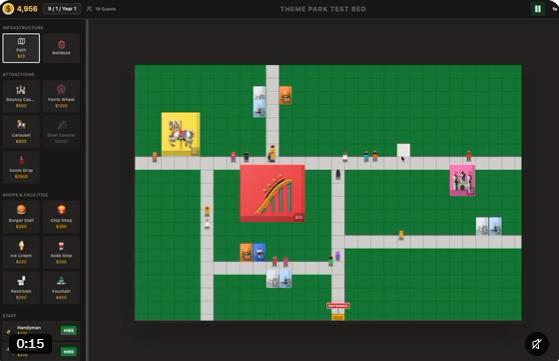
When Google launched its Gemini 3 model in November 2025, Hassabis posted a short clip on X.
He’d spent a few late nights “vibe coding,” which means telling the AI what you want through prompts and letting it write the software for you.
In a matter of hours he had a rough test version of Theme Park running, salt slider and all.
 Source: Demis Hassabis on X
Rough is certainly the word for it!
It almost looks like a spreadsheet with filled-in columns and rows. Back then, it was the kind of thing that made for an interesting experiment, but it was far from a fully functional game that anyone would pay for.
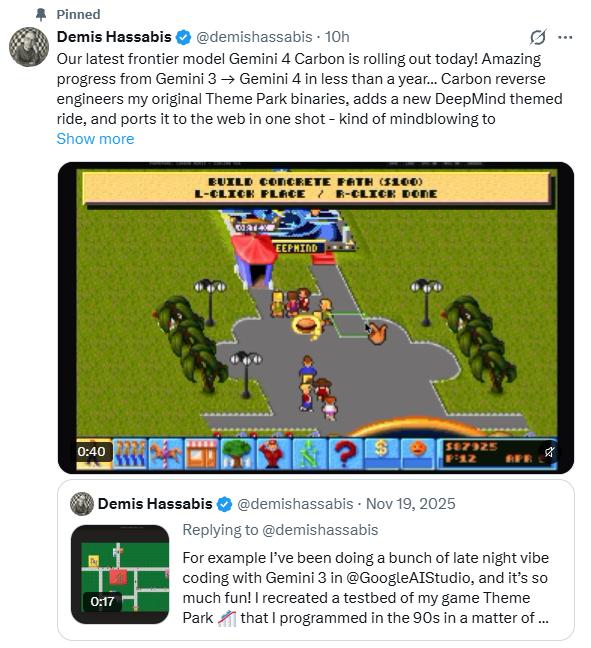
Then yesterday he replied to his own post… one year later.
 Source: Demis Hassabis on X
Google has launched its newest model, Gemini 4 Carbon.
It took his original Theme Park game files from the 1990s, worked backwards from those files, and rebuilt the game.
But it didn’t stop there. It added a new DeepMind-themed ride with its own code and moved the whole thing onto the web.
Hassabis says it did that in “one shot.” Even he said it was, “kind of mindblowing to see!”
This is coming from a guy who won the Nobel Prize for his AI work in 2024.
In 1938, The Fleet Street Letter warned its readers that war was coming to Europe — and even identified September as the critical month. Since then, its readers have been warned ahead of Black Monday, the dotcom crash and the 2008 financial crisis. Today, Britain’s longest-running investment advisory is still looking for the “news behind the news” — and the investment opportunities others could be missing. Click here to discover what The Fleet Street Letter sees coming next. Capital at risk. It warned readers ahead of Black Monday. The dotcom crash. And the 2008 financial crisis. Now, nearly 90 years after it was founded, The Fleet Street Letter is still searching for the “news behind the news” — and the investment opportunities that could emerge from the next major turning point. Click here to discover what its editors are seeing now. Capital at risk. Britain’s Investment Letter Since 1938
What Does Britain’s Oldest Investment Letter See Coming Next?
Why a game shows you more than a test score
It’s hard to get your head around how quickly these models are improving.
That’s why this example of Theme Park is such a great way to understand it.
I wonder, did you play the original Theme Park game Hassabis helped develop?
|

What AI can do when it comes to something like game development shows just how quickly things are moving. One year, the machine draws coloured boxes on a green field. The next, it gives you a commercially ready game.
And if it can do that in a single year, just think what it will be able to do this time next year, and then the year after that.
Where it goes from here has infinite potential.
I believe that by this time next year, a series of prompts could get you a game that might have been made in the 2010s.
Give it two years, and I think you’ll be able to talk your way to a big open-world game built on something like Unreal Engine, like Cyberpunk 2077, made by a kid in a bedroom. Maybe my kid.
Now, it should be said, I don’t think that level of complexity will be achieved in “one shot.” But it will give a single person with the right imagination and commitment the ability to build something of real value in a very short space of time and potentially commercialise it.
And if it can do that for complex gaming worlds, then what about other industries, from automotive design to aerospace engineering, healthcare, and medicine?
And maybe it does come from a 12-year-old or a 15-year-old.
Kids have always had incredible imaginations. What they’ve never had is a way to bring those ideas to life.
But if your kid can come home, describe a game after school, and play it before tea, isn’t that saying something about where we’re heading?
I think AI is the greatest gift humanity has been handed.
From the screen to your hand
Like I say, gaming is just one avenue into what AI can do.
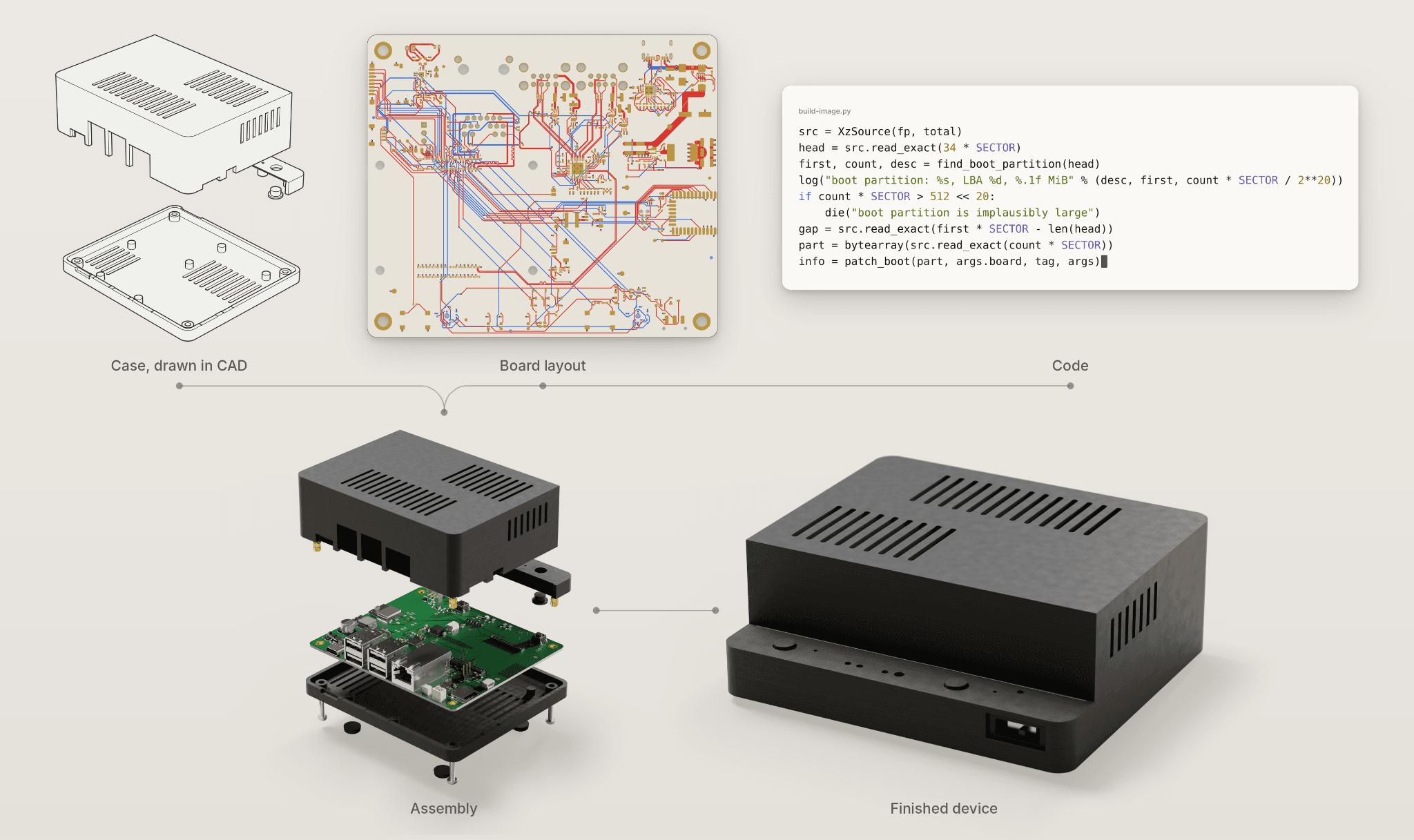
While Google released Gemini 4 Carbon, Anthropic released its Claude Fable 5.2 model this week, along with a write-up of a test in electronics.
 Source: Anthropic
It gave the model a short brief for a speakerphone, a voice-assistant hub, and a handheld virtual pet.
Claude chose the parts, drew the circuit boards, designed the plastic cases and wrote the software. A firm called Diode then built them.
Each board was ready for the factory in under a day.
How new is this?
Anthropic says the models it tried a little over a year ago, “couldn’t reliably lay out a circuit board.”
On Diode’s own circuit board test, Fable 5.2 scored 69%, compared to 25% for Fable 5.
Again, it’s not like mass production of consumer devices is going to shift from huge companies to kids in their garages. At least not yet.
But this is the early stage of that shift. We’re getting to a point where someone can dream up a new kind of device, get a complete set of blueprints and schematics drawn up, and then have it made in a matter of days or weeks on a relatively small budget.
AI is effectively breaking down the barriers to prototyping, beta testing, creating, and building ideas. It’s the great democratisation of creativity.
So, I take the view that AI will unlock far more creativity and opportunity than people fear it will destroy.
And that also unlocks a huge investment opportunity.
As the skills needed to make things become cheaper, demand grows for the infrastructure that makes AI so useful.
Computing power, memory, storage, connectivity, networking, cooling, and energy. These are all AI-related sectors whose stocks have taken a beating of late. But when you see the unstoppable progress of AI and the reach and scale it’s achieving, I think every key company in those sectors is grossly undervalued.
If you can consistently invest in those beaten-down stocks, with regular, steady, long-term investment, I think you’ll build incredible wealth for yourself and for generations to come.
Until next time,

Sam Volkering
Investment Director, Southbank Investment Research
PS I’m curious, how “AI-native” are your kids, or grandkids? Do they know what is possible with Gemini or Claude or ChatGPT? Not for answering questions but for building and creating something? If you’ve got a great story about how you, your kids, or your grandkids have used AI creatively to make something, I’d love to hear about it – investorsdaily@southbankresearch.com