
On any other day, today’s headline would be somewhat salacious… maybe hyperbolic and even a bit benign.
Alas, that is not the case today.
Over the weekend, news broke that the founder and CEO of Nvidia, Jensen Huang, has been caught “in the act,” so to speak.
It’s come to light that Huang is allegedly having an affair with a woman who has been accused of being a Chinese spy.
A good old-fashioned honeypot bit of spycraft! Reads like a James Bond novel…
And before you think this is too wild to be true, The Times said this exact thing was happening back in October 2025.
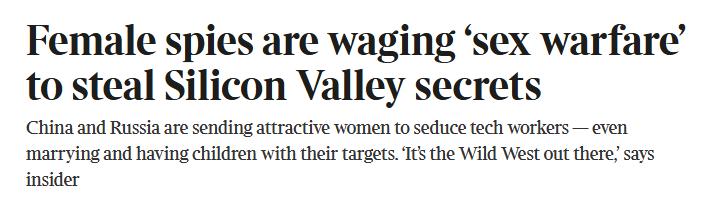
Regarding Huang’s “situation,” there’s a view that it was either to influence Huang’s negotiations around the flow of AI chips to China or to effectively throw his reputation into the bin so that he wouldn’t have leverage in future trade negotiations.
Whatever the case may be, the allegations about Chinese spycraft are serious enough that Nvidia’s board has reportedly launched an independent investigation to figure out what the heck is going on.
I also wonder what role the CIA or FBI might play in this, seeing as the idea of a Chinese spy bedding arguably the most powerful man in AI probably displeases the President.
Can you imagine the phone call Trump made (or will make) to Jensen about all this?
I’m guessing Huang won’t put the President on speakerphone like he did a few weeks back while on a conference panel.
All this skullduggery certainly adds more fuel to the AI stocks fire that’s already been burning quite intensely over the last few weeks.
So, where to next?
Is this just one more indication that the AI “bubble” has burst?
Or is this, weirdly, the signal for the market to turn back into bull market mode?
Britain’s Investment Letter Since 1938
In 1938, The Fleet Street Letter warned its readers that war was coming to Europe — and even identified September as the critical month.
Since then, its readers have been warned ahead of Black Monday, the dotcom crash and the 2008 financial crisis.
Today, Britain’s longest-running investment advisory is still looking for the “news behind the news” — and the investment opportunities others could be missing.
Click here to discover what The Fleet Street Letter sees coming next.
Capital at risk.
What Does Britain’s Oldest Investment Letter See Coming Next?
It warned readers ahead of Black Monday.
The dotcom crash.
And the 2008 financial crisis.
Now, nearly 90 years after it was founded, The Fleet Street Letter is still searching for the “news behind the news” — and the investment opportunities that could emerge from the next major turning point.
Click here to discover what its editors are seeing now.
Capital at risk.
Not so Democrat Democrats
Last week’s US midterm elections saw a “Blue Tsunami” flood the US. That means the Democrats took a huge number of seats and now hold a majority in both the House and the Senate.
It puts President Trump’s grand plans somewhat in flux because he can’t really get anything done now without the support of a sufficient number of Democrats.
The market took that as a sign that anything related to the AI trade is in big trouble, particularly around data centres and the buildout of AI infrastructure.
Nowhere was this more apparent than for AI factory companies focused on Texas.
Texas (of all places) now has a Democrat governor in Tina Hinojiso, with the state turning blue for the first time in 30 years.
The fear in the market was that no data centres would get built in the Lone Star state, which had been the place where wealth had escaped California for fear of Democrat lawmaking…
Oh, the irony.
Now, the expectation is that opposition to the buildout of AI will be so fierce and staunch that any grand plans for growth will grind to a halt.
CNN even ran this headline late last week:

But it’s unlikely that will be the practical outcome.
Sure, Hinojiso will be very proactive, I’m sure, in trying to fix the problem around the cost of living, but I expect she’ll stand somewhat to the side when it comes to the progress and development of AI factories.
And I don’t expect that any state that flipped from red to blue will cause too many headaches for hyperscalers, neoclouds, and everything else that’s been beaten down in the last two weeks.
There’s even talk now that a new bipartisan bill is expected to be rushed through the Senate this week, with the aim of getting it passed and into law by the end of the year to unlock the speed at which data centres get built.
According to The Verge:
A massive permitting bill that could help energy projects come online much quicker and potentially lower utility bills for Americans is advancing with bipartisan support. And while it could be a catalyst for lots of clean energy, it could also speed up polluting projects and limit oversight of new data centers.
The core idea here is to speed up the permitting process and pathway to operation for energy projects, from gas pipelines to fossil-fuel generation.
A by-product of this, however, is that it would also reduce the red tape and blockades for data centres.
|
If you’re thinking about building a data centre with a co-located energy source, even better. And while there might be some new restrictions, like ensuring that you contribute back to the local energy grid and provide union-represented jobs at the new infrastructure projects, we might end up with exactly the opposite of what the market thinks will happen.
Imagine that…
The opposition isn’t actually that opposed to a growth opportunity when it’s put in front of them.
And I suspect that, deep within the power brokers of the Democratic Party, conversations have been had about whether the best way to get back into power isn’t to stand in the way of American progress.
Democrats with not so much of the old Democrat flavour.
Chinese spies and AI tools
We’ll see if this bill gets legs and ends up becoming law, but it is some indication that even if the political spectrum swings back the other way in America, it’s not like everything does or will grind to a halt.
What all this also does is provide an opportunity for the AI buildout to accelerate outside the US, too. Nick Hubble and I discussed this at some length in Friday’s YouTube video, which I suggest you watch here.
Whatever the ultimate fallout from Huang’s alleged clandestine Chinese spy affair, it’s worth remembering that it’s also relatively insignificant to the actual company.
It does bring into question who succeeds Huang when his time at the helm is done, or whether this is serious enough that someone else needs to take the role.
But ultimately, customers aren’t going to stop queuing up for Nvidia AI chips because he allegedly got caught in a honeypot trap.
And the buildout of AI won’t slow down because of him or because of the midterms. If anything, I think what comes next might end up surprising those most pessimistic about the whole AI trade.
Dare I say that things may even accelerate?
The use of AI is spreading at a rate that’s hard to fathom. The costs of compute and token production are falling so fast that it makes high-level AI more accessible to everyone than it’s ever been.
That’s also why we’ve been on an “AI drive” here at Southbank in the last couple of months.
It’s why I introduced you to John P. Reese, the “godfather of AI investing,” last week, and why what he says about his AI trading is something you absolutely need to watch.
It’s also why we think AI investing tools should be at the disposal of every investor in the market.
To maintain any success in the market, I think you need the best AI tools at your disposal. And your regular chatbot AI from Claude or ChatGPT isn’t going to cut it. You need specialised tools to make the markets work for you.
It’s been a wild week, a wild 24 hours, but as the dust settles, I’m expecting the market to run hard and hot, and you’ll want to be on the side of AI, both in the tools you use and the portfolio you shape.
Until next time,

Sam Volkering
Investment Director, Southbank Investment Research
PS Today is your last chance to act on the opportunity the “godfather of AI investing,” revealed in The MIT Code. Discover the #1 stock his AI system is flagging right now, and the ONE move he believes investors should make before tonight’s deadline. Watch The MIT Code here before time runs out.