Two interesting things happened last week. The first was worrying, and it made us wonder why it didn’t happen more often.
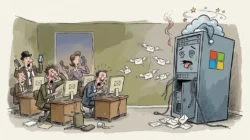
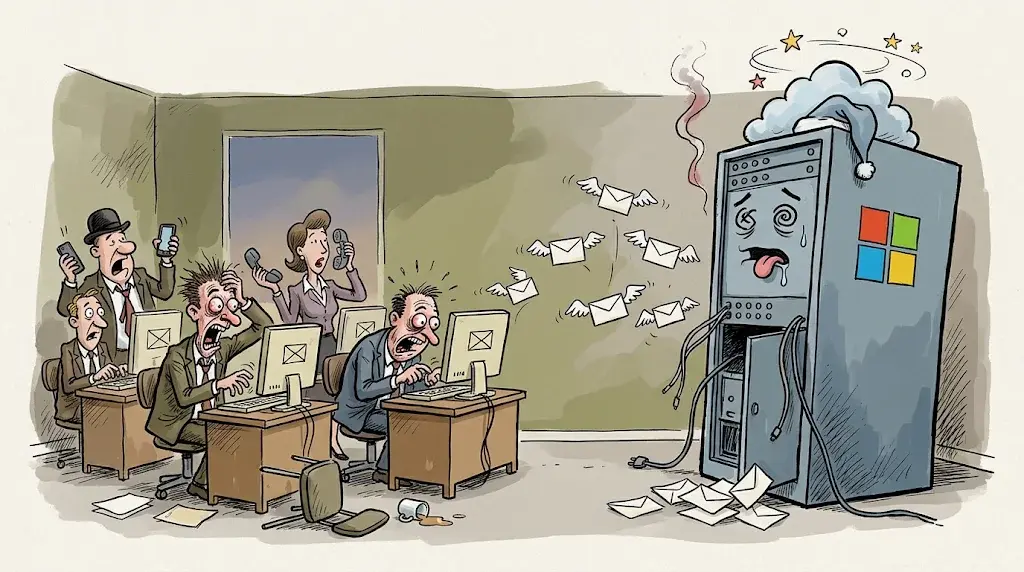
We took notice when Elizabeth couldn’t get her email. “The system is just not working,” she reported. TIME elaborated on Friday:
An outage affecting Microsoft services including Outlook, Teams, and Copilot has stretched into a second day, leaving businesses and governments around the world struggling to access email communications.
Then, also on Friday, an air traffic control glitch grounded US air traffic. Business Insider:
The FAA halted flights nationwide for about four-and-a-half hours after an issue with air traffic control systems, stranding travelers in airports and canceling about 12,500 flights on Friday and Saturday.
“These were both accidents,” Elizabeth commented. “People couldn’t communicate… and couldn’t go anywhere. I wonder what would happen if someone actually tried to shut the country down.”
Britain’s Investment Letter Since 1938
In 1938, The Fleet Street Letter warned its readers that war was coming to Europe — and even identified September as the critical month.
Since then, its readers have been warned ahead of Black Monday, the dotcom crash and the 2008 financial crisis.
Today, Britain’s longest-running investment advisory is still looking for the “news behind the news” — and the investment opportunities others could be missing.
Click here to discover what The Fleet Street Letter sees coming next.
Capital at risk.
What Does Britain’s Oldest Investment Letter See Coming Next?
It warned readers ahead of Black Monday.
The dotcom crash.
And the 2008 financial crisis.
Now, nearly 90 years after it was founded, The Fleet Street Letter is still searching for the “news behind the news” — and the investment opportunities that could emerge from the next major turning point.
Click here to discover what its editors are seeing now.
Capital at risk.
We’ll hold that thought for another day. Instead, we pass from digital to analogue… from failures of the circuit board to those of the heart. Each is fragile in its own way.
The second curious thing in last week’s news had all the juicy elements the press looks for: sex, lies, and videotape.
Centre stage, the leading characters, a beautiful young woman and a powerful older man, were exactly what the story called for. It was, or appeared to be, a classic honey trap.
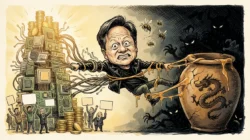
Honey traps have been around for a long time. Every spy agency worth its cloak and dagger probably has one or two of them going. And while men and women are not equally susceptible, all appreciate being appreciated… which is the job of the honey in the pot.
|
Sean Thomas in The Spectator reports that a honey trap is not as easy as it sounds. The KGB got Indonesia’s president, Sukarno, into a room full of air hostesses… and filmed it all. Then, when they confronted Sukarno, his reaction was not what they were looking for. He asked for copies of the film so he could show his friends back in Jakarta.
Gay men were often targeted; they could be blackmailed easily. But women were sometimes ensnared, too.
East German spymaster Markus Wolf noticed that the West German capital was full of lonely secretaries who worked for the government.
Back then, in the 1950s, they took dictation and typed up important communications. They knew state secrets whether they wanted to or not.
So, Wolf put some masculine honey in the pot, attractive men known as “Romeos,” who were meant to seduce and befriend the women. “Lust is a transient thing,” Thomas remarks. But “love will have you photocopying documents for 20 years.”
In today’s case, the trap was ordinary, but the honey was exceptional. The woman, Alice Huang, may or may not have been working for the Chinese government.
AI Overview:
According to multiple reports, Huang admitted in an internal memo that he was unfaithful to his wife and had a romantic relationship with Alice Huang, a senior executive at Singapore-based data center firm Megaspeed. US intelligence agencies reportedly suspected she was recruited by China’s Ministry of State Security to target Huang. The allegations stem from earlier US concerns that Megaspeed may have diverted Nvidia AI chips to China despite export restrictions…
No sooner had this shoe hit the floor than another came down with a thud. Mashable:
Nvidia CEO Jensen Huang may be ousted after second affair revealed
And then the shoes were beginning to pile up outside the bedroom door. Forbes:
Jensen Huang Had A Third Affair – With Another Nvidia Employee, Report Says
In other countries, at other times, an executive without a mistress or two would have been considered peculiar or deficient. People would have thought there was something wrong with him.
But this is the USA, 2026.
And finally, a powerful man, who was not Donald J. Trump, was doing something that is considered a no-no. Commentators were unified in their sniffy outrage.
Up until a couple of days ago, Jensen Huang was the most powerful man, at the head of the most important company, in what is widely considered the world’s most important industry, in the most powerful country in the world.
To those superlatives, we add that he seems to have just had the most expensive illicit sex in the history of the world.
In October, Nvidia (Nasdaq: NVDA) was selling for as much as $238 a share. When we checked on Saturday, the share price had fallen to $166.
The company was allegedly worth $5.7 trillion at its October peak. By our calculations, it has lost $1.7 trillion in market capitalisation, much of it attributable to Mr. Huang’s amorous proclivities.
We have no personal knowledge of the subject, but we won’t shrink from the research a story demands. A Paris website offers an entire night of “companionship” for just $1,800. Which is to say, Mr Huang could have saved himself a lot of embarrassment and money by doing a little comparison shopping.
The company has not changed. Same products. Same customers. Same profits. Mr Huang’s infidelities should have little effect on the real value of the company. But when stocks are overvalued, they look for a reason to come down. Mr Huang provided it.
We’ve never personally been the target of a honey trap. But we’re open to it. Want to know our views on the Triffin Paradox… or the Efficient Market Hypothesis? All it takes is a friendly smile, and we’ll sing like a canary.
Regards,

Bill Bonner
Founder, The Agora
PS Bill’s right about one thing: when investors get caught up in the headlines, they can miss what’s happening beneath the surface. And in Britain’s case, that could be quite literal. Scientists have reportedly identified an enormous potential oil resource near a little-known British island, with estimates putting its value at £55 trillion. Sam Volkering believes one British company, with shares trading around £1, could be positioned to benefit if the oil can be commercially developed. Click here to discover the company he’s watching.