 ***To the tune of the “Hokeypokey”
You put Jensen Huang in…
You take Jensen Huang out…
You put Jensen Huang in…
And Scott Bessent shakes it all about.
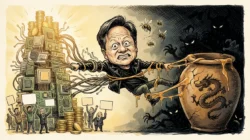
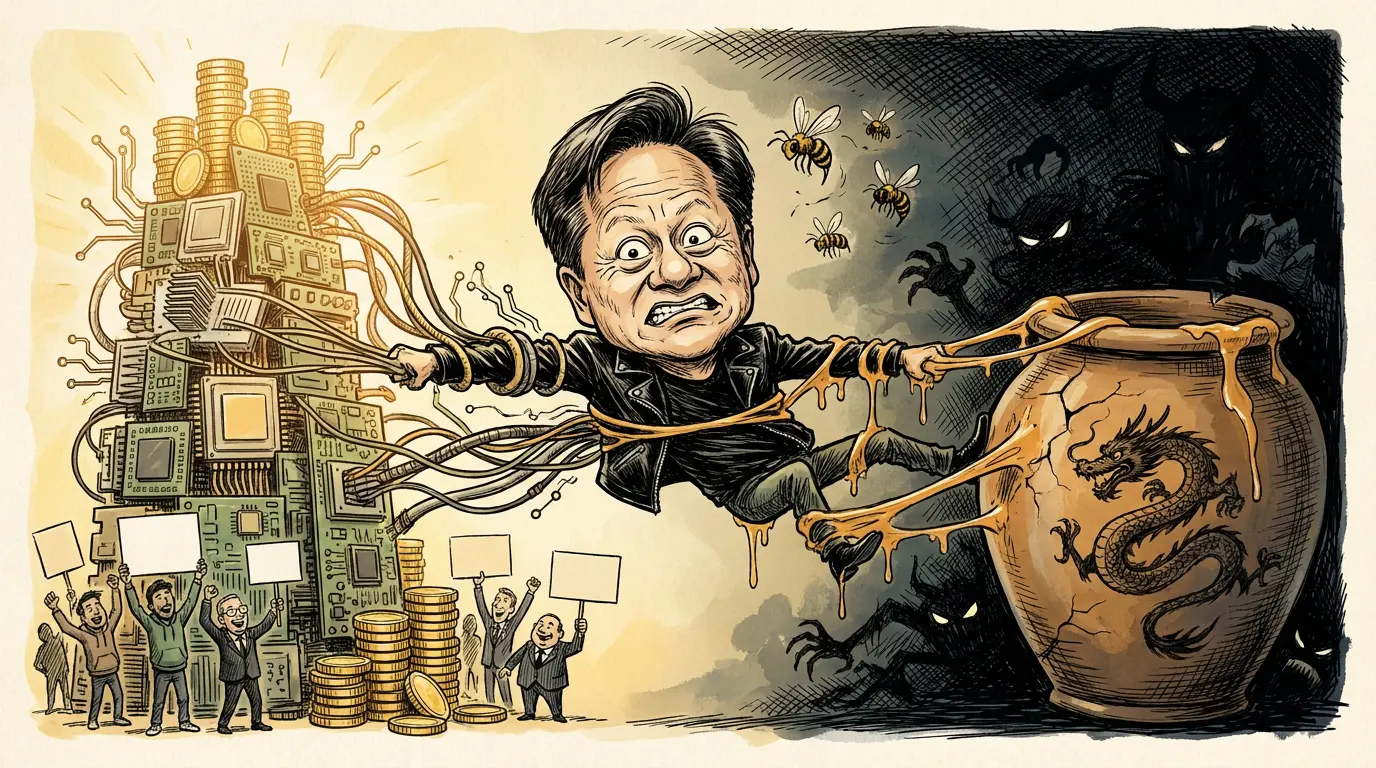
You get stung by a Chinese honeypot, and you turn around (to have another affair)…
That’s what corporate America is all about (in 2026).
Well, well, well.
What a comical turn of events things are taking with Nvidia.
Have you seen it yet?
Or better yet, signed it?
You know, the most important petition on Earth?
Nope, not the Brexit one…
Not the grooming gangs one…
Not the Rosebank oil one either.
In fact, nothing to do with any of the petitions here in the UK.
I’m talking about the “Bring Jensen Back” petition.
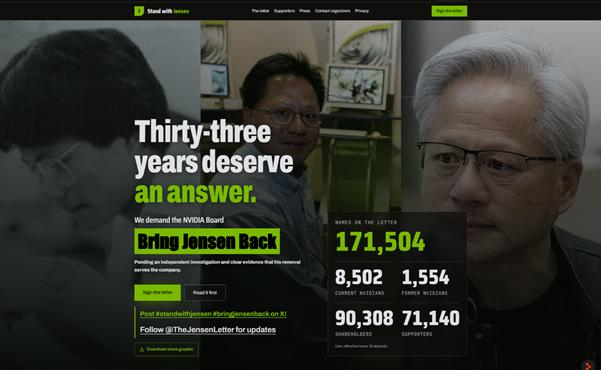
It’s a real thing.
So real, in fact, that even Elon Musk has signed it, along with Tim Sweeney (Epic Games), Tobias Lütke (Shopify), Travis Kalanick (co-founder of Uber), Steve Chen (co-founder of YouTube), and a whole bunch of other big names in tech.
Oh, and there are signatories from within Nvidia too, including a director from its robotics division, a principal ASIC engineer, the senior director of autonomous driving, one of its vice-presidents, and several other principal engineers, software engineers, architects, directors, and research scientists… you get the idea.
171,603 signatures (and counting), including 8,505 current Nvidia employees and 1,555 former employees.
I reckon the only other person who might inspire this kind of fandom is Elon Musk. But he can’t (or won’t) sack himself, so that’s not happening any time soon.
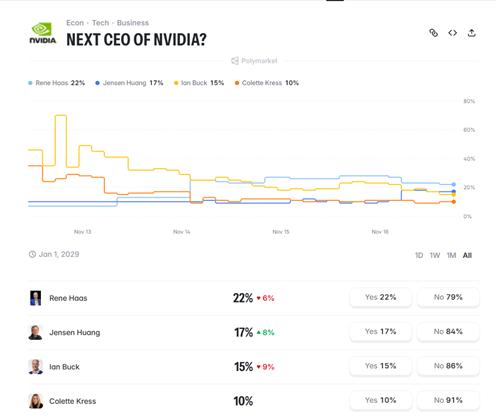
Polymarket now even has Jensen as the second favourite under their “Next CEO of Nvidia” market.
I called it the biggest corporate scandal in history on Friday (and rightly so)… and now there’s a chance he’ll come back!
Was it the White House?
But as this all unfolds, the US Treasury Secretary, Scott Bessent goes on Fox News and says,
I want to keep coming back to what was the culture at Nvidia, and were they pressing these seemingly illicit sales to goose their revenues and their earnings? I think we need answers in the next 10 days from the board and from outside council.
They then went on to call it a national security issue.
I cannot recall such theatre around any company in my lifetime. Let alone a sitting US Treasury secretary demanding answers.
It does lend some weight to the theory doing the rounds that the White House itself leaked these affairs as part of a coup to oust Huang and rein in the riskier lending and financing arrangements Nvidia was getting itself into.
What happens next?
I have no idea, but I’m all here for it.
Especially because all this drama is distracting from the fact that Nvidia remains a pillar of the AI trade.
And now you’ve got these additional risk factors feeding into the doomers’ view that Nvidia is on a fast track to misery.
But let’s take a quick look back at Nvidia’s latest earnings…
- Revenue: $96.2 billion, up 18% on the previous quarter and 106% year on year.
- GAAP net income: $59.7 billion, up 126% from $26.4 billion.
- Non-GAAP net income: $53.95 billion, up 118% from $24.76 billion.
- Earnings per share: GAAP diluted EPS was $2.46, up 128% from $1.08. Non-GAAP diluted EPS was $2.22, up 120% from $1.01. Wall Street expected EPS of $2.09 and revenue of $92 billion, so Nvidia beat expectations by roughly 6% on earnings and 4.6% on revenue.
- Operating income: GAAP operating income was $63.73 billion, up 124% from $28.44 billion.
- Data centre revenue grew 117% year on year, with margins of 75% across the business.
And the market is worried about who he’s cheating on his wife with?
No wonder more than 171,000 people want him back.
Britain’s Investment Letter Since 1938
In 1938, The Fleet Street Letter warned its readers that war was coming to Europe — and even identified September as the critical month.
Since then, its readers have been warned ahead of Black Monday, the dotcom crash and the 2008 financial crisis.
Today, Britain’s longest-running investment advisory is still looking for the “news behind the news” — and the investment opportunities others could be missing.
Click here to discover what The Fleet Street Letter sees coming next.
Capital at risk.
What Does Britain’s Oldest Investment Letter See Coming Next?
It warned readers ahead of Black Monday.
The dotcom crash.
And the 2008 financial crisis.
Now, nearly 90 years after it was founded, The Fleet Street Letter is still searching for the “news behind the news” — and the investment opportunities that could emerge from the next major turning point.
Click here to discover what its editors are seeing now.
Capital at risk.
A comeback of the ages?
Of course, he’s not the only person running the company. And now, with the CFO in play, many are waiting with bated breath to see if she’ll keep things going or dial back the aggressiveness.
Either way, know this: Nvidia is not going to fade away. It’s not suddenly about to lose its competitive advantage just because Huang isn’t there anymore.
There’s no guarantee it’ll still be a market leader in five or 10 years’ time, but that wasn’t guaranteed with Huang as CEO anyway.
In short, you’ll have some very loud voices calling this a travesty, insisting he must come back, and that Nvidia is nothing without him.
But I say that if he stays gone (which I expect he will), the market will look back in five years’ time and wonder what all the fear was about.
|
Here’s what we know for sure…
Nvidia chips are still in incredible demand. So far, no one has cancelled any major orders. Blackwell and Vera Rubin continue to lead the market.
In fact, Nvidia’s hardware is so sought-after that SpaceX is believed to be working on Project Kessel, using custom Nvidia hardware for its orbital data centre ambitions.
SpaceX and Terafab alone could eat up pretty much all the compute, memory, storage, and connectivity capacity available in the market.
And that doesn’t even factor in demand from Anthropic, OpenAI, Meta, Microsoft, Alphabet, and Amazon. Many are developing their own hardware, but all still use Nvidia.
I could go on and on.
But while this is clearly a massive market story, and it has dragged down the AI trade and may do so again, when you add up the facts, the pathway for the next five to 10 years looks very clear.
AI hardware demand is no longer following a traditional cyclical pattern. It’s becoming a constant, growing source of demand for every component and the infrastructure that connects them.
That demand doesn’t simply get wound back.
Anthropic isn’t going to announce during its IPO that it’s reducing the computing power it delivers to customers.
OpenAI isn’t going to throttle its ambitions because Huang was shown the door over an affair.
Maybe financing terms for smaller neocloud companies get a little stricter, which is probably a good thing.
But this is not the death knell for Nvidia.
Of course, Huang could also come back, which would be astounding.
And if he does, it’s hard to fathom just how sharply the market could rally in the short term.
But over the long term, I see the same outcome whether he stays gone or stages the comeback of the ages.
Until next time,

Sam Volkering
Investment Director, Southbank Investment Research
PS While the world’s biggest technology companies are fighting over billions in AI spending, one of the biggest investment opportunities sits beneath the ocean, almost completely overlooked. I’m talking about a tiny British island with an estimated £55 trillion oil deposit just off its coast.
That’s the equivalent of 183 North Seas.
And while everyone’s debating whether Nvidia can survive without Jensen Huang, I’ve got my eye on a little-known British oil stock trading for around £1 that I believe could be positioned to benefit from this extraordinary opportunity.
I’ve put together a free presentation revealing where this oil is, the company I’m watching, and why I think it deserves your attention.