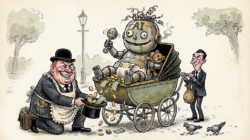
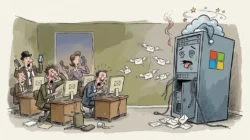
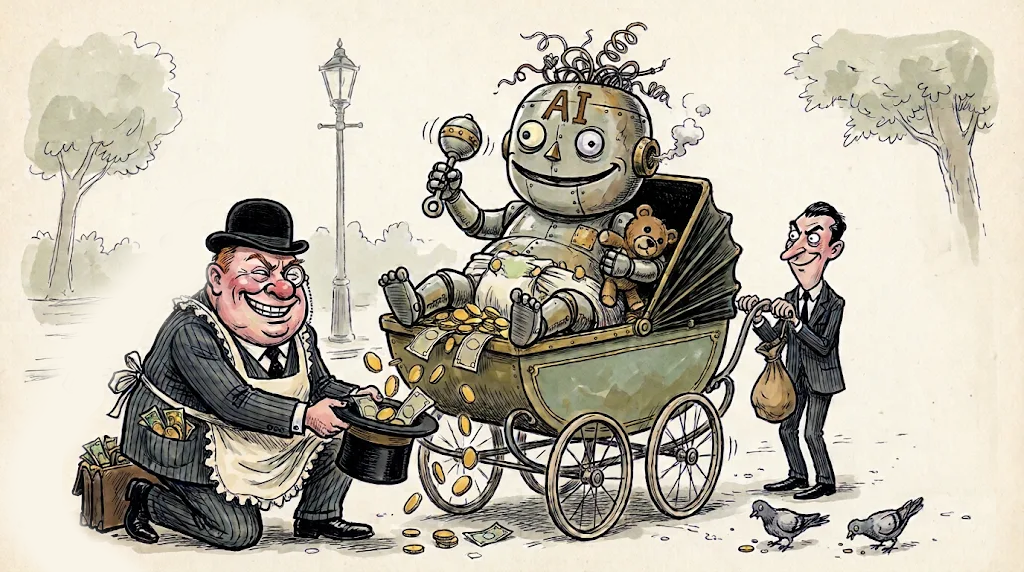
 You’ve probably asked an AI something this week.
Maybe even today.
A health question. A tax question. What to do with your 401(k).
I use AI all day. I’m a super-bull. I think the $10 trillion going into it will pay back four times over in the next 10 years.
But AI has weak spots. Places where it needs a babysitter.
And every one of them is an opportunity waiting for someone (basically ANYONE, in a bunch of ways) to grab it.
I’ll run through them.
- It gives you the average answer. Ask it for a toast at your daughter’s wedding, and you’ll get a toast a million fathers could give. That won’t change, and it makes anything with a human fingerprint worth more. Your voice, your memories, your experience, and your judgement just became more valuable. Congratulations on your promotion.
- It does the maths based on assumptions you never chose. Ask how long your savings will last if you withdraw 4% a year. The arithmetic might be right. But it may have assumed an inflation rate, market returns, and how long you’ll live. Only you know which assumptions fit your life. Human judgement (and liability) will always count.
- It loses the thread on long jobs. Spend a few weeks working through your estate plan with it. Somewhere along the way, it drops a detail you gave it in week one. Even the best models still say, “I’m sorry. I slipped.” Whoever perfects AI memory will win your business. You can build your own assistant, but it still needs hardware to run on. Either way, the memory-chip makers get paid.
In 1938, The Fleet Street Letter warned its readers that war was coming to Europe — and even identified September as the critical month. Since then, its readers have been warned ahead of Black Monday, the dotcom crash and the 2008 financial crisis. Today, Britain’s longest-running investment advisory is still looking for the “news behind the news” — and the investment opportunities others could be missing. Click here to discover what The Fleet Street Letter sees coming next. Capital at risk. It warned readers ahead of Black Monday. The dotcom crash. And the 2008 financial crisis. Now, nearly 90 years after it was founded, The Fleet Street Letter is still searching for the “news behind the news” — and the investment opportunities that could emerge from the next major turning point. Click here to discover what its editors are seeing now. Capital at risk. Britain’s Investment Letter Since 1938
What Does Britain’s Oldest Investment Letter See Coming Next?
- It has no taste. It learned from billions of essays. Only a few thousand are any good. Taste is scarce, and scarce things get paid. Great editors, designers, and curators who learn to use AI effectively are about to be worth a lot more.
- It’s stuck in the past. Ask about this year’s Social Security increase with web search switched off, and you may get last year’s number. Companies that feed AI fresh, verified facts get paid every time it answers. This also applies to knowledge, skills, and expertise.
- It’s confidently wrong. In 2023, a New York lawyer filed a brief citing six court cases ChatGPT had made up. The judge sanctioned the lawyers. Someone will get rich making AI prove what it says. Others will go broke taking AI answers as gospel.
What bizarre thing happened when researchers gave an AI the task of winning a boat-racing video game?
|
- It changes its answer. Ask whether to claim Social Security at 62 or 70. Ask again tomorrow, and you may get a different answer. Banks, insurers, and hospitals will pay big for AI that gives the same answer twice. This means narrow, specialised AI is an opportunity.
- It misses the rare case. Your symptoms usually point to the common thing, and AI bets on the common thing. You might be the exception. As AI handles the routine, the expert who catches the exception becomes more valuable.
- It agrees with you. Tell it, “This stock can’t go any lower,” and it may find reasons you’re right. That’s why smart users start every question with “Tell me why I’m wrong.” It also puts a premium on AI built to push back, and on advisers who push back for a living.
- It’s getting worse at the small stuff. The AI giants are chasing the coding money. Your trade, your hobby, and your town get less attention every year. Someone who knows a field inside out can build the tool the giants won’t bother with.
AI has weaknesses.
Every weakness is a market.
If you think this opportunity has passed you by, think again. It’s only just beginning.
Best,
James Altucher
Contributing Editor, Investor's Daily
PS Speaking of opportunities hiding in plain sight, my colleague Sam Volkering has uncovered something extraordinary off the coast of a little-known British island. Scientists have identified a potential oil deposit estimated to be worth £55 trillion. And Sam believes a little-known British company trading for around £1 a share could be positioned to benefit. Click here to see what he’s found.