 In today’s Issue:
- Is the commodity rally the real deal?
- Inflection points are very rare, but…
- The best way to play a resources boom right now
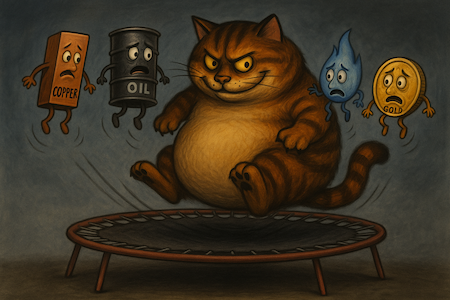
There’s a saying in the trading pits: even dead cats bounce. The idea is that prices can rally during a bear market. The big question for investors is whether the recent rally in commodities is a dead cat bounce…or the end of a morbid cycle of lower prices.
So far, the bounce looks healthy. The Bloomberg Commodity Index is hitting highs not seen since 2023. Copper, which has a PhD in predicting economic activity, is leading the charge. Aluminium isn’t far behind. And even natural gas is on the move.
What about sentiment?
A year ago, the news looked very different. Climate change, DEI, ESG, green energy projects, AI, quantum computing, and immigration dominated the headlines. Now there’s only one bullish story making the front page: commodities.
Trump has pushed the US government into partnerships with all sorts of resource companies, which promptly shot up in value on stock markets.
We just highlighted three companies that might benefit next to our subscribers at Jim Rickards’ Strategic Intelligence.
Trump is also busy unlocking extraordinary amounts of oil, gas and other commodities. And it’s working. BHP is looking to revive its commodity projects in the US in response. Barrick is considering a spin-off for its US-based assets. And vast tracts of land are being auctioned off to mining companies.
Lower political risk equates to higher valuations of commodity stocks.
The trade war is now focused on commodities too. China imposed export controls on rare earths. The Europeans are back to sanctioning Russian oil and gas. The Japanese are trying to avoid those sanctions without getting into trouble. The Indians are negotiating with Trump and Putin over whose oil to buy.
LNG export and import terminals and their supply projects are popping up as fast as new gas power plants all around the world. Coal and oil demand is rising, not falling, according to the International Energy Agency’s new estimates. Gas turbines are sold out.
German industry is frozen for lack of key materials. Australia is trying to ramp up supply. Even the Europeans are backing mining projects these days, if only in lithium!
And of course, there’s the gold and silver price spike. The precious metals have even left cryptocurrencies in the dust.
The commodity space is dominating.
But this is only the beginning.
I’ve been waiting 200 years for this
Commodity prices move in very long cycles. You can measure them in decades. That’s why most investors don’t bother to pay attention.
Of course, measuring them at all is difficult to do. Because over such long timeframes, the value of money fluctuates heavily. Well, it always depreciates. But the pace varies a lot. This obfuscates the data.
And so investors should use relative prices to figure out how to deploy their money.
A popular example is the Goldman Sachs Commodity Index relative to the S&P500. It tells you whether financial assets or real assets are performing well as investments.
The gold to copper ratio tells you whether a boom is an artificial monetary policy aberration or the real thing.
The gold to oil ratio tells you that oil is cheap relative to gold right now. That’s why gold miners are the place to be when it comes to precious metals investing. Their costs (oil) are low relative to their prices (gold).
There are many more relative price measures – ratios – which tell you what’s cheap and what’s already had its day in the sun.
But the point of cycles is that they reverse. Relative prices oscillate between ratios. While the price of gold can go infinitely parabolic in terms of Reichsmark, the ratio between gold and oil prices can’t simply surge exponentially in either direction, because they are real things. Any aberration must correct.
Right now, for example, the gold to oil ratio tells us that gold is extremely expensive relative to oil. This implies oil is the place to be. Thus, mining investment legend Rick Rule is telling his interviewers that he’s shifted his assets to oil.
And, after more than 15 years of investing in the gold space, so am I.
The reason this style of investing works is simple. The dollar denominated price of gold and oil can literally go off the charts, given enough inflation. But the relative value of oil and gold is bound by reality. Both are scarce.
Their fluctuations relative to each other are what create the profitable opportunity. It tells you where your money should be invested – in the undervalued option.
And the same thing applies to all other commodities. Relative price indicators highlight when to buy and sell. They tell you which investment asset class has a brighter future ahead of it.
Why do commodity cycles happen in the first place?
The key is the delay in bringing production online. It takes years to find new resources. Years more to get the right permits and approvals from the government. Then you need to build the mine. And find a refiner.
And so our commodity supply today is based on investment decisions made decades ago. Right now, our oil supply is dominated by US shale, for example. That’s an age-old boom by modern investing standards.
A 10-20 year lag between today’s commodity prices and future production is a real challenge for producers.
Can you imagine how much regulatory change, commodity price risk, demand fluctuation, technological advancement and other shifts play out over that timeframe?
But it’s great news for investors. We can take advantage of surprisingly long-term profit opportunities. Because it takes the resource-producing world years to catch up to higher prices. We can make serious money. More on that to come.
The commodity cycle makes clear, now is an especially good time to invest. Governments have crushed commodity production opportunities for all sorts of reasons. Local politics is wreaking havoc with the remaining mines. Underinvestment in both exploration and mine development implies supply would struggle to keep up with demand.
Commodity markets are poised for a commodity price boom. And the producers who have secured production will reap outsized profits for years to come.
Why resources demand is about to spike
You’ve probably heard that AI is spiking energy demand forecasts. Grid operators in developed countries had expected steady declines. But that would’ve been exceptionally unusual.
Electrification continues apace too. But the electricity grid is stuck in the analogue age. Underinvestment is even worse than in the commodity sector. At some point, grids are going to need a spectacular overhaul. In The Fleet Street Letter, I calculated this to be the biggest infrastructure project in world history.
The energy transition requires more resources than can possibly be mined and refined. A concept I called the “Metallic Dissonance of Net Zero” years ago.
But there’s one more reason why we need a commodity boom. It trumps all others.
Governments need the money
They’ve tried to transition from an energy system dominated by resources that pay royalties to one that costs subsidies. And are going bust as a result.
Taxpayers will soon be given the choice between cutting emissions and sustaining welfare spending. They will choose coal mining’s royalties all day long.
But the point is that governments are about to transition from obstructing resource development to backing it. Just when prices spike.
It’s going to be an extraordinary boom.
Until next time,

Nick Hubble
Editor at Large
P.S. One thing this memory story makes clear is how quietly these wealth windows open. It wasn’t the flashy names that moved first — it was the overlooked components, the bottlenecks no one was paying attention to, until prices had already tripled. That’s how every major wealth-building era works. The biggest gains don’t come from chasing headlines, but from recognising when a structural shift is underway and positioning early. That’s exactly the lens behind this latest briefing — where James Altucher breaks down how these moments form, and how to spot them before the crowd does.