 In today’s Issue:
- Socialism isn’t the only expensive ideology
- Even a worthy cause costs money
- How to profit from a change in priorities
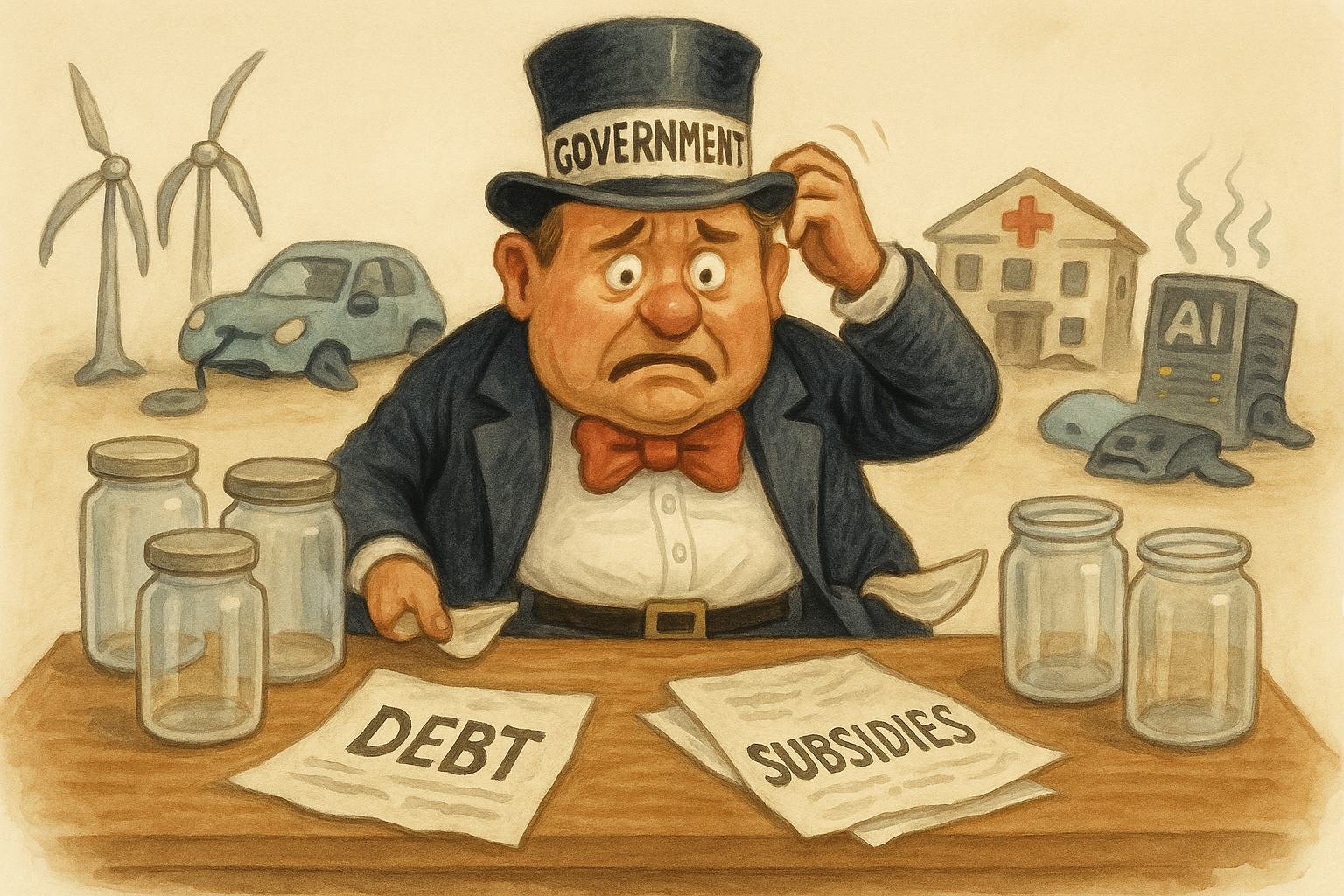
Back in 1976, Margaret Thatcher explained that, “The trouble with socialism is that eventually you run out of other people’s money.”
But socialism was just one format of the ideology the Iron Lady was really combating. It is best understood as interventionism. The idea that governments can do things better.
What politicians are doing doesn’t really matter. And why they are doing it matters even less. It is the government’s interference in our lives in and of itself that causes the problem.
Thatcher’s point was that government intervention is economically inefficient. The government can only destroy and redistribute wealth, not create it. So, countries with high government intervention eventually “run out of other people’s money”.
We’ve moved on from socialism. Today, ideologies like climate change are the source of government intervention.
Sure enough…
The green energy transition ran out of other people’s money
Governments are struggling to offer wind farm developers enough money to show up to project auctions.
Energy-intensive industries are going bust or moving offshore.
The EU and US have withdrawn their combustion engine car bans.
In the UK, EVs will be taxed by distance travelled.
Car companies are facing billion-dollar write-downs over their failed EV transitions.
Oil companies are facing whopping losses on their green energy projects.
Wind turbine manufacturers are closing plants.
Green energy companies are going bust, despite government support.
Of course, focusing on the green dream would be missing the point. It’s just the latest example.
Humans come up with no end of campaigns they expect politicians to pursue for them.
The good news is that we’ve run out of money to pursue much more…
Maxed out
Some of our politicians want us to pursue the green dream to the bitter end.
Others want to re-arm to fight off the Russians.
Some voters want to spend ever more on our state religion, the NHS.
Others think more immigration is a good idea.
Some lobbyists want nuclear power.
Others are pushing for AI data centre subsidies.
Some unions want bailouts for their industries.
Others want tax cuts.
Some entrepreneurs want a government-sponsored space industry.
Others want protectionism for strategic industries.
Some civil servants want to get paid more – their wages just rose at a record pace.
Others want more licenses, fees, registrations and regulations.
But it might not matter anymore.
Like in Thatcher’s day, we’re running out of other people’s money to pursue much of anything. Even if a good cause came along, we may not have the funds.
The Office for Budget Responsibility’s Professor David Miles is warning that UK government debt to GDP could hit 270% by the 2070s. This is both wildly optimistic and impossible. We’ll have a crisis long before then.
It’s not just us, of course. Government debt is maxing out all around the world. Bond markets are wobbling. And anything that’ll spike the deficit risks causing a panic.
The days of political promises and causes are over. We can’t afford whatever the politicians come up with next. You can vote all you like. We’ve run out of other people’s money.
Thatcher was cyclical
Of course, this situation is nothing new. Governments periodically run out of other people’s money. And have done so since long before socialism or the green energy dream.
Usually, it was war and conquest that got them into trouble. Sometimes over religion. But vanity projects caused financial strife, too.
Some governments try to print their way out of trouble. But creating more money causes inflation.
In some political systems, inflation really is preferable to austerity…for a while.
But what’s interesting is that all governments must eventually submit to basic maths. They have to balance the books to bring down debt.
Before I get to how they’ll do it, and how investors can profit, I want to make two more points…
Austerity is going to be unusually difficult for governments today because they face a dangerous demographic headwind.
Since the history of government debt, the demographic pyramid has provided a bailout. It was only ever a matter of time before more taxpayers grew up to shoulder the debt burden. Governments could freeze spending and wait for enough taxpayers to emerge.
That won’t happen anymore. Our population pyramid is no longer a pyramid. We must balance the books based on today’s workforce size.
The second point is that we got to our present level of debt on waves of long-term spending programs, not just short-term crises like 2008 and COVID.
You can argue that governments really should intervene during a crisis. But this requires them to have a sound balance sheet in anticipation of one.
We are one major economic crisis away from a budget crisis.
What would 2008 have looked like without the financial capacity to bail out the banks and spend on economic “stimulus”?
What would 2021 have looked like without the financial capacity to pay furlough and other stabilisers?
Today, thanks to a persistent deficit, we are facing crisis like finances without being in a crisis.
When one comes along, the government will struggle to do much about it.
How to save a government from its own policies
Every government facing financial ruin must balance the books. The question is how.
You can cut spending or grow the economy enough to raise taxes.
This has already dawned on our own government…
Our Prime Minister is complaining that too many regulations are preventing him from doing his job. This is astonishingly ironic. But it might just be the wake-up call we need.
Each additional regulation may look like it makes sense. But add them all up, and you get too big a burden on the economy.
More low hanging fruit is in the energy sector. The green energy transition transformed our energy system from taxpayer to tax taker. This can be reversed quickly by reversing green policies.
Oil companies and combustion engine cars pay a lot of tax revenue. As do mining companies.
Tariffs used to be a major source of fiscal revenue. As did home building. Politicians are waking up to both right now.
Tightening immigration to allow only those who are blatantly obvious a fiscal tailwind is another easy move that has begun.
So you’ll notice many of these changes are already well underway, even in the UK.
But it is the US that’s leading the way. And that’s why it is also home to the biggest opportunity for investors to profit from the government’s coming shift in priorities.
For now, though, investors need to beware of industries that rely on government causes and spending. They are on borrowed time.
Until next time,

Nick Hubble
Editor at Large
P.S. When governments run out of other people’s money, they don’t become generous — they become selective. Causes get dropped. Priorities harden. And entire industries discover they were living on borrowed time.
That’s why I’ve been paying close attention to a new briefing from Jim Rickards. It lays out, in cold arithmetic, how this shift plays out — which areas lose support, which suddenly become indispensable, and where investors can position themselves before the crowd realises the rules have changed.