 I had grand plans for today…
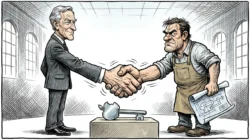
I was going to write to you about the will-they-won’t-they saga between Sam Altman and Jensen Huang.
Reports circulated last year that NVIDIA pledged up to US$100 billion of investment capacity to OpenAI, a headline-grabbing figure that implied an AI arms race unlike anything markets had ever seen.
Then, in recent weeks, reports shifted toward OpenAI struggling with competition, NVIDIA not liking the direction and discipline of the company, and that NVIDIA would be bailing on their $100 billion “commitment”.
Then, in the streets of Taiwan, Jensen Huang shut that down fast.
Huang called reports of their dislike of OpenAI as “nonsense.”
He said NVIDIA would continue investing — and that it would invest more into OpenAI than into anything it has ever backed before.
He also clarified that NVIDIA never committed $100 billion and they’d just do any raise round one at a time.
Oh boy! What a love affair this is. And as I say I was going to go into this in more depth. It was shaping up to be the biggest AI market story of the week — maybe the month, maybe the year.
Until Elon Musk walked in and blew the doors off the entire conversation.
The Muskonomy
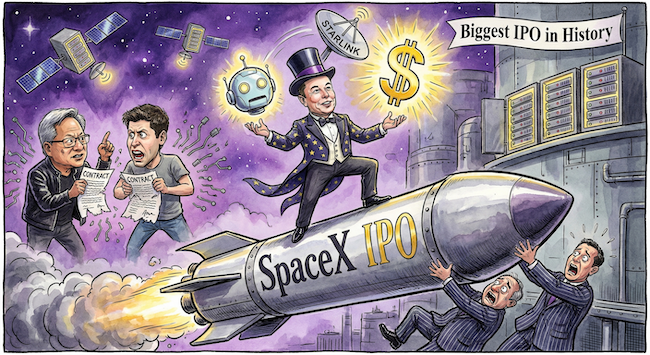
On Monday, Musk announced that SpaceX had acquired his artificial intelligence company, xAI.
SpaceX said they’re going to be “the most ambitious, vertically integrated innovation engine on (and off) Earth, with AI, rockets, space-based internet, direct-to-mobile communications and the world’s foremost real-time information and free speech platform.”
I mean…if you thought the SpaceX IPO was going to be huge (and it was!), it just got a heck of a lot bigger.
The obvious question is: why now?
With SpaceX reportedly targeting an IPO as early as June, why would they bring all of xAI (and X.com) underneath SpaceX, which already has Starlink in there too?
Geez, why not just throw in Tesla for the laughs?
I see this as a two-fold decision.
- First, it consolidates the infrastructure needed to deploy everything from space rockets to AI datacentres in space under one umbrella.
- Second, it effectively provides an exit for backers of xAI and com effectively handing them an exit to public markets when SpaceX (and Starlink) goes live on the NASDAQ.
I think point 2 is the real catalyst here.
Keeping it all separate probably pushes an xAI IPO out another two years, maybe more. And with Tesla already public, and no doubt a lot of investors in xAI and X.com wanting some payback, this is the cleanest way to do that.
Sure, it also likely puts datacentres in space faster, but Elon would have done that anyway.
So it’s a payoff. That’s cool. No big deal really.
But then there is a big deal. And that’s what this juggernaut of a company becomes next.
Because whether you like Elon or not, whether you like his companies or not, what’s coming was the biggest IPO in history. And now…it’s BIGGER.
Multiplanetary species?
Before this announcement, SpaceX was already the most anticipated IPO ever..
The company was raising capital privately at valuations around US$800 billion, with widespread speculation that a listing could clear US$1 trillion.
xAI, meanwhile, was valued at roughly US$230 billion following its Series E round.
Put it together, and there’s a strong chance the combined SpaceX, Starlink, xAI, and X IPO exceeds $1.5 trillion.
That would make it, by a wide margin, the largest IPO in history.
And the wild part will be that first day of trading.
I can easily see Elon-driven hype and FOMO building around this,
This is not just a bigger IPO. It’s the IPO to end all IPOs. Nothing will get the market as amped up as this IPO.
Investors won’t be buying a rocket company. They’ll be buying AI models, orbital data centres, a global communications backbone, and a social platform with hundreds of millions of users, all wrapped inside one vertically integrated ElonMachine.
The truly disruptive idea Elon confirmed is coming is AI compute in space.
SpaceX’s vision involves one million satellites acting as energy-efficient compute nodes, powered by continuous solar input and cooled naturally.
That would radically alter the economics of AI infrastructure and apply long-term pressure to hyperscalers down here on solid ground.
And as Elon also rightly pointed out, up there you could have so many of these satellites that you’d still not be able to see another if you were standing on one, such is the absolute vastness of space.
For investors, the implications ripple outward, making this IPO a true market mover across multiple industries.
Chipmakers like NVIDIA and AMD. Memory suppliers like Micron. Storage from SanDisk.. Foundries like TSMC. Advanced materials and critical metals companies. Space-grade power and optical and guidance systems. Space-ready robotics.
It’s difficult to overstate how much SpaceX now represents a rising tide and there’s hundreds of boats that are rising with it.
If SpaceX lists at anything close to current expectations, every public company connected to this ecosystem gets repriced. Telecom operators, semiconductor suppliers, satellite hardware firms, energy and infrastructure players.
And even companies that aren’t directly linked to SpaceX, but are involved in these big areas of next-gen tech will move as the market realises that SpaceX won’t be the only one pushing this tech forward.
The market melt-up is coming, we got a very good preview of what that looked like in 2025, and I don’t see 2026 being any different.
What was already going to be the biggest IPO in history has now been supercharged into a bigger biggest IPO in history.
And it’s more than Elon’s space dreams. It’s the start of off-planet infrastructure, space-AI, rocket tech, and yes even humanity as an interplanetary species.
I can’t wait to see it all unfold and the myriad of companies that profit along the way.
Until next time,

Sam Volkering
Contributing Editor, Investor’s Daily
P.S. The point of all this isn’t to guess where SpaceX might open on day one. By the time an IPO of this size lists, the easy gains are usually gone. The real opportunity is understanding which parts of the ecosystem get repriced in advance — the suppliers, platforms, and hidden infrastructure that benefit as capital and attention flood in. That’s exactly what James Altucher breaks down in his latest briefing: not speculation, but a practical way to position before the biggest IPO in history becomes a ticker symbol. If this article made you think differently about what Elon just built, you’ll want to see how James is approaching it here.