 Publisher’s Note: Changes at the US Federal Reserve are never just an American affair.
The Fed still anchors global liquidity, and its interest-rate decisions ripple through sterling, gilt yields, mortgage rates, equity valuations, and the availability of capital far beyond US borders. When the Fed shifts, UK markets feel it — often faster and more violently than markets in the US itself.
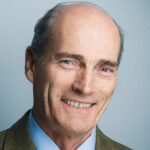
That’s why President Trump’s decision to nominate Kevin Warsh as the next Fed Chair deserves closer attention. On the surface, Warsh appears hawkish: sceptical of balance-sheet expansion and openly critical of the Fed’s role as a universal market backstop. But history points to something more nuanced — a policymaker deeply embedded in Wall Street’s crisis machinery, and one who understands when financial stability ultimately trumps ideological purity.
The real risk isn’t whether rates are cut or held. It’s what happens when markets begin to question whether central banks will always step in to smooth volatility.
That uncertainty is arriving at a particularly fragile moment. Japan’s bond market — the quiet foundation of decades of ultra-cheap global funding — is under visible strain. Rising Japanese yields threaten the yen carry trade that has supported risk assets worldwide, from equities and credit to commodities and property. When that plumbing seizes up, capital doesn’t retreat neatly. It rushes.
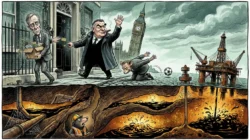
The UK, with its dependence on foreign capital, persistent current-account deficits, and sensitivity to global rate shocks, sits directly in the path of those flows. What looks like a US personnel decision can quickly turn into a repricing event across sterling assets.
This essay explores why Warsh’s appointment matters less for what he says, and more for what markets are forced to confront: a world where cheap money is no longer guaranteed, volatility returns as a feature rather than a bug, and risk management matters more than narratives.
Understanding these dynamics is no longer optional. It’s becoming a prerequisite for navigating the next phase of global markets.
The question remains an unsolved mystery. Why would a dovey “Low Interest Rates” Trump appoint a supposed ‘hawk’ to lead the Fed?
This leads, of course, to follow-on questions: is he trying to lose the mid-terms…has he lost his mind…or our favorite, is the fix in?
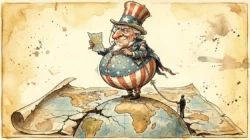
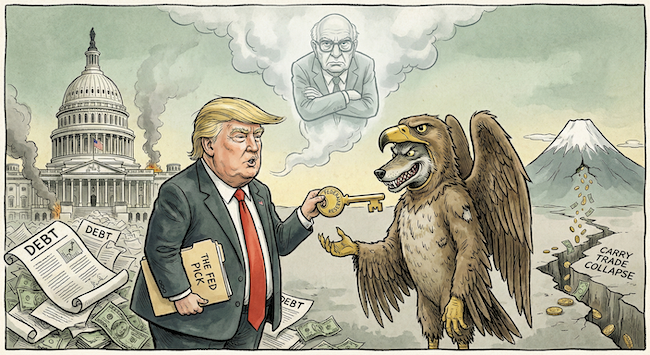
Passing judgement before listening to the arguments, our so-far- unchallenged hypothesis is that Mr. Trump has an historical mission of which he is unaware. It is to wreck the empire. That mission will be best served by giving the big donors what they want – more money and more war. Debt and inflation will rot the empire from the inside. Alienating friends and unnecessary wars will topple it from the outside.
In that light…
Youngish. Good looking-ish. Harvard. Wall Street. Rich. Warsh seems like the perfect person to lead the Fed to catastrophe.
But let’s look more closely to see if he’s really the man for the job.
Warsh was on the Fed board previously. As a former Morgan Stanley banker, he was ‘Bernanke’s bridge to Wall Street’ during the 2008 mortgage finance crisis. An insider, he was able to work with Bernanke to make sure Wall Street’s mistakes were suffered by someone else.
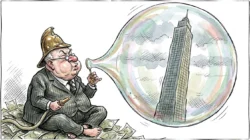
You’ll recall that during the great real estate bubble of 2003-2007 — caused by the Fed’s recklessly low rates — Wall Street made billions in profit by lending too much money to far too many people who couldn’t pay it back. Then, when the chickens came home to roost, the great and the good figured out how to make the dumb cluck voters take the losses.
Remember TARP? The feds took $700 billion of taxpayers’ money and gave it to Wall Street, essentially transferring the big banks’ bad bets onto the public. Bernanke shamelessly told a credulous Congress that ‘we won’t even have an economy,’ unless the legislation were passed. The Fed did its part too, cutting its key rate down to a nub, which caused another huge credit-financed bubble.
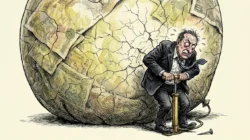
Rather than correct the problem, in other words, Warsh, Paulson, Bernanke et al made it worse. And now Warsh will slip into the shoes previously worn by the scalawag Greenspan and the rascal Bernanke and will come upon the same can, bigger and heavier than ever. Greenspan kicked it down the road in 2001 and Bernanke did the job in 2008. Now it’s Warsh’s turn.
Trump’s confrontational win/lose politics makes enemies. The last thing he wants is for those enemies to control key Congressional committees. They’d start looking into his business deals…his unconstitutional policies…and his use of federal police power to pester his opponents. They might even want to see the full Epstein files!
A credit boom is about the only thing that might juice the economy enough to keep Republicans in control of Congress. Warsh, most likely, has already made a deal; he will provide lower interest rates as soon as he is able.
And the next can-kicking session may be approaching fast. Japanese bond yields have risen to the highest levels in at least a quarter of a century. The bubble finance window — in which you could borrow yen at almost no carry cost…and use the money to speculate on stocks, cryptos, bonds…silver – seems to be closing. Japanese speculators are now being squeezed out of their positions, forcing them to sell speculative assets in order to repatriate the money into yen and pay their debts. Bloomberg:
Japan Bond Crash Unleashes $7 trillion Risk for Global Economy
The recent bond market turmoil in Japan has…pushed the 40-year yield to 4.24 percent, the first time any Japanese sovereign maturity has breached the 4 percent threshold in over three decades. This situation has not only affected Japan but has also reverberated across global financial systems, challenging decades of conventional wisdom about the world’s safest haven for low-cost funding.
Any day now could bring an avalanche of collapsing prices. And by the end of the year, the Democrats may be back in power in Congress…asking a lot of uncomfortable questions. Will Warsh stand tall and firm, like Paul Volcker, resisting both Congress and POTUS, leaving Fed policy unchanged? Remember, even Volcker couldn’t have done what he did without President Reagan’s support.
What we conclude from this is that no matter how the election goes, Mr. Warsh’s hawkish wings will be clipped. Maybe they already have been.
Regards,
Bill Bonner
Contributing Editor, Investor’s Daily