 In today’s Issue:
- Renewables must be replaced
- With what?
- Even Europe will have to act, this time
All around the world, governments are turning their backs on net zero. And where the government hasn’t woken up yet, an anti-net zero political party is polling ahead of them.
It is therefore only a matter of time before net zero commitments end.
The big question now is what energy policies will replace them.
Will renewables manage to stand on their own two feet without subsidies, vast power grid rollouts, subsidised batteries, and curtailment cheques?
Will we transition back to coal? Its price is certainly spiking lately.
Will we continue the pivot to gas, but produced domestically to shore up supply lines?
Or will we try something new, like a nuclear-dominated system?
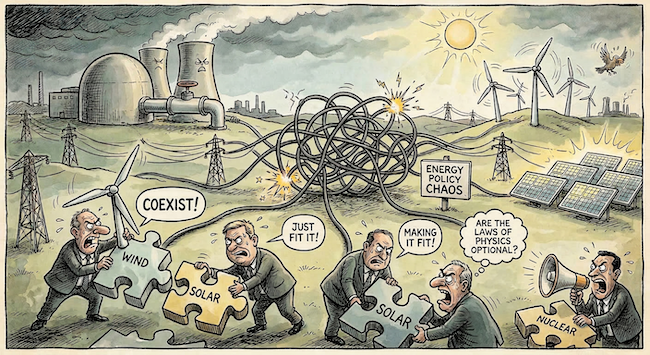
Each of these options has plenty of merit. What’s not well understood is how well and badly some of them combine on the same grid. Sometimes into a toxic mix.
A mix made in hell
Governments love to tell us that our energy sources should be a mix. Which sounds sensible at first.
Relying on just one source of power seems risky. Diversification means stability, right? Don’t put all your power sources into one basket.
But it’s simply not true.
The most successful energy grids take advantage of local conditions to the extreme. Hydropower provides about 90% of Norway’s electricity. Paraguay gets 99.7% of its power that way too. Selling solar panels in Paraguay to “diversify the mix” would be silly.
Some forms of power are very well suited to dominating a grid.Nuclear is a good example. France is the country that demonstrates the benefits of doing exactly that.
Some forms of generation fit together like puzzle pieces. . Renewables and pumped hydro, for example.
Others combine like the contents of a punch at a university frat party.
Nuclear power is nobody’s switch
The trouble with nuclear is that it struggles to combine well with other forms of power.
At the moment, France is curtailing its nuclear output to make room for solar power.
It’s difficult for me to convey just how dumb this is. But I’ll give it a good go…
The first point is simple: carbon-neutral power is pushing carbon-neutral power out of the mix. There is no gain in terms of emissions.
Although, of course, all those solar panels did cause plenty of environmental damage while they were being made.
But it’s the costs that expose the stupidity of adding solar to the French grid.
Nuclear power has very low marginal cost and very high fixed costs. Producing less nuclear power doesn’t save the power plant much money. It has to pay its whopping bills whether it’s running at 100% or 50% of capacity.
That means nuclear only makes sense if you run it as close to full capacity as possible.
When nuclear gives way to solar, it becomes expensive per unit of power produced.
So, the French are undermining the viability of their nuclear plants for no benefit. It’s a terrible thing to do. Naturally, this is exactly what the UK now plans to emulate.
The value of a nuclear plant is that it works when the sun doesn’t shine. So you don’t need a solar power system to back it up. Whereas solar does need some form of backup. If that’s gas, it pollutes. If it’s nuclear, that undermines nuclear power when the sun is shining.
The point is that solar and nuclear are a mix made in hell. Unless you give nuclear power priority to produce baseload under fixed long-term contracts and leave solar power doing the curtailment. Unfortunately, solar farms tend to demand rather a lot of money to be curtailed…
Much the same goes for wind, by the way. Which makes all those windfarms a poison pill to our future electricity system. Whatever we use for power will have to combine well with wind farms.
The only good news is that wind turbines don’t seem to last as long as it says on the label. And it takes us so long to build nuclear that it really could replace wind by the time it’s ready.
Tied at the hip
Another major decision concerns interdependence.How much do we want to rely on our neighbours for our power?
According to Karthryn Porter of the Watt Logic blog, we came mighty close to a blackout in January last year. The Danes performed a last-minute rescue by bringing their interconnection cable back from maintenance early.
And so a bigger grid makes more sense at first glance. It creates redundancy. And opens us up to a bigger mix of energy supply types.
The weather is unlikely to be the same across Europe. So interconnectors can combat the intermittency of renewables by offsetting them against each other.
But we’ve also discovered some downsides that weren’t mentioned when a European-wide grid was sold to us.
There’s the possibility someone simply cuts the cables. As someone did to Germany’s Nord Stream pipelines.The Russians have been busy mapping our subsea connector cables, for example.
Then there’s pricing power. Countries supplying electricity through interconnectors can demand eye-watering prices during shortages.
Recently, the Norwegian government has been considering cutting energy links with the South. They expected renewable energy to flow north during years of drought. Instead, the continent is sucking Norway’s water resources and power resources dry at the same time.
Besides, weather patterns around Europe do tend to be correlated, so we’re all bidding for the small amount of dispatchable energy when the weather turns against us.
In many countries, power supply is tied to other priorities like water reserves. Or the price instability of other countries is too much for the local market.
And foreign partners aren’t always as reliable as they seem when you sink multi-decade power infrastructure into the ground. Just ask the Germans about their Russian gas.
Choices must be made soon
The latest spike in gas prices is the final straw. Governments will have to announce measures soon.
The Financial Times reports that “Eight former UK energy ministers have called for the government to curb restrictions and taxes on the North Sea oil and gas industry.” And inside the EU, populist governments are already pushing to water down carbon constraints.
With our future energy system shaping up to be such an almighty mess, I can’t help but wonder whether small modular reactors may yet prove to be the solution. But only if they can circumvent the problems of our fouled-up energy grid.
They’d have to be rolled out very fast, avoiding the planning bottlenecks that slow every major UK project.
They’d have to be deployed on small microgrids in locations that opt out of the mess renewables have made for our national and international grid. (This would also dodge the vast transmission system cost.) Adding SMRs to the main grid would be an even bigger cost nightmare by adding to curtailment bills during windy and sunny days.
They’d have to be cost efficient, including the waste handling.
And they would likely need funding from entities capable of absorbing the upfront burden — large industrial power users such as AI data centres.
Although nobody in their right mind would build an energy system based on SMRs, we’re not starting with a blank slate. We’re starting with a messed up planning system, a messed up energy system and a messed up grid design.
So, as often happens in technology, the best solution is not to fix the old system but to circumvent it with something better, even if it’s not perfect.
The gains on offer for the technology that manages to circumvent our broken electricity system will be extraordinary.
But that’s just one of the technological breakthroughs we’re monitoring here.
Until next time,

Nick Hubble
Editor at Large, Investor’s Daily
P.S. Broken systems create the biggest investment opportunities.
The global energy grid is just one example. Instead of fixing it, new technologies will likely bypass it entirely — microgrids, modular reactors, decentralised power systems.
James believes we’re about to see the same kind of “circumvention” across multiple industries right now — from AI infrastructure to finance to energy itself. That’s why we decided to make this lifetime access opportunity available to you now.