
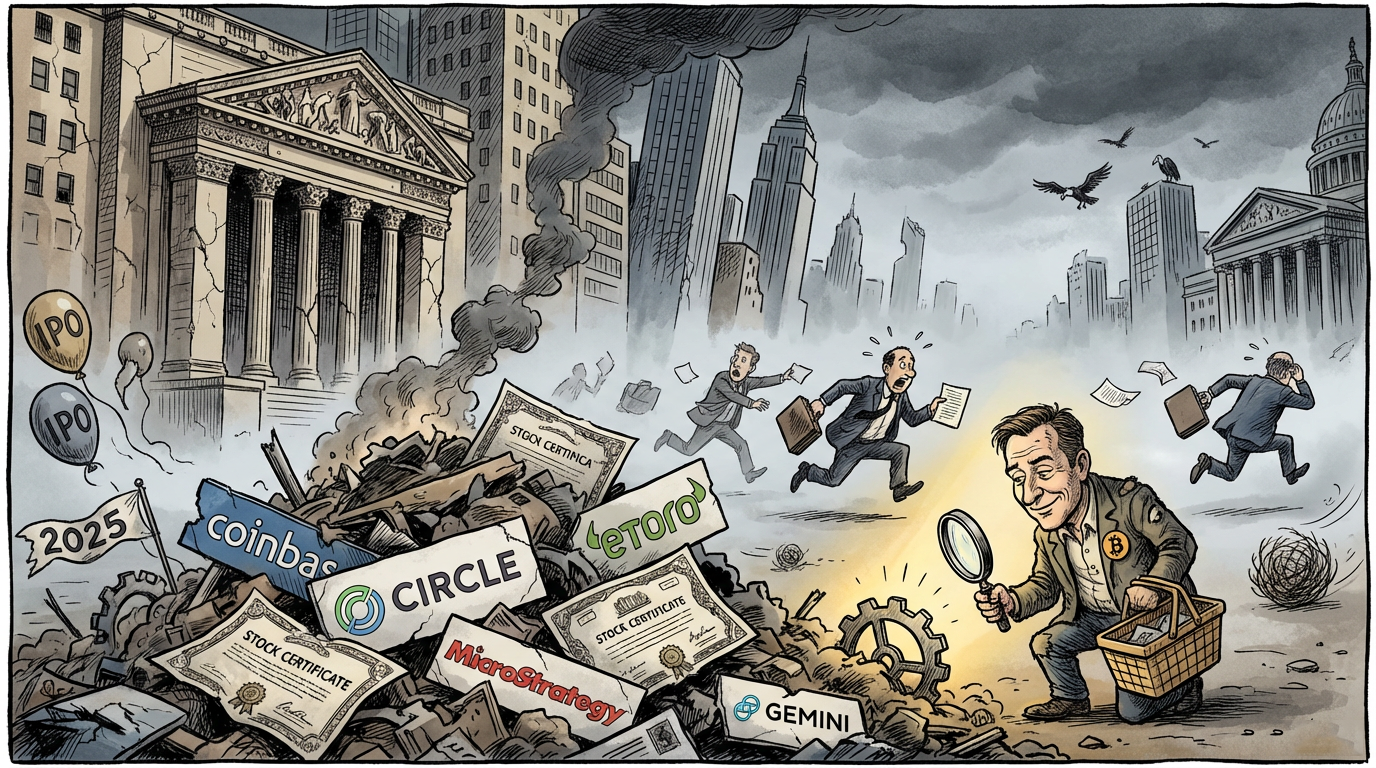
 CoinShares started trading on the Nasdaq last week. A profitable crypto asset manager, every year since 2014, now publicly listed in the US after merging with a SPAC (Special Purpose Acquisition Company).
Any other time, that would be a headline. Right now, nobody cares.
You want to know how much nobody cares?
This much.
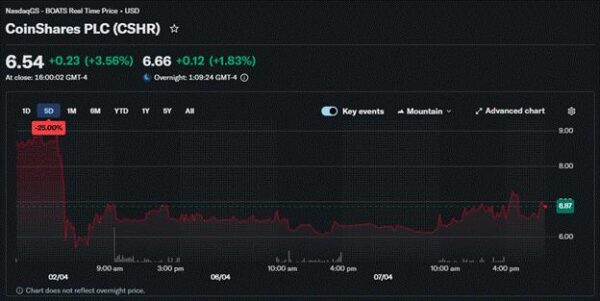
After hitting an intraday high of $10.43 last Wednesday it’s now well under $7 and has barely any volume.
That tells you more about where we are in the cycle than any chart ever could, which to me is fantastic!
The wreckage is damning
Cast your mind back 12 months. Crypto stocks were the hottest ticket in town.
Circle went public in June 2025, tripled on day one.
Bullish, backed by Peter Thiel, doubled at debut.
Galaxy Digital hit the boards, rocketed higher.
eToro listed and went from $52 to $75 in a day.
Eleven crypto IPOs in 2025 raised a combined $14.6 billion.
Fast forward to today and the scoreboard for crypto stocks in the last 12 months reads like a disaster movie script.
Coinbase is off roughly 65% from its July 2025 highs.
Strategy, the company formerly known as MicroStrategy, has collapsed around 72% from its mid-2025 prices and sits near $125.
Circle, the standout performer of the class, still got hammered from close to $300 down to $90.
Bullish has been cut in half.
eToro is down nearly 60%.
Gemini? Crushed. Close to 80% off its listing day high.
Kraken, which had been lining up a blockbuster IPO for this November, pulled the pin a couple of weeks back. It said market conditions weren’t right. Hard to argue with that looking at the current role call
So yes, it’s ugly.
But here’s the thing…
We’ve been here before, multiple times. And every single time the exits have been this packed, it’s turned out to be one of the great entry points for long-term investors.
Separating the survivors from the casualties
The important distinction right now is between crypto companies with recurring revenue and those that live and die by trading volume.
Circle earns yield on its USDC reserves regardless of whether bitcoin is at $100,000 or $60,000. CoinShares generates management fees on assets under management. These businesses don’t collapse when winter kicks in. They grind on, buidling and hodling (ie holding on for dear life – hodling).
On the other hand, exchange-heavy platforms are entirely cyclical. When bitcoin dips and altcoin volumes dry up, their income evaporates. That’s why Gemini is down 80%.
The lesson from this IPO class mirrors exactly what happened in 2021 and 2022.
Public investors pile into crypto stocks at the peak, ride the euphoria, then get scorched when the cycle turns. The pattern repeats because human nature doesn’t change.
But you know what…?
In 2023, peak crypto winter, Coinbase stock was trading around $30. Even today in the current so-called “winter” it’s now at $175. So, when I look at Coinshares, or Circle, I see long term opportunities.
That’s because the fundamentals underneath tell us the real story.
Stablecoin adoption is accelerating.
Tokenisation of real-world assets is accelerating.
Institutional infrastructure is being built at a pace we’ve never seen.
The regulatory backdrop in the US, for all its messiness, is more constructive and positive than it’s ever been.
None of that disappears because share prices are down. What it does is lay a foundation for the next big leg up for crypto native companies.
When that arrives, it will reward the investors who had the conviction to accumulate quality names while the headlines were awful, and the sentiment was in the gutter.
This is prime crypto stock hunting season. And there are plenty of great trophies to take in this market.
Until next time,

Sam Volkering
Investment Director, Southbank Investment Research