 You’re lying in bed, typing something into a chatbot you’d never say out loud to your GP.
You hit enter.
Then, for a second, you wonder who else gets to read it.
Sensitive information you’re just typing into your AI without even thinking about it.
But… where is that data and info going?
Who has access to it now, or in 10 years’ time?
Oh boy, maybe that wasn’t such a good idea…
Erik Voorhees has built a business on that problem.
His Venice AI promises to forget you when you close the tab, and its token is the standout AI trade in crypto this year.
Venice Token (VVV) bottomed at US$0.92 in December 2025. Last week, it closed at a record US$34.53. That’s a whopping 3,653% higher in just nine months.
Just goes to show you can have a bull market in the crypto market even when the crypto market isn’t in a bull market… yet.
Since mid-August alone, VVV is up 120% compared with about 35% for NEAR, the biggest AI token by market cap.
Why has Venice run so hard?
Because it makes money.
Voorhees said in August that Venice had passed $100 million in annualised revenue, up from $70 million in July.
You see, the token has a job. You stake VVV, which means locking it up, and get a share of Venice’s AI capacity without paying per request.
When Dragonfly led a $65 million raise at a $1 billion valuation in July, Voorhees said Venice was being built for,
“a few hundred million people and several billion AI agents.”
He’s counting the machines as customers, and that means an infinite number of customers.
In 1938, The Fleet Street Letter warned its readers that war was coming to Europe — and even identified September as the critical month. Since then, its readers have been warned ahead of Black Monday, the dotcom crash and the 2008 financial crisis. Today, Britain’s longest-running investment advisory is still looking for the “news behind the news” — and the investment opportunities others could be missing. Click here to discover what The Fleet Street Letter sees coming next. Capital at risk. It warned readers ahead of Black Monday. The dotcom crash. And the 2008 financial crisis. Now, nearly 90 years after it was founded, The Fleet Street Letter is still searching for the “news behind the news” — and the investment opportunities that could emerge from the next major turning point. Click here to discover what its editors are seeing now. Capital at risk. Britain’s Investment Letter Since 1938
What Does Britain’s Oldest Investment Letter See Coming Next?
Stripe and Coinbase see it too
Two days after Voorhees posted that number, Stripe agreed to buy OpenRouter, which sends AI requests to whichever of 400-plus models suits the job.
Bloomberg reported the price at more than $7 billion, compared with a $1.3 billion valuation in May.
That’s a jump of more than 430% in three months. All of it on the back of a rise in agentic AI commerce.
Then, on 25 September, Coinbase (Nasdaq: COIN) boss Brian Armstrong posted that crypto and stablecoins will become the way AI agents pay each other.
We’re seeing announcement after announcement after announcement of agentic AI slowly but surely moving towards an entire infrastructure being set up.
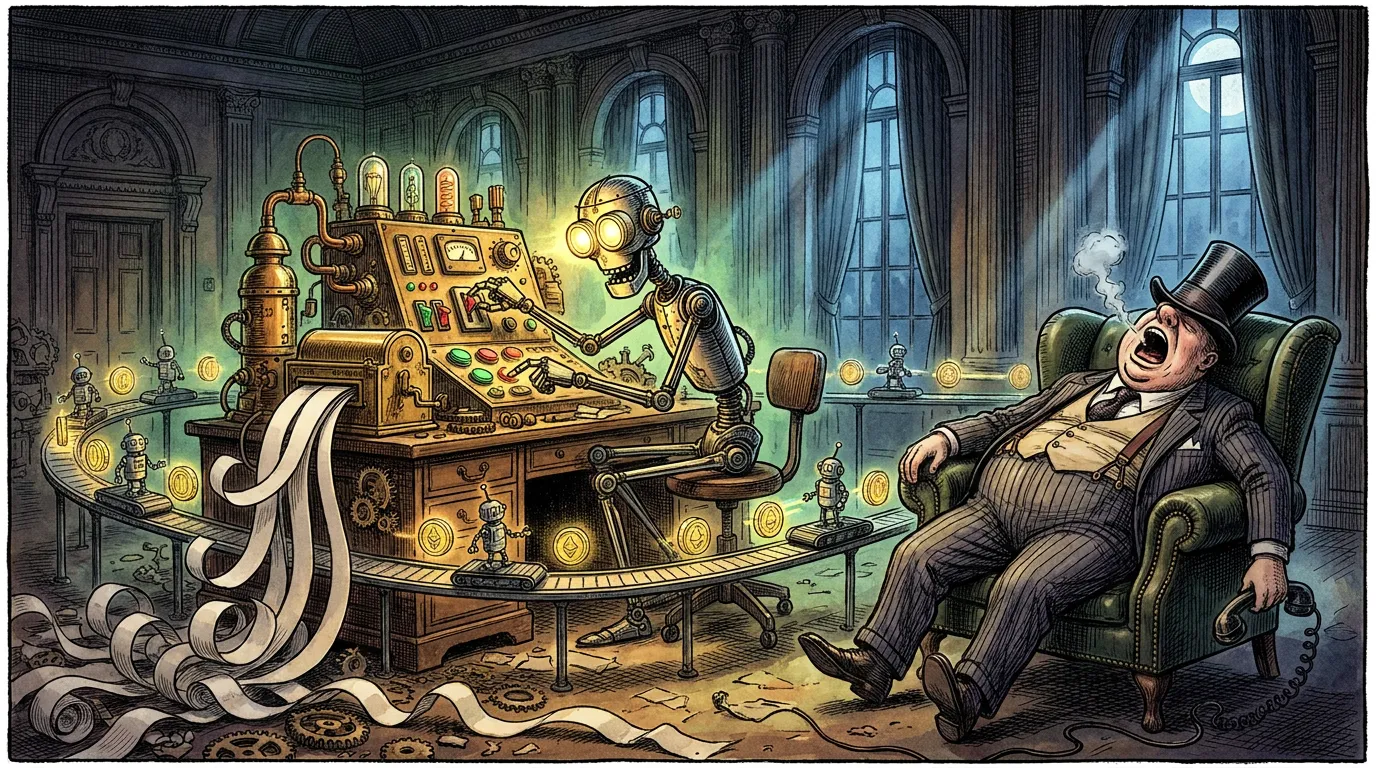
That means AI agents doing things like making payments, buying, selling, swapping, and trading. All of it automated, with approvals, but involving tiny transactions and micropayments, all built on decentralised crypto infrastructure.
If AI agents start transacting with each other at scale, which feature of money could become more valuable?
|
It’s the convergence of AI and crypto, and it’s one of the biggest opportunities in the market (as VVV is showing us).
Robinhood hands the robots the keys
Added to that, overnight, at its HOOD Summit in Houston on Tuesday, Robinhood (Nasdaq: HOOD) said all its roughly 29 million customers now get a trading agent built on OpenAI or Anthropic models.
A feature called “Loops” lets it watch the market and trade when your conditions are met, even overnight.
AI agents are the new degens!
The point is that an agent transacts in crypto because it’s AI, not a human. So it can’t open a bank account, it can’t pass certain verifications. To automate these things, you need an “AI friendly” infrastructure, which is exactly what crypto provides.
Agents will buy a tokenised stock at three in the morning on a Saturday, because the market is open. An agent pays Venice, or another AI crypto like it, for the thinking, and every step settles on-chain.
Robinhood, Stripe, Coinbase, and Venice are all building out this future now. And I believe this is exactly what drives the next massive crypto bull market.
For me, the AI x Crypto trade is maybe the best in the market. VVV is an indicator of what to expect, and when the whole market is in a bull run, AI crypto might be the fastest runner in the race.
Until next time,

Sam Volkering
Investment Director, Southbank Investment Research
PS AI agents may be about to change how money moves. But AI is already changing how investors find opportunities. My Hyperion system scans and ranks 1,796 investable UK and US stocks, from worst to first, according to its algorithm – and its latest buy alert has just gone out to members. Click here to see how you can get Hyperion working for your portfolio.