
When I was a teenager, the big PC upgrade you saved up for was a killer GPU.
You opened the case, slotted in the new graphics card (or two if you were really pushing the boat out), and suddenly the machine felt brand new again.
Building a PC was all about understanding bottlenecks. You had to know which component was holding everything else back.
I still think that way. Even now, I’ll open Task Manager and wonder: do I need more RAM? A better GPU? Or is the CPU the real constraint?
I mention this because that understanding of compute bottlenecks shaped how I interpreted Jensen Huang’s recent comments.
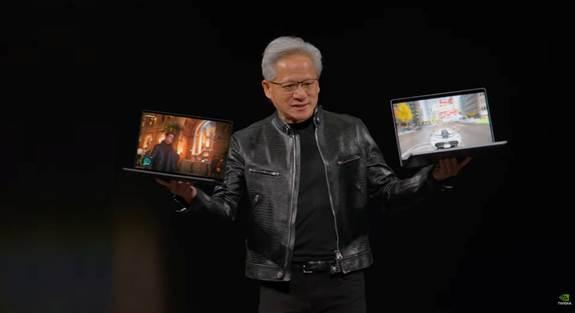
Speaking at GTC Taipei, Huang said that Nvidia (Nasdaq: NVDA) and Microsoft (Nasdaq: MSFT) are going to reinvent the PC.
That’s a bold claim.
The centrepiece of that reinvention is RTX Spark, which Huang also refers to as the N1X.
It’s the result of three years of development work between Nvidia and Microsoft, and it will begin appearing in Windows laptops and compact desktops from Dell, HP, Lenovo, MSI, ASUS, and Microsoft’s own Surface range this autumn.
The chip pairs a Blackwell GPU with 6,144 CUDA cores and a 20-core Arm-based Grace processor over NVLink. It was designed alongside MediaTek (TPE: 2454) and built on TSMC’s 3-nanometre process.
It packs one petaflop of AI compute and up to 128GB of unified memory, enough to run a 120-billion-parameter model locally on the device, with a million tokens of context and nothing sent to the cloud.
What that all boils down to is an insanely powerful personal AI PC.
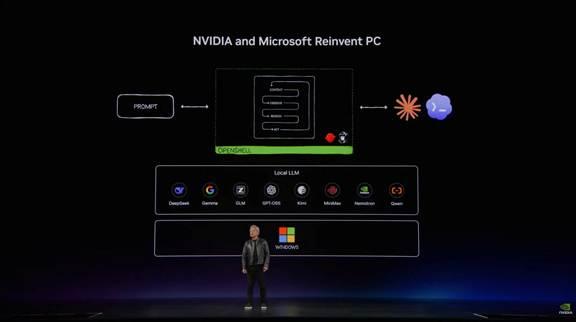
What Huang pushed hardest, however, was the shift from operating the machine to simply asking it.
An agent runs locally through Nvidia’s OpenShell runtime and a set of new Windows security controls, reading your files, moving across your apps, and completing tasks without sending everything to the cloud.
Your AI assistant runs continuously in the background rather than waiting for you to open an app. Satya Nadella later described it as “unmetered intelligence” on every desk.
Memory and storage get an old friend back as a customer
For two years, the AI money has gone almost entirely into the data centre.
Huang said as much in Taipei. His customers do not want to buy computers; they want to build AI factories, the largest infrastructure buildout we have ever seen. That has made the component suppliers a lot of money.
It’s also why Huang now calls Nvidia an “AI infrastructure” company.
I wrote to you in January that this data-centre demand squeeze would be bad for consumer devices. It meant less memory and storage, with manufacturers directing every spare wafer towards data centres that paid more.
That still rings true, and several consumer brands have backed away to focus on the data centre.
But RTX Spark is the first sign that things may begin to reverse over the next couple of years.
Nvidia is putting 128GB of memory into a laptop, which puts consumer devices back in the queue for the same parts the data centres are bidding up.
That helps memory companies such as Micron (Nasdaq: MU), SK Hynix, and Samsung, along with storage providers such as SanDisk (Nasdaq: SNDK) and Micron’s NAND business.
They have already run hard on the data-centre story. A swing back towards the consumer market adds to demand that is already there, but can now finally get supply.
I think the next big opportunities will come from the consumer market as we move from “smart” devices to genuinely intelligent ones.
Forget AI, America’s No.1 forecaster says a bigger boom is coming:
“I’ve invested $1 million of my own money to prepare for this…”
He predicted the Financial Crash, both Trump victories and 2025’s record rare metals surge that saw stocks soar as much as 645%
Now discover the move he is making as America seeks to unlock a home grown fortune potentially worth trillions on Friday, May 15th
Find out what that move is right here >>
Capital at risk
The CPU shift, and two riskier bets
The other significant shift from GTC Taipei is the return of the processor.
Nvidia has entered the consumer CPU market for the first time with an Arm design, and the market reacted in a big way.
Intel (Nasdaq: INTC), AMD (Nasdaq: AMD), and Qualcomm (Nasdaq: QCOM) all fell on the news. But Arm (Nasdaq: ARM), whose architecture now spans phones, data centres, and now PCs, along with MediaTek (TPE: 2454), which co-designed the chip, moved higher.
But the other thing these new AI devices have me thinking about is power.
When I run Claude on my iPhone, it chews through battery life faster than almost any other application.
I am constrained in how much I can use Claude on the go simply because of the battery.
An always-on machine that is constantly computing needs a level of power density that today’s batteries still struggle to provide.
Silicon-anode developers such as Enovix (Nasdaq: ENVX) and Amprius (NYSE: AMPX) are on my watchlist. They are small, they burn cash, and plenty of battery start-ups have promised the world and delivered nothing. So, for now, I’m simply watching where things go next. But I do think we could see a major resurgence in battery technology.
There is now a reason to want serious compute on your own machine that did not exist before, because these agents are only getting better.
With Nvidia and Microsoft behind this push, I think the firms that sell into both the data-centre and consumer markets are the ones that come out even further ahead.
Just like the AI factories, when you look at these laptop brands, look at the parts too.
That’s where the real money gets made.
Until next time,

Sam Volkering
Investment Director, Southbank Investment Research
PS Nvidia’s AI PC push is a reminder that fortunes are often made by getting in early, before the crowd realises where things are headed next. That’s why 12 June matters. SpaceX is expected to open its IPO window to UK investors, and opportunities of this scale don’t come around often. If you haven’t yet seen the full breakdown of the IPO and the “backdoor” alternative, I’d encourage you to do that before the window opens.